

Teacher Talking Time: 9 Proven Ways to Cut It
Count the minutes in your next lesson and the result is usually uncomfortable: in an untrained classroom the teacher does 60 to 80 percent of the talking. That number is backwards. Students booked a speaking class and spent it listening. The fix is not a personality transplant or a scripted method — it is a handful of small habits that hand the airtime back to the people who are supposed to be practising. This guide walks through what teacher talking time is, the ratio to aim for, how to measure your own, and nine changes you can make on Monday.

What Is Teacher Talking Time (TTT)?
Teacher talking time is any moment in a lesson when the teacher is the one speaking — giving instructions, presenting grammar, asking and answering questions, correcting errors, or filling a silence. The British Council defines it simply as the language the teacher uses in class, and pairs it with its opposite: student talking time, the stretches when learners are the ones producing English.
Not all TTT is equal. A teacher reading a definition aloud and a teacher telling a short, level-appropriate story are both “talking,” but the story feeds learners rich, comprehensible input while the definition mostly fills air. The problem is rarely that teachers talk. It is that they talk instead of the students, and often about things the students could have worked out themselves.
Why Too Much Teacher Talking Time Slows Learning
Excess teacher talking time slows learning because language is a skill, and skills are built through repetition by the learner, not the coach. A swimming instructor who demonstrated stroke technique for fifty minutes while the class sat dry on the poolside would be considered negligent. The ESL equivalent happens every day and passes for a normal lesson.

There is a second, quieter cost. Every extra sentence you add is more English a lower-level student has to decode, so heavy TTT can actually make instructions harder to follow, not easier. The truth is that most over-explaining is not for the students at all — it is a teacher soothing their own discomfort with silence. Learn to sit in that silence and the room changes.
What’s a Good Teacher Talking Time Ratio?
The widely used target in EFL teacher training is roughly 20–30% teacher talking time to 70–80% student talking time. For a strong upper-intermediate or advanced class you can push your own share down toward 10%; for absolute beginners who need more modelling and support, 30% is reasonable. Treat these as a compass, not a stopwatch — a lively grammar clarification that takes ninety focused seconds is worth more than two minutes of manufactured pair chatter.
The ratio also shifts by lesson stage. During a presentation or feedback stage your share naturally rises; during controlled practice and freer production it should collapse to almost nothing. If you are still the loudest voice in the room during a speaking activity, something has gone wrong with the task, not the students.
How to Measure Your Own Teacher Talking Time
The fastest way to measure teacher talking time is to record one lesson on your phone and listen back with a timer, tallying the minutes you speak versus the minutes learners do. It is humbling and it is the single most useful thing on this list — almost every teacher who tries it discovers they talk far more than they believed.
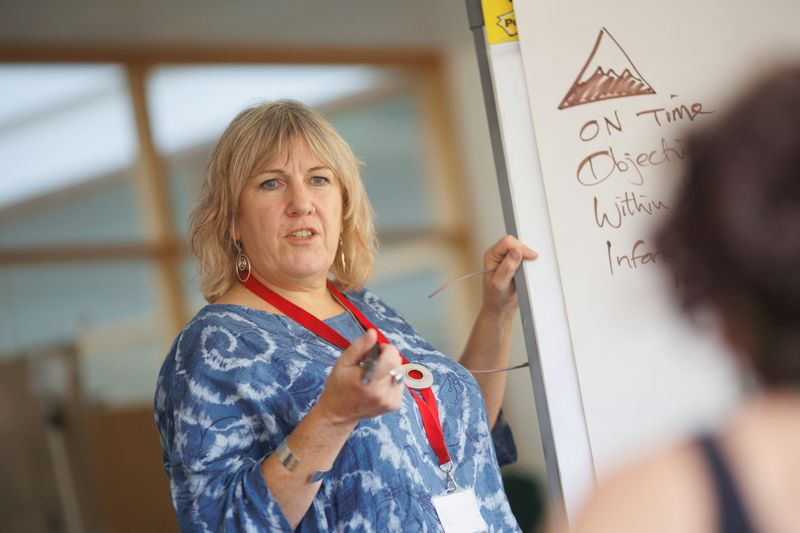
If a full recording feels like too much, try a lighter version. Ask a colleague to sit in for ten minutes and simply click a tally each time you start and stop talking, or set a silent vibrating timer to buzz every five minutes and jot down who was speaking at that instant. Either method turns a vague feeling into a number you can actually move.
9 Proven Ways to Reduce Teacher Talking Time
Reducing teacher talking time comes down to replacing the moments where you speak with structures that make students speak instead. None of these require new materials — they are changes to how you run the lesson you already planned.
1. Elicit instead of explain
Before you tell the class anything, ask whether they can produce it themselves. Instead of announcing “the past tense of go يكون went,” draw a timeline, point to yesterday, and wait. Someone knows. Eliciting turns a thirty-second explanation into a five-second confirmation and puts the target language in a student’s mouth first.

2. Demonstrate instructions — don’t narrate them
Long spoken instructions are where TTT balloons and comprehension collapses. Rather than describing a pair activity for two minutes, model one exchange with a strong student, hold up the worksheet, and gesture “now you.” A ten-second demonstration beats a paragraph of instructions every time, and beginners actually follow it.
3. Check with questions, don’t re-explain
When you sense confusion, resist the urge to say it all again, louder. Fire a concept-checking question instead: “Is this finished or still happening?” A quick ICQ (“How many people in your group?”) confirms understanding in one word from a student rather than another paragraph from you.
4. Increase your wait time
After you ask a question, count silently to five before you say anything else. Classroom researcher Mary Budd Rowe found that teachers typically wait less than a second before jumping in, and that extending that pause to three seconds or more produces longer, more thoughtful student answers and pulls in students who normally stay quiet. The silence feels eternal to you and normal to them.
5. Let gestures do the talking
A hand cupped to the ear means “say it again.” A rewind gesture means “go back.” A raised eyebrow flags an error without a single word. Build a small, consistent set of classroom gestures and you can manage correction, repetition, and pacing while barely speaking.
6. Nominate a student to explain
When someone gets it, don’t confirm it yourself — bounce it. “Maria, tell Kenji why it’s have been and not have gone.” Peer explanation doubles the language practice, checks Maria’s understanding, and often lands better than the teacher’s version because it comes in a classmate’s plainer English.

7. Build in pair and group work
The simplest lever of all: every time you are about to ask the whole class a question, ask them to discuss it in pairs first. In a lockstep class only one student talks at a time; in pairs, half the room is speaking at once. Group work multiplies student talking time without you saying a word once the task is running.

8. Use information-gap tasks
An information-gap activity — where each student holds half the information and must talk to complete the picture — forces communication by design. Because the gap only closes through speaking, students carry the whole exchange and you become a monitor rather than a mouthpiece.
9. Record a lesson and count
This one closes the loop. Once a month, record yourself and run the tally from the measurement section above. Habits drift, and the recording keeps you honest in a way no amount of good intention will. Teachers who review one lesson a term almost always find their TTT creeping back up between check-ins.
When Teacher Talking Time Is Actually Good
Cutting teacher talking time is not the same as going silent, and the current fashion for near-zero TTT can go too far. Quality teacher talk — a graded, natural story; a clear model of target pronunciation; a genuine two-way conversation where you react to what students actually say — is some of the richest input a learner gets all week. Stripping it out to chase a percentage is a mistake.
The distinction that matters is not quantity but function. Teacher talk that gives learners something they cannot get elsewhere is an asset; teacher talk that replaces work the students should be doing is waste. Aim to cut the second kind, and protect the first.
Common Mistakes When Cutting Teacher Talking Time
The most common mistake is treating silence as the enemy and rushing to fill every pause — which is exactly the reflex that inflated your TTT in the first place. The second is over-correcting into pure activity with no input, so students happily practise the same errors on each other for forty minutes with nobody modelling the correct form. Balance the freer stages with focused feedback.
A third trap is confusing drilling and choral repetition with genuine student talking time. Repeating a sentence after you is useful for form and confidence, but it is not the same as producing original language. Both belong in a lesson; don’t let one masquerade as the other on your mental tally.

Pick one habit from this list for next week — wait time is the easiest to start with — and record a single lesson before and after so you can see the number move. Teacher talking time is not a character flaw to feel guilty about; it is a dial, and now you know where it is. For more on building lessons that run on student energy rather than teacher effort, read our guide to eliciting techniques and start handing the room back.
مصادر
- Teacher talking time — TeachingEnglish, British Council — Definition of TTT and its relationship to student talking time.
- Managing Teacher Talking Time — TEFL Lemon — Practical strategies and target TTT ratios for EFL classrooms.
- What Is TTT When Teaching English? — Bridge Education Group — Overview of the 80/20 student-to-teacher talk ratio and how it varies by level.
- Wait time (education) — Mary Budd Rowe’s research — Findings on average teacher wait time and the effect of extending it to three seconds.








 AR
AR  EN
EN  ZH
ZH  ZH_CN
ZH_CN  KO
KO  VI
VI  FR
FR  ES
ES  HI
HI  PT
PT  BN
BN  RU
RU  JA
JA  TR
TR  DE
DE  IT
IT  PL
PL  ID
ID  TH
TH  FA
FA  UK
UK  TL
TL  HE
HE  UR
UR  SW
SW  RO
RO  NL
NL  MS
MS  TA
TA  PS
PS  HU
HU  EL
EL  SV
SV  NB
NB  NN
NN  DA
DA  CS
CS  SR
SR  AM
AM