

Intellectual Disability: 8 Proven Strategies
About 1.65% of American children carried a diagnosed intellectual disability as of 2021, according to the CDC’s National Center for Health Statistics, and boys were diagnosed at nearly double the rate of girls. In a mainstream ESL classroom of 25 to 30 students, that puts the odds of having at least one student with an intellectual disability somewhere above one in three. Most of us never got trained for that in a TEFL certificate course, so the strategies below come from special education research adapted specifically for the language classroom — not generic “be patient” advice.
What Intellectual Disability Actually Means for Language Learning
Intellectual disability is diagnosed when a student scores at or below roughly 70 on a standardized IQ test and shows significant limits in adaptive behavior — things like communication, self-care, and social skills — before age 18. The CDC’s 2023 data brief found that 78% of diagnosed cases are mild, 12% moderate, and only about 1% severe or profound, which matters because mild cases are exactly the students who show up in a regular ESL class without a dedicated aide. A mild intellectual disability doesn’t mean a student can’t learn English. It means the student needs more repetition, more concrete support, and a slower build to abstraction than a same-age peer.
The mistake most teachers make isn’t cruelty, it’s assumption. We assume a student who struggles with “where were you born” has a comprehension problem with English specifically, when the real issue is that the grammatical concept of past tense itself hasn’t solidified yet in any language. Treating a cognitive processing gap as a language gap wastes months of intervention on the wrong target.
Strategy 1: Replace Lecture With Multisensory Input
Verbal explanation alone is the least effective channel for a student with an intellectual disability, and it’s the one most ESL lessons default to. Pair every spoken instruction with a visual, a gesture, or an object the student can touch. If you’re teaching prepositions, don’t describe “under” and “on top of” — hand the student a block and a box and let them physically place one under the other while you say the word.
This isn’t dumbing down the content. Sorting flashcards by category, acting out a short dialogue instead of reading it, or using a real toy car to demonstrate “fast” and “slow” all keep the language target intact while changing the input channel. Students with intellectual disabilities frequently have stronger visual-spatial processing than verbal processing, so you’re playing to a strength rather than working around a weakness.

Strategy 2: Scaffold With Gradual Release, Not Sink-or-Swim
Start every new skill at maximum support — full modeling, sentence frames, picture cues on the desk — then remove one layer of support at a time only after the student has shown independence at the current level. The common failure mode is removing support too fast because the student got one answer right, then watching them shut down on the next three questions.
Sentence frames work especially well here: “I like ___ because ___” gives a student with an intellectual disability the grammatical scaffolding to produce a full sentence while still generating original content. Pull the frame away gradually — first by shortening it, then by removing it entirely — rather than switching cold from frame to blank page.
I’ve watched well-meaning teachers skip straight from heavy scaffolding to independent work because a student “seemed ready” after one good day. One good day isn’t the same as consolidated skill. Give it a full week of the same support level before you reduce anything.

Strategy 3: Break Every Task Into One Step at a Time
A standard ESL task like “write three sentences about your weekend using the past tense” actually bundles four separate cognitive steps: recall an event, select vocabulary, conjugate the verb, and sequence the sentence. A student with an intellectual disability can get stuck on any one of those steps and the whole task collapses. Separate the steps explicitly. Have the student first say the event out loud, then pick the verb from a short list you provide, then practice the conjugation in isolation, then combine it all into a sentence.
This takes more class time per task, which is the real tradeoff teachers resist. But a student who masters the four steps separately over two weeks retains the skill far longer than one who was rushed through the combined task and forgot it by Friday. For one-on-one instruction time, the structure below has worked consistently across multiple students I’ve supported.

Strategy 4: Build a Visual Schedule Students Can Trust
Unpredictability is one of the biggest hidden barriers for students with intellectual disabilities, and it’s rarely the language itself causing the shutdown — it’s not knowing what happens next. A visual schedule posted where the student can see it, updated at the start of every class, cuts down on the anxiety-driven behavior that gets mislabeled as a discipline issue.
- Use icons or photos, not just written words, for each activity block
- Physically check off or flip each item as the class moves through it
- Give a two-minute verbal warning before any transition
- Keep the same schedule structure every day even as content changes
Students who know exactly what’s coming next spend far less energy managing anxiety and far more energy on the actual language task in front of them.
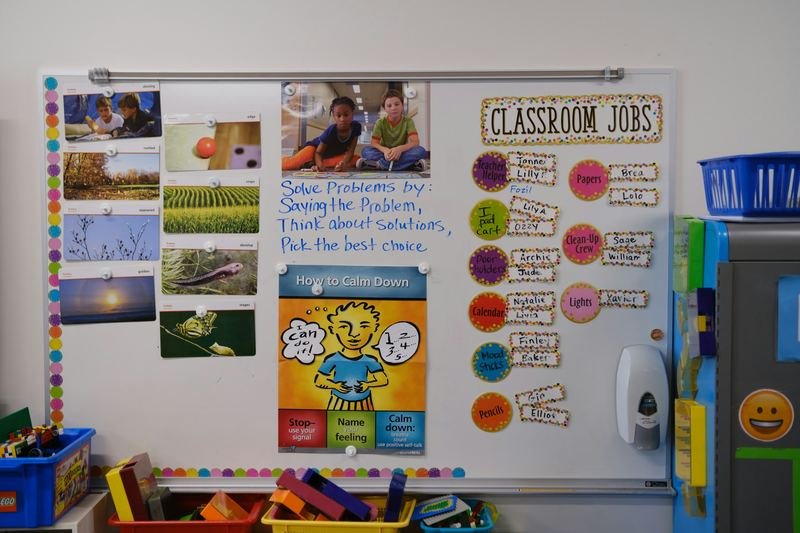
Strategy 5: Pair Students for Peer Modeling, Not Just Peer Pressure
Strategic peer pairing gives a student with an intellectual disability a live, lower-stakes model of the target language that a worksheet can never provide. The pairing has to be deliberate, though — dropping a struggling student next to the fastest kid in the room usually produces frustration on both sides, not modeling.
Pick a peer who’s patient and slightly above the target student’s level, not the top performer. Give the pair a structured task with a clear role for each person, so the stronger student isn’t just doing the work for both of them. Rotate the pairing every few weeks so the student with an intellectual disability doesn’t become permanently dependent on one classmate.
Peer pairing also does something a teacher can’t: it builds a genuine social relationship around the language task instead of just a tutoring dynamic, and that relationship often outlasts the unit it started in.

Strategy 6: Separate Accommodations From Modifications on the IEP
These two terms get used interchangeably by teachers who’ve never had to write an IEP, but the distinction changes what you’re actually allowed to do. An accommodation changes access — extra time, preferential seating, a reader for test questions — without changing what the student is being tested on. A modification changes the content itself, like simplifying a reading passage to a lower level or reducing the number of vocabulary words required for a unit.
Mixing the two up matters because a student only receiving accommodations is still expected to hit the same language benchmark as the rest of the class, just with different tools to get there. A student receiving modifications is being assessed against an individualized goal. Read the IEP before you decide which bucket a given student falls into — don’t guess, and don’t assume every student with an intellectual disability needs a modified curriculum. Many only need accommodations.
Strategy 7: Create a Sensory-Friendly, Low-Anxiety Room
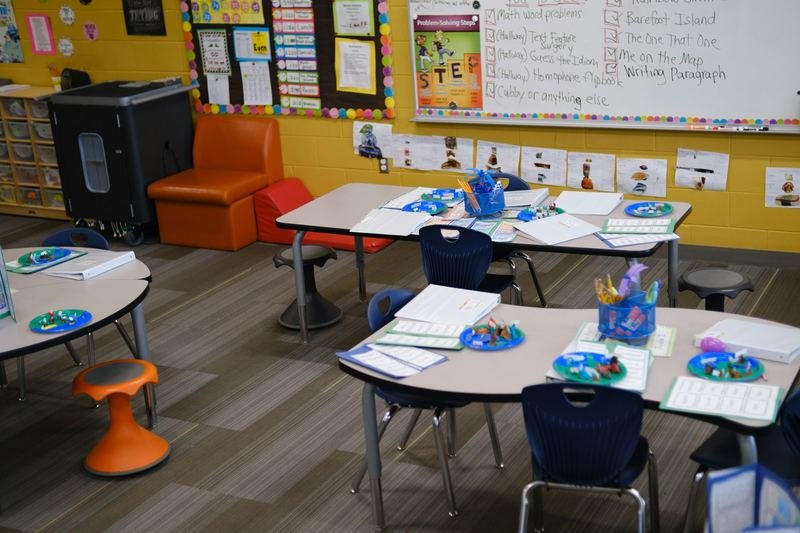
Fluorescent lights buzzing, a cluttered word wall, background noise from the hallway — none of that registers for most students, but for a student with an intellectual disability it can consume enough processing capacity that there’s nothing left over for the English lesson. A calmer physical space isn’t a nice-to-have, it’s a precondition for the language instruction to land at all.
Small changes make a measurable difference: a designated quiet corner, noise-reducing headphones available on request, consistent seating that doesn’t change week to week, and visual clutter kept to only what’s actively being used in that lesson. None of this requires a renovation budget — it requires deciding what gets left on the walls and what gets taken down.
Strategy 8: Teach Emotional Vocabulary Alongside Language Targets
Self-regulation isn’t a separate subject you teach before the English lesson starts — it’s part of the language curriculum for this population. A student who can say “I’m frustrated” or “I need a break” in English has a functional communication tool that prevents a shutdown from turning into a behavior referral. Build emotion words, feeling check-ins, and simple self-advocacy phrases into your regular vocabulary rotation instead of treating them as a one-off social skills lesson.
This also gives the student language to use with you specifically. A student who can name “confused” instead of just going silent is a student you can actually intervene with before the lesson falls apart.

Putting It Together in a Real Lesson
None of these eight strategies work in isolation forever. A typical 40-minute block for a student with a mild intellectual disability might open with the visual schedule, move into a multisensory warm-up using objects instead of pure vocabulary, scaffold a single grammar target with a sentence frame, pair the student with a peer for guided practice, and close with a feelings check-in before transition. That’s four or five strategies stacked into one lesson, not deployed as separate programs.
What ties the strategies I’ve outlined here back to the broader special needs toolkit is overlap. If you’re also supporting students with autism অথবা ADHD in the same room, visual schedules and one-step task breakdowns serve both populations simultaneously — you’re not running three separate systems. The same is true for deaf ESL students, where visual-first instruction was already your default. Build the room once for the strategies that overlap, then layer the individual accommodations on top.
উৎস
- CDC NCHS Data Brief No. 473 (2023) — prevalence of diagnosed intellectual disability among U.S. children by year, sex, and race/ethnicity.
- ADCET: Inclusive Teaching — Intellectual Disability — framework for accommodations vs. modifications in inclusive classrooms.
- American TESOL: Teaching Strategies for Success — multisensory and scaffolding approaches for special needs ESL students.









 BN
BN  EN
EN  ZH
ZH  ZH_CN
ZH_CN  KO
KO  VI
VI  FR
FR  AR
AR  ES
ES  HI
HI  PT
PT  RU
RU  JA
JA  TR
TR  DE
DE  IT
IT  PL
PL  ID
ID  TH
TH  FA
FA  UK
UK  TL
TL  HE
HE  UR
UR  SW
SW  RO
RO  NL
NL  MS
MS  TA
TA  PS
PS  HU
HU  EL
EL  SV
SV  NB
NB  NN
NN  DA
DA  CS
CS  SR
SR  AM
AM