Find Someone Who: 8 Best ESL Activities
Eight find someone who ESL activity variations by grammar point, plus fixes for the three ways this mingle activity usually falls apart.


Eight find someone who ESL activity variations by grammar point, plus fixes for the three ways this mingle activity usually falls apart.

A practical ESL teacher career guide comparing pay rates, required certifications, and growth opportunities across the world’s top teaching markets — plus the online and beyond-classroom paths most teachers overlook.

The ESA method — Engage, Study, Activate — is a three-stage lesson-planning framework Jeremy Harmer introduced in his 1998 book How to Teach English. Unlike the fixed order of PPP, ESA lets teachers reorder or repeat its three stages using one of three sequences (straight arrows, boomerang, or patchwork) to match what’s actually happening in…

Dogme language teaching is an ESL approach that drops the textbook and builds the lesson from conversation instead — the teacher reacts to what students actually say, writes it up correctly on the board, and lets grammar and vocabulary emerge from that exchange rather than from a pre-set syllabus. Scott Thornbury and Luke Meddings developed…

Project-based learning can turn into a craft activity with no new language if you’re not careful. Here are 7 techniques that keep ESL students producing English throughout the whole project, not just the final presentation.

The Natural Approach teaches English through comprehensible input and a low-anxiety classroom, not grammar drills. Seven classroom-ready techniques from Krashen and Terrell’s method.

Community Language Learning (CLL) is a 1970s teaching method, created by psychologist Charles Curran, that puts students in a circle and has the teacher act as a “knower” who translates what students want to say into English. Students record their own sentences, transcribe them, then analyze the grammar together — turning their own conversation into…
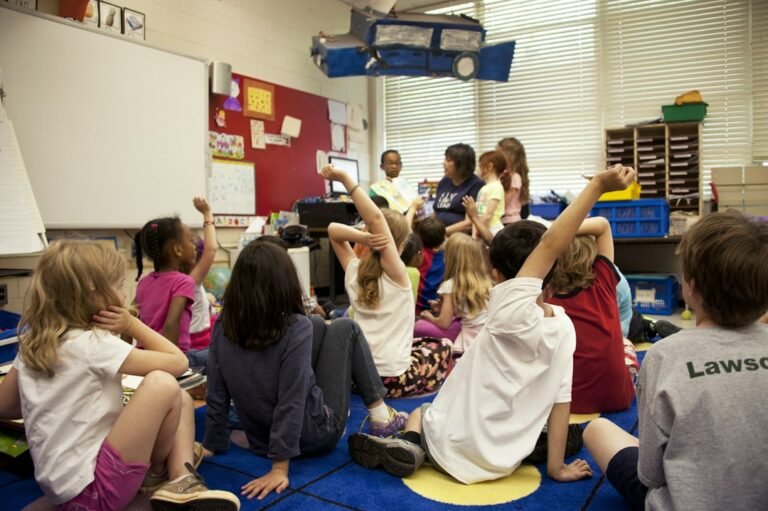
The Audio-Lingual Method drills English through repetition and pattern practice. Seven classroom-ready ALM techniques for ESL teachers, from dialogue memorization to minimal pairs.

Beneath every forest floor, invisible to the naked eye, there is a network of extraordinary complexity. It connects trees to each other, carries nutrients across hundreds of meters, and allows a dying tree to send a final gift to its neighbors. Scientists call it the mycorrhizal network. Most of us call it the Wood Wide…

No. Plants have no brain, no nervous system, and no nociceptors, so they cannot feel pain the way an animal does. But they detect damage in seconds, send electrical and chemical signals through their whole body, and change their behavior afterward — responses that look remarkably like reacting to an injury, even without anyone home…
 BN
 EN
 ZH
 ZH_CN
 KO
 VI
 FR
 AR
 ES
 HI
 PT
 RU
 JA
 TR
 DE
 IT
 PL
 ID
 TH
 FA
 UK
 TL
 HE
 UR
 SW
 RO
 NL
 MS
 TA
 PS
 HU
 EL
 SV
 NB
 NN
 DA
 CS
 SR
 AM