

ESL Students With ADHD: 8 Proven Strategies
About 10.5% of children in the United States — roughly 6.5 million — carry a current ADHD diagnosis, according to the CDC’s most recent national survey data. A global meta-analysis puts the worldwide rate closer to 7-8%, which means almost every ESL classroom of 20-plus students has at least one or two kids wired for constant movement and short attention spans. Add a second language on top of that, and a lesson plan built around 20 minutes of quiet listening comprehension is going to fail before it starts.
I’ve taught buxibans and private classes in Taiwan for over two decades, and the ADHD kids are almost never the problem — the pacing is. Slow the transitions, cut the instructions into single actions, and the same “disruptive” student becomes the first one to volunteer.
Why Standard ESL Lesson Plans Fail ADHD Students
Most ESL curricula are written for sustained, sequential attention: listen to the dialogue, then answer five comprehension questions, then write a paragraph. A student with ADHD can hold working memory for about one instruction at a time — stack three steps together (“open your book, turn to page 12, and underline the verbs”) and by step two, the first instruction is already gone. That’s not a motivation problem. It’s how the executive function network in ADHD brains processes sequential demands, and it gets worse under the extra cognitive load of a second language.
The second-language layer matters more than most teacher training accounts for. A neurotypical ESL learner can usually mask a missed instruction by watching classmates. An ADHD student who also missed the vocabulary needed to ask “wait, what page?” gets stuck twice — once on the instruction, once on the language to recover from missing it. That compounding is why generic classroom-management advice written for native-English special-education settings doesn’t transfer cleanly to an ESL room.
Chunk Every Instruction Into One Step
Give one direction, confirm it’s done, then give the next one. “Take out your workbook” — pause, scan the room — then “turn to page 12.” This feels painfully slow the first week. It isn’t once you see how much repeated re-explaining it saves. Write the single current step on the board in large letters and point to it as you say it out loud, so students who lose the spoken instruction mid-sentence still have a visual anchor.
For writing tasks, chunking means literally lowering the output target. Instead of “write a paragraph about your weekend,” ask for one sentence, check it, then ask for the next. A student with ADHD who stares at a blank page for five minutes isn’t being lazy — the task has no entry point small enough to grab onto. One sentence is an entry point. A paragraph is a wall.

Build Movement Into the Lesson, Not Around It
Sitting still for 40 minutes is a genuinely difficult physical task for a student with ADHD — not a discipline issue to correct, but a biological constraint to design around. Total Physical Response activities solve two problems at once: they teach vocabulary through action instead of translation, and they give the ADHD student a legitimate reason to be out of the chair every few minutes.
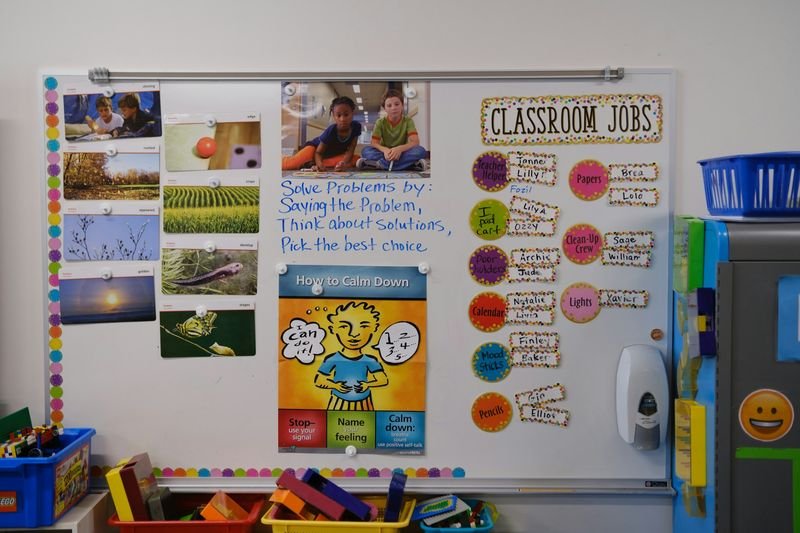
Rotate jobs that require standing and moving — handing out worksheets, writing answers on the board, being the “timer” who walks to the clock. These aren’t rewards for good behavior; they’re scheduled outlets that prevent the disruption that shows up when movement gets suppressed too long. A five-minute stand-and-stretch break between a listening task and a writing task resets attention for the whole class, not just the ADHD students.

Make the Lesson Visually Predictable
A visible agenda — even four icons on the whiteboard for “listen, speak, write, game” — removes the anxiety of not knowing what’s coming next, which for ADHD students often manifests as off-task behavior while they try to figure out the plan themselves. Cross off or flip each icon as you move through it. The physical act of marking progress gives a concrete sense of “almost done” that an ADHD brain, which struggles with internal time estimation, can’t generate on its own.
This matters more in ESL specifically because the language barrier already removes one source of predictability — students can’t always follow verbal cues about transitions in a language they’re still learning. A visual schedule compensates for both the attention gap and the comprehension gap with the same tool.
Use Visible Timers for Every Task
“You have five minutes” means nothing to a student who can’t track elapsed time internally — which is a core ADHD trait, not an ESL issue. A sand timer or a countdown projected on the board turns an abstract instruction into something the student can watch. Set one for every independent task, even short ones, and narrate it occasionally (“two minutes left”) rather than assuming the visual alone will be checked.
Timers also solve the opposite problem: hyperfocus. Some ADHD students lock onto a task they enjoy — coloring a worksheet, for instance — and miss the transition to the next activity entirely. A timer gives you a neutral cue to end the task that isn’t “stop, you’re being disruptive,” which keeps the interaction from feeling like a correction.

Offer a Fidget Tool Before You Need One
A stress ball, a piece of putty, or a small fidget cube kept at the desk gives restless hands something to do that doesn’t involve tapping a pencil on the desk for ten minutes straight. The key is introducing it on day one as a normal classroom item available to anyone, not handing it out mid-lesson as a response to disruption — that framing turns it into a visible punishment instead of a tool, and the student who needs it most will refuse to use it.
Keep two or three options available since not every student responds to the same texture or motion. Putty works for some; a textured cube works for others. If a fidget tool becomes its own distraction — thrown across the room, used to poke a neighbor — swap it out rather than removing the concept of fidgeting entirely.

Seat Strategically, Not Punitively
Front-row seating near the teacher works for ADHD students who need frequent redirection and quick eye contact — it shortens the distance between losing focus and getting pulled back in. But some students find that proximity itself distracting, especially if there’s foot traffic near the door or window. Test both: front-center for a week, then a quieter corner seat next to a focused peer, and watch which one actually reduces off-task behavior rather than assuming the “front row fix” works universally.
Avoid using seat changes as discipline. Moving a student’s seat the moment they act up teaches them that losing focus gets punished, not supported — and it erodes the trust needed for every other strategy on this list to work. Decide the seating plan proactively, before the lesson, not reactively in the middle of one.

Lean on Small Groups for Sustained Tasks
A 25-minute independent writing task is a rough ask for most ADHD students regardless of language level. Breaking the same class into groups of three or four for a shared task — one student writes, one reads aloud, one checks vocabulary — distributes the sustained-attention demand across the group instead of asking one brain to carry it alone. It also builds in natural movement and talk breaks that a solo task doesn’t.
Rotate roles every few minutes so the ADHD student isn’t stuck in the one role that requires the longest stretch of stillness. If “writer” is a 10-minute stretch of sitting and focusing, give that role to someone else and let the ADHD student handle “reader” or “vocabulary checker” instead, where output comes in short bursts.

This Isn’t a Small Population to Plan Around
Global prevalence estimates vary by methodology — one pooled analysis of 175 studies lands at 7.2%, another meta-analysis at 8.0% — but the Global Burden of Disease project put the worldwide count at roughly 47 million children and adolescents under 20 living with ADHD as of 2021, with rates running about twice as high in boys as in girls. However the number is sliced, it’s not a rare-exception population any ESL teacher can plan around ignoring.
That scale is exactly why the strategies above aren’t niche accommodations for one disruptive kid in the back row. Chunked instructions, built-in movement, and visible timers help the whole class process a second language faster — the ADHD students just need them to function at all.
Combine This With Your Existing Classroom Toolkit
None of these strategies replace good general classroom management — they stack on top of it. The Strategien zur Klassenführung that already work for your class — clear routines, consistent consequences, positive reinforcement — still apply. ADHD-specific adjustments just add a second layer: shorter instruction chunks, built-in movement, visible timers. If you’re already running differentiated groups for mixed-ability classes, folding in ADHD seating and pacing is a small addition, not a separate system.
The same goes for students who also show signs of dyslexia: researchers put the comorbidity rate between dyslexia and ADHD at 25-40%, so it’s worth screening for both rather than assuming one explains every struggle you’re seeing. A student who can’t sit still AND can’t decode text needs both sets of strategies running at once, not a choice between them.
Most teachers discover these adjustments by trial and error over a few frustrating semesters. Start with chunked instructions and a visible timer this week — they’re the two changes that cost nothing, take no prep, and show results by the second class.
Quellen
- CDC — Data and Statistics on ADHD — national prevalence figures for children diagnosed with ADHD in the United States.
- The global prevalence of attention deficit hyperactivity disorder in children and adolescents: An umbrella review of meta-analyses — ScienceDirect — pooled global prevalence estimates across multiple meta-analyses.
- Incidence, prevalence, and global burden of ADHD from 1990 to 2021 across 204 countries — Nature — Global Burden of Disease data on worldwide ADHD counts and sex differences.
- Teaching ESL to Students with ADHD — Twinkl — classroom strategies for seating, movement, and fidget tools.
- The Role of Co-Morbidity in the Identification and Treatment of Dyslexia — Colorado Department of Education — comorbidity rates between dyslexia and ADHD.









 DE
DE  EN
EN  ZH
ZH  ZH_CN
ZH_CN  KO
KO  VI
VI  FR
FR  AR
AR  ES
ES  HI
HI  PT
PT  BN
BN  RU
RU  JA
JA  TR
TR  IT
IT  PL
PL  ID
ID  TH
TH  FA
FA  UK
UK  TL
TL  HE
HE  UR
UR  SW
SW  RO
RO  NL
NL  MS
MS  TA
TA  PS
PS  HU
HU  EL
EL  SV
SV  NB
NB  NN
NN  DA
DA  CS
CS  SR
SR  AM
AM