

Concept Check Questions: 12 ESL Examples That Work
Concept check questions are short, simple questions a teacher asks after presenting new language to confirm the students actually understood the meaning — not just the words. They are the quietest, fastest tool in the ESL classroom, and the one that saves the most face. Asked well, a single concept check question can expose a misunderstanding before it turns into ten minutes of wasted practice.
This guide walks through what makes a good concept check question, twelve worked examples for grammar and vocabulary, the difference between CCQs and ICQs, where they sit in a PPP lesson plan, and the small mistakes that turn a sharp check into a confusing one.

What Are Concept Check Questions?
A concept check question — usually shortened to CCQ — is a short question a teacher asks after introducing a piece of target language (a tense, a phrase, a word, a function) to verify the student has grasped the meaning, the form, or the function being taught. The point is to test the concept, not the vocabulary in the question itself.
The truth is, “Do you understand?” almost never tells a teacher anything useful. Students nod because they don’t want to lose face in front of the class, or because they think they understand until they try to use the language. A CCQ replaces that nod with a real answer. If the student answers correctly, you can move on. If they answer wrong, you know exactly which slice of the concept you need to re-teach.
CCQs work in three places: after presenting new grammar, after introducing a vocabulary item, and after explaining a function (a request, an apology, an invitation). They take five to fifteen seconds each. They cost nothing. They reveal more than most quizzes do.
5 Rules for Writing CCQs That Actually Check Understanding
Good CCQs share a small set of features. Break any of these rules and the question becomes a vocabulary test, a guessing game, or noise.
- Don’t use the target language in the question. If you are teaching the present perfect, the CCQ cannot contain a present perfect verb. If you are teaching the word exhausted, the CCQ cannot use the word exhausted. The whole point is that the student couldn’t already use the thing you are testing.
- Keep the question grammar simple. Present simple or past simple, short clauses, common vocabulary. A CCQ on the first conditional should be readable by an A2 student.
- Aim for yes/no or short answers. Open-ended questions create new comprehension problems. Stick to questions a student can answer in one or two words.
- Ask multiple small questions, not one giant one. Three CCQs that each test one part of the concept beat one CCQ that tries to test everything at once.
- Plan them before the lesson. Writing CCQs on the fly is how teachers end up asking “Is it ok?” — the question CCQs were invented to replace.

12 Concept Check Question Examples (Grammar + Vocabulary)
Every CCQ below uses simpler language than the target item, sticks to short answers, and isolates one piece of meaning. Use them as templates — the pattern matters more than the specific sentence.
1. Past Simple — “I saw my friend last night.”
- Was it yesterday or today? Yesterday.
- Did I see my friend? Yes.
- Is the action finished? Yes.
- Can I see my friend last night again? No.
The fourth question is the one that catches false confidence. Students who confuse last night με tonight will hesitate here.
2. Present Perfect — “I’ve lived in Taipei for ten years.”
- Do I live in Taipei now? Yes.
- When did I start? Ten years ago.
- Have I finished living in Taipei? No.
- Did I leave and come back? No, I stayed.
3. Present Perfect with “this week” — “I’ve called my mum twice this week.”
- Is this week finished? No.
- Can I call her again this week? Yes.
- Do you know which day I called? No.
4. First Conditional — “If it rains, I’ll stay home.”
- Is rain certain? No.
- Is rain possible? Yes.
- If it doesn’t rain, will I stay home? No.
- Am I talking about the past or the future? The future.
5. Second Conditional — “If I had a million dollars, I’d buy a house.”
- Do I have a million dollars? No.
- Is it likely I will get a million dollars? Not really.
- Am I talking about now or the past? Now / future.
6. Modal “must” (obligation) — “You must wear a helmet.”
- Is it your choice? No.
- Is it a rule? Yes.
- If you don’t wear a helmet, is it a problem? Yes.
7. Modal “should” (advice) — “You should drink more water.”
- Is it a rule? No.
- Is it a good idea? Yes.
- Can you refuse? Yes.

8. Used to — “I used to play piano.”
- Do I play piano now? No.
- Did I play in the past? Yes.
- One time or many times? Many times.
9. Vocabulary — “gigantic”
- Is a gigantic dog small? No.
- Is a gigantic dog big? Yes.
- Is a gigantic dog very big or a little big? Very big.
That third question is the one that does the work. “Gigantic” lives next to “big” in a learner’s head — the CCQ pulls them apart.
10. Vocabulary — “whisper”
- If I whisper, is my voice loud? No.
- Can people far away hear me? No.
- Can the person next to me hear me? Yes.
11. Vocabulary — “exhausted”
- Am I a little tired or very tired? Very tired.
- Do I want to run more? No.
- Do I want to sleep? Yes.
12. Function — Polite Request: “Could you open the window, please?”
- Am I asking or telling? Asking.
- Am I polite or rude? Polite.
- Can the person say no? Yes.
Print these patterns out, swap the example sentences for whatever sits in your textbook unit, and you’ll never reach for “Do you understand?” again.
CCQs vs ICQs — Two Different Jobs
Concept check questions and instruction check questions (ICQs) get lumped together on teacher training courses, but they answer different questions. A CCQ tests whether the student understands the language. An ICQ tests whether the student understands what they are supposed to do next.
An ICQ for a pair-work activity sounds like this: “Are you writing or speaking? Do you work alone or with a partner? How many minutes do you have?” These questions don’t care if the student grasped the present perfect — they only confirm the activity will run. Mix the two up and you waste time. Teach grammar, run a CCQ. Set up a task, run an ICQ. They live in different parts of the lesson.
The two skills feed into each other. Strong ICQs at the start of a stage mean students start on time. Strong CCQs in the middle mean they finish learning what they were meant to learn. The same instinct — refuse to assume understanding — sits behind both.
How CCQs Fit Into a PPP Lesson Plan
In a Presentation–Practice–Production lesson, CCQs live at the seam between Presentation and Practice. You introduce the form, model the meaning, and then check the concept before letting students drill or produce anything. If you skip the CCQ, the controlled practice becomes the test, which means students burn through their first attempts confused.
One CCQ pass is rarely enough for a full grammar point. Plan three to five questions for a tense or function, sequenced from broad to narrow: first the timeline (past, present, future), then the certainty (real, hypothetical), then the relationship between subject and action. For a vocabulary item, two or three CCQs usually do the job — meaning, intensity, and a contrast with the nearest neighbour word.

If you teach within a structured stage plan, drop your CCQs into the PPP lesson plan structure at the end of Presentation and a quick refresher at the start of Production. Two checkpoints, ninety seconds total, and the rest of the lesson runs cleaner.
Should You Use CCQs With Beginners?
Yes — but the CCQs themselves need to be cut down even harder. With an A1 class, “Was it yesterday or today?” is fine. “Is the action finished?” is not, because finished may not yet be in the student’s receptive vocabulary. Translate the question into the simplest classroom English you can, or fall back on gesture and timeline drawings on the board for the binary checks.
A common A1-friendly pattern is the two-choice question: “Big or small? Now or before? Yes or no?” These work because they remove the burden of producing language and reduce the task to recognition. They also give the quieter half of the class a way to participate without speaking a full sentence, which is one of the reasons eliciting techniques pair so well with CCQ sequences in beginner lessons.
6 Common CCQ Mistakes (and How to Fix Them)
Most CCQ problems aren’t about not knowing the technique — they’re about old habits sneaking in under pressure.
Mistake 1: Asking “Do you understand?” anyway
The default question still pops out when a teacher gets nervous. Fix: write your three CCQs into the lesson plan in the margin next to the target language. If they are on the page, you will ask them.
Mistake 2: Using the target language in the question
“I’ve finished my homework.” → “Have you finished?” That’s not a check — you’re asking them to produce the very tense you are testing. Fix: write your CCQs in present simple or past simple only.
Mistake 3: One enormous question
“So is it like a hypothetical situation where the action is finished but the result is still relevant in the present?” No A2 student is parsing that. Fix: break it into four small questions.
Mistake 4: Letting one strong student answer everything
If the same student answers every CCQ, the rest of the class is hiding. Fix: nominate by name, or use whole-class hand signals — thumbs up, thumbs down, flat hand for “not sure.”
Mistake 5: Skipping CCQs on vocabulary because “it’s just a word”
This is where the most damage happens. Borrow και lend, say και tell, do και make — these collisions are why students still mix the pair up after years of study. Two CCQs per problem pair would have caught the error in week one.
Mistake 6: Treating wrong answers as failure
A wrong CCQ answer is the most valuable signal in the entire lesson. It tells you precisely what to re-teach and to whom. Adjust the next forty seconds of the lesson, then re-CCQ. Don’t move on. This is closely linked to how you handle ESL error correction in general — both rely on treating mistakes as data, not as embarrassment.

Should CCQs Live in the Lesson Plan or Be Improvised?
Plan them. The honest answer is that experienced teachers can improvise CCQs because they have already written hundreds. New teachers who try to improvise tend to produce two kinds of bad question: the one that uses the target language, and the one that is so long the student starts trying to translate it. Writing your CCQs into the plan during prep takes maybe four extra minutes per lesson and makes the difference between a fluid clarification stage and a foggy one.
A reasonable mid-career compromise is to write CCQs only for the language items you’ve never taught before. Once a teacher has run the present perfect lesson a dozen times, the four CCQs are locked into muscle memory. Reach for the lesson plan when the target language is new to you or new to the level you’re teaching it at.
Watch: CCQs for Vocabulary and Grammar
This short walkthrough from CELTA-trainer Fergus Fadden shows the difference between a weak and a strong CCQ in real classroom phrasing — useful if you learn the rhythm better by ear than from a list.
One Question to Test Yourself
Pick any grammar item from next week’s lesson. Write three CCQs for it without looking at this article. Now read each question out loud: does any one of them contain the target language? Is any one of them longer than ten words? Could a beginner answer it with a single word? If the answer to all three is yes, you are ready to use them tomorrow. If not, rewrite the offending question — that small piece of friction is exactly where students get lost, and you’ve just caught it before they did.
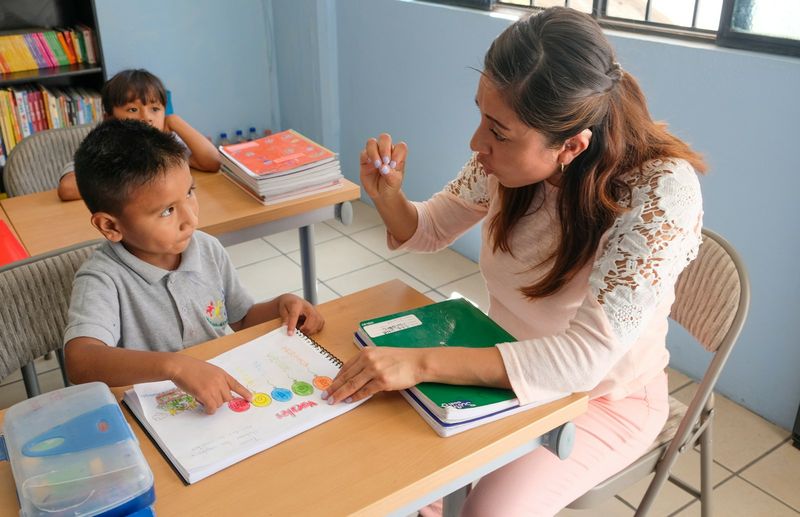
The fastest upgrade most teachers can make to their next lesson is not a new app, a new textbook, or a new game. It is three written concept check questions sitting in the margin of the page, ready to fire the moment the explanation ends.

Πηγές
- British Council — English teachers, are you asking the right questions? — Background on classroom questioning patterns and why default checks fail.
- Sandy Millin — How to write CCQs (concept checking questions) — Practical drafting framework from a long-serving ELT teacher trainer.
- ESLbase — Concept Questions — TEFL primer with examples across tenses and functions.
- Bridge TEFL — Using Concept Checking Questions in the ESL Classroom — Teacher-trainer overview of when and how to deploy CCQs.
Looking for free ESL worksheets? Browse our full collection — printable resources for every level and age group. Browse Free Worksheets →
Students can access free worksheets and reading materials at 18KEnglish.com.







 EL
EL  EN
EN  ZH
ZH  ZH_CN
ZH_CN  KO
KO  VI
VI  FR
FR  AR
AR  ES
ES  HI
HI  PT
PT  BN
BN  RU
RU  JA
JA  TR
TR  DE
DE  IT
IT  PL
PL  ID
ID  TH
TH  FA
FA  UK
UK  TL
TL  HE
HE  UR
UR  SW
SW  RO
RO  NL
NL  MS
MS  TA
TA  PS
PS  HU
HU  SV
SV  NB
NB  NN
NN  DA
DA  CS
CS  SR
SR  AM
AM