

ESL Vocabulary Games | 12 Fun Activities That Boost Retention
Getting students to remember new vocabulary is one of the biggest challenges ESL teachers face. You introduce ten words on Monday, drill them through worksheets, and by Friday half the class draws a blank. Sound familiar?
The problem usually isn’t the words themselves — it’s how we teach them. Research in applied linguistics consistently shows that active engagement beats passive memorization. When students play with language rather than simply copy it, neural pathways strengthen and recall improves dramatically.
That’s exactly where ESL vocabulary games come in. These aren’t time-fillers or rewards for “good behavior.” They’re instructional tools that get students processing, producing, and personalizing new words in ways that stick. Below you’ll find 12 classroom-tested games that work across proficiency levels — from absolute beginners to upper-intermediate learners.

Why Games Work for Vocabulary Learning
Before jumping into specific activities, it helps to understand why games outperform traditional methods for vocabulary acquisition.
First, games lower the affective filter. Stephen Krashen’s well-known hypothesis tells us that anxiety blocks language acquisition. When students are laughing and competing in a game, stress drops and openness to input rises. They stop worrying about mistakes and start experimenting with language.
Second, games force repeated exposure without the boredom factor. A student playing vocabulary bingo will encounter the same target word five or six times in a single round — and actually enjoy it. Try getting that kind of repetition from a fill-in-the-blank worksheet.
Third, many of these activities involve multiple modalities. Students hear, say, read, write, draw, and physically move during game play. Each modality creates another memory hook, which is why game-based vocabulary learning tends to produce better long-term retention than study-and-test approaches.
1. Vocabulary Bingo
This classic never gets old, and there’s a reason it shows up on every ESL teacher’s go-to list. Students create their own bingo cards by selecting words from a master list and writing them in random squares. The teacher then reads definitions, shows pictures, or gives example sentences — anything except saying the word directly.
How to set it up: Give each student a blank 4×4 or 5×5 grid. Display 20-25 target vocabulary words on the board. Students choose words to fill their grid. Call out clues one at a time. First student to mark five in a row wins.
The genius of this game is that students review vocabulary three times: once when selecting words for their card, again when listening to clues, and a third time when checking their answers. For lower levels, use picture clues. For higher levels, use definitions or collocations.

2. Word Association Chains
Sit students in a circle. One student says a vocabulary word, and the next student must say a related word within five seconds. The chain keeps going until someone repeats a word or can’t think of one in time.
What makes this deceptively powerful is that it forces students to think about semantic relationships — how words connect in meaning. A student who says “ocean” followed by “whale” followed by “mammal” is building a mental vocabulary web, which is exactly how fluent speakers store and retrieve words.
For beginning students, allow any connection. For intermediate and advanced learners, require students to explain the connection before moving on. This turns a 5-minute warm-up into a genuine vocabulary deepening exercise.
3. Pictionary Relay
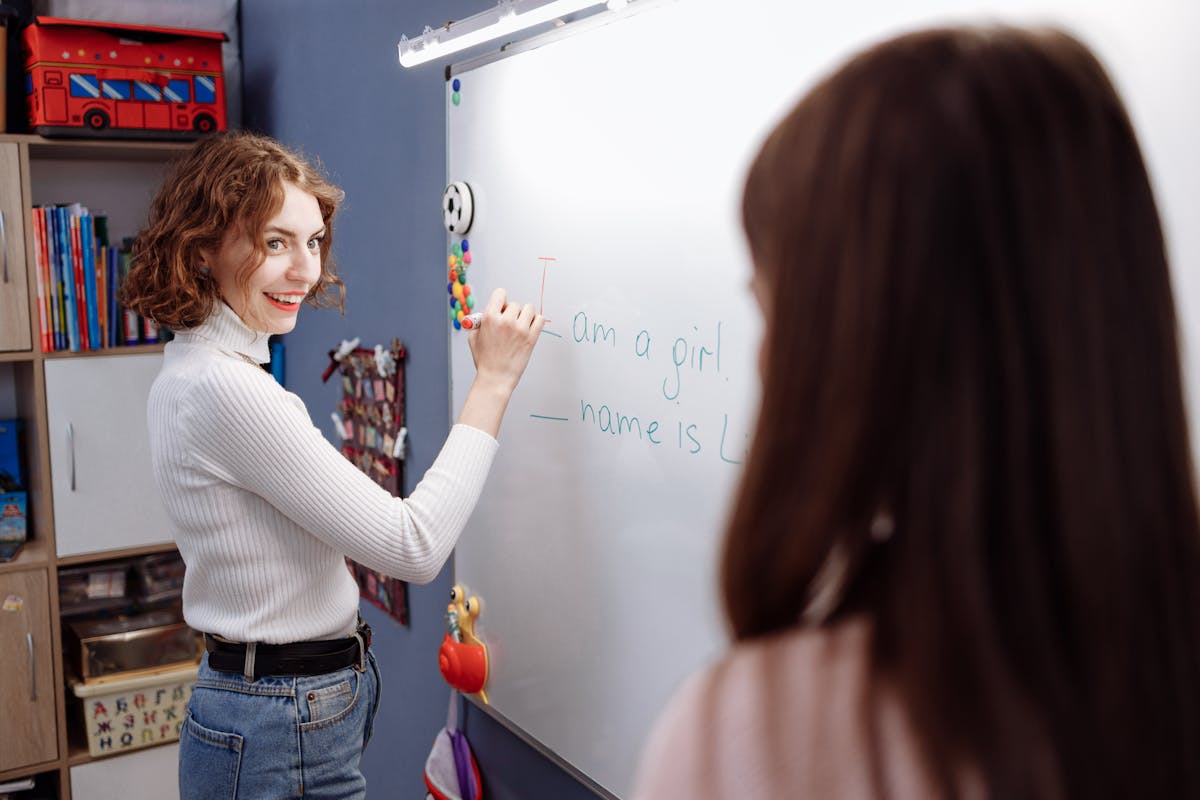
Divide the class into teams of four or five. One student from each team comes to the board, and the teacher whispers or shows them a vocabulary word. They have 60 seconds to draw it while their teammates shout out guesses. No letters, no numbers, no gestures — only drawing.
Why it works: Drawing requires students to think about the meaning of a word, not just its translation. A student who has to draw “generous” will process the concept far more deeply than one who simply writes the L1 translation in a notebook. The rest of the team is actively guessing, which means they’re cycling through their own vocabulary trying to find a match.
Add a relay twist: after one student draws, the next team member immediately takes over with a new word. This keeps everyone engaged and prevents the common problem of half the class zoning out while waiting for their turn.
4. Hot Seat
One student sits in the “hot seat” with their back to the board. The teacher writes a vocabulary word behind them. The rest of the class gives clues — definitions, synonyms, example sentences, gestures — until the hot seat student guesses correctly.
This flips the usual classroom dynamic. Instead of the teacher doing all the explaining, students become the ones defining and describing. That production practice is exactly what moves vocabulary from passive recognition to active use. For scaffolded support, allow students to give three-word clues at first, then challenge them to use complete sentences.
5. Vocabulary Auction
Here’s one that students rarely see coming. Write 20 sentences on the board, some with correct vocabulary usage and some with errors. Give each team a budget of $1,000 in play money. Teams “bid” on sentences they believe are correct. If they buy a correct sentence, they keep it. If they buy an incorrect one, they lose their money.
The discussion that happens within teams is where the real learning takes place. Students debate whether “effect” or “affect” belongs in a sentence, whether “make” or “do” pairs with “homework,” and whether “depended on” needs a preposition. The competitive element means they pay close attention to detail — nobody wants to waste their team’s money.

6. Find Someone Who…
Create a worksheet with sentences like “Find someone who knows what ‘ambitious’ means” or “Find someone who can use ‘compromise’ in a sentence.” Students mingle around the room, asking classmates questions and collecting signatures.
This is a communicative vocabulary game, meaning students actually use language to accomplish a task. It also gets bodies moving, which helps kinesthetic learners and breaks up the monotony of seat work. Teachers who use this approach for vocabulary review often notice that students retain words better because they associate them with specific social interactions (“I remember ‘ambitious’ because Maria told me about her sister’s business”).
7. Taboo
Similar to Hot Seat but with a twist that raises the difficulty. The describing student receives a card with the target word AND a list of “taboo” words they cannot use. For example, the target word might be “beach” with taboo words “sand,” “ocean,” “water,” and “swim.”
Removing the most obvious clue words forces students to think creatively and access deeper vocabulary knowledge. A student who can’t say “sand” for “beach” might say “a place with a long, flat area of tiny rocks where people lie in the sun.” That kind of circumlocution — describing something when you can’t remember the exact word — is a survival skill that every language learner needs.
8. Flashcard Slap
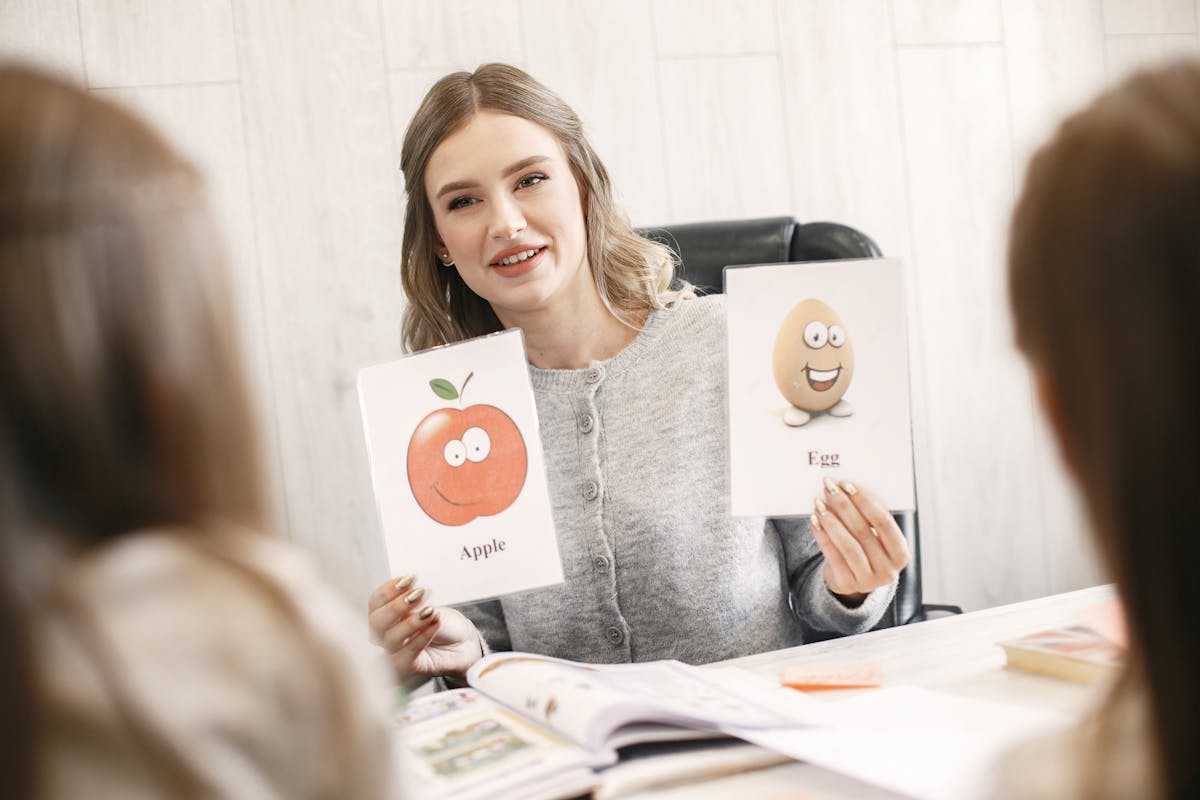
Spread vocabulary flashcards face-up on a table. Two students stand on opposite sides with their hands behind their backs. The teacher says a definition, and students race to slap the correct card first. Whoever touches it first keeps it. The student with the most cards at the end wins.
This works best with concrete vocabulary — animals, food, household objects, professions. The physical movement and competitive element create a memorable experience that helps cement word meanings. You can differentiate by giving verbal definitions for stronger students and showing pictures for learners who need more support. This pairs well with listening comprehension practice, since students must process spoken input quickly.
9. Vocabulary Charades
A twist on the classic party game tailored for language learners. Students draw a vocabulary card and act out the word — no speaking, no props, no pointing at objects in the room. Teammates have 60 seconds to guess.
Charades pushes students to think about what words actually mean at a conceptual level. Acting out “frustrated” requires understanding the emotion, not just knowing a dictionary definition. This is especially effective for teaching adjectives describing feelings, action verbs, and idiomatic expressions. Students consistently rate charades as one of their favorite classroom activities, which means they associate positive feelings with the vocabulary — and positive associations aid memory.
10. Crossword Races
Create a simple crossword puzzle using your target vocabulary. Write definitions as the clues. Divide students into pairs and see which pair completes the puzzle first. Online tools like Crossword Labs make it easy to generate puzzles in minutes.
Pair work adds a collaborative dimension that solo crosswords lack. Students discuss possibilities, negotiate meanings, and catch each other’s spelling errors. The time pressure of a race keeps energy high without creating the kind of anxiety that shuts down learning. For writing-focused classes, have students create their own crossword puzzles as a follow-up activity — writing good clues requires deep processing of word meanings.

11. Story Chain with Target Words
Give each student (or pair) five vocabulary cards. The first student starts a story using one of their words: “Last weekend, a mysterious package arrived at my door.” The next student continues the story, working in one of their own words. The chain continues until every word has been used.
This game forces contextualized production — students must use words in meaningful sentences that connect logically to what came before. It also builds narrative skills and encourages creative thinking. Some of the best stories happen when students get ridiculous vocabulary combinations and have to find a way to connect “penguin” to “democracy.”
Record the stories and play them back the following week as a review activity. Students love hearing their own collaborative creations, and the emotional connection reinforces word retention.
12. Digital Vocabulary Races with Kahoot
Technology-based games like Kahoot bring a modern edge to vocabulary review. Create a quiz with multiple-choice vocabulary questions — match words to definitions, identify correct usage in sentences, or choose the right synonym. Students answer on their phones or tablets, and scores update in real time on the projector.
The leaderboard element taps into healthy competition, and the instant feedback loop means students know immediately whether they’ve mastered a word or need more practice. Kahoot is especially effective as a unit review tool — play it the day before a test and watch students voluntarily study vocabulary in a way they never would with a traditional review sheet.

Making Vocabulary Games Work in Your Classroom
Dropping a game into your lesson plan without thought won’t produce results. Here are some practical tips that separate effective game use from wasted time:
Pre-teach before you play. Games work best as practice and review tools, not as initial instruction. Students need at least one exposure to the vocabulary before a game can reinforce it. Introduce words through a reading, listening exercise, or direct instruction — then use the game to deepen processing.
Set clear expectations. Explain the rules once, demonstrate with a quick example round, then start. Spending ten minutes explaining a three-minute game kills momentum. Keep instructions short and let students learn by doing.
Balance competition with collaboration. Some students thrive on competition; others shut down. Mix competitive games (Kahoot, flashcard slap) with collaborative ones (story chains, find someone who) throughout the week. This way every personality type gets a chance to shine.
Follow up. After a game, take two minutes to recap. “Which words were hardest? Which ones did you already know?” This metacognitive step helps students identify their own gaps and gives you informal assessment data you can act on.
Putting It All Together
Here’s how a vocabulary-focused game week might look in practice:
Monday: Introduce 12 new words through a reading passage. Students identify meanings from context. Homework: write each word in a sentence.
Tuesday: Flashcard Slap to check basic recognition, followed by Word Association Chains to build semantic connections.
Wednesday: Pictionary Relay for deeper processing, then Vocabulary Bingo to reinforce definitions.
Thursday: Taboo for production practice, Story Chain for contextualized use.
Friday: Kahoot quiz for final review and informal assessment.
Each day uses a different game targeting a different level of vocabulary knowledge — from basic recognition all the way to creative production. By Friday, students have encountered each word in at least six different contexts through six different activities. That’s the kind of multi-layered practice that transforms short-term memorization into genuine vocabulary acquisition.
Try one or two of these games this week and pay attention to what happens. Students get louder. Hands go up faster. And the words you taught actually show up in their writing and conversation — which is the whole point, isn’t it?
Check out this video for even more vocabulary game ideas you can use right away:





 EN
EN  ZH
ZH  ZH_CN
ZH_CN  KO
KO  VI
VI  FR
FR  AR
AR  ES
ES  HI
HI  PT
PT  BN
BN  RU
RU  JA
JA  TR
TR  DE
DE  IT
IT  PL
PL  ID
ID  TH
TH  FA
FA  UK
UK  TL
TL  HE
HE  UR
UR  SW
SW  RO
RO  NL
NL  MS
MS  TA
TA  PS
PS  HU
HU  EL
EL  SV
SV  NB
NB  NN
NN  DA
DA  CS
CS  SR
SR  AM
AM