
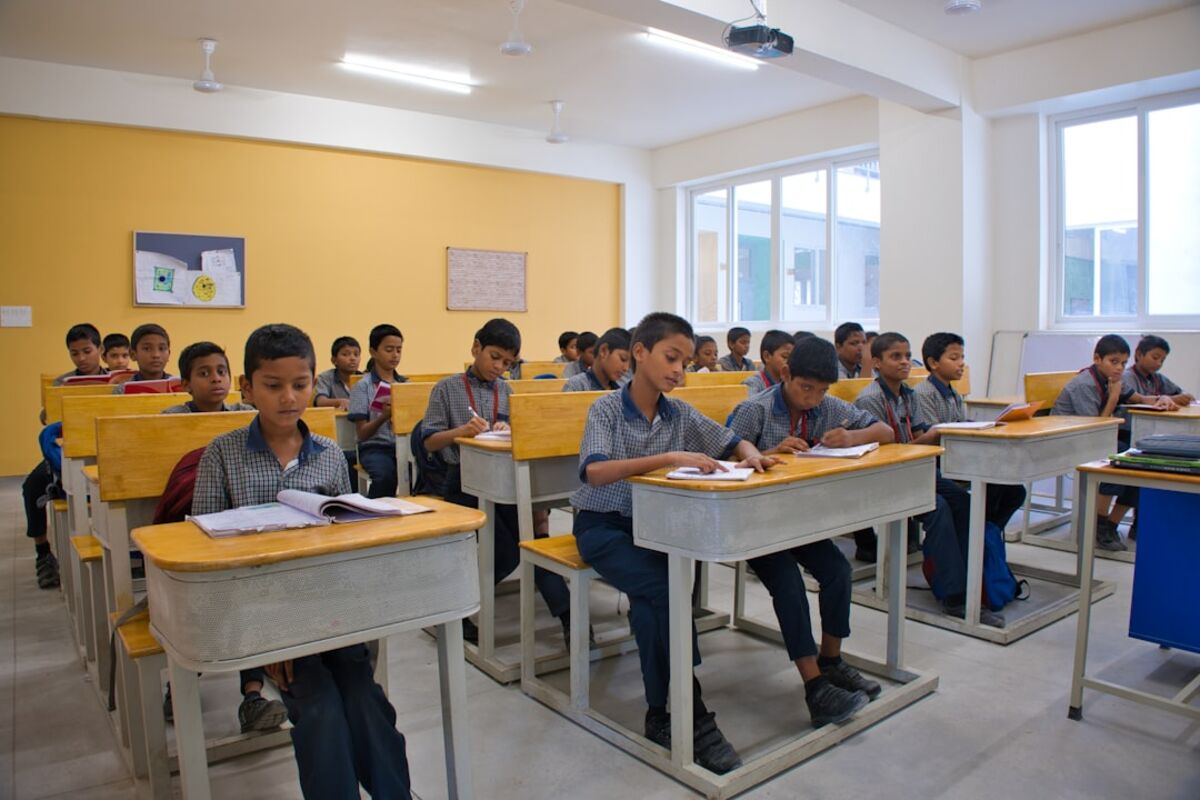
ESL Warm Up Activities: 15 No-Prep Games That Energize Any Class
ESL warm up activities set the tone for everything that follows in your lesson. A well-chosen five-minute warm up activates prior knowledge, switches students’ brains into English mode, and builds the energy you need for productive learning. Without one, you spend the first fifteen minutes dragging students out of their native-language headspace — and by then, half your lesson time is gone.
Whether you teach young learners, teens, or adult professionals, the activities below require minimal preparation and deliver maximum engagement. Each one includes the time needed, ideal class size, target level, and materials so you can scan the list and grab what works for tomorrow’s class.

Why ESL Warm Up Activities Matter More Than You Think
Research from the University of Cambridge’s Teaching Knowledge Test framework shows that warm up activities serve three critical functions in language classrooms. First, they lower the affective filter — the emotional barrier that prevents students from taking risks with a new language. Second, they activate schemata, connecting new material to what students already know. Third, they establish English as the classroom language from the moment students walk through the door [1].
A 2019 study published in the TESOL Journal found that classes beginning with structured warm up activities showed 23% higher participation rates during the main lesson compared to classes that jumped straight into textbook work [2]. That’s not a marginal improvement — that’s the difference between a classroom where half the students contribute and one where nearly everyone does.
The best ESL warm up activities share three characteristics: they’re short (3–7 minutes), student-centered (the teacher facilitates, students produce), and connected to the lesson theme when possible. Here are 15 activities that check every box.
ESL Warm Up Activities That Need Zero Materials
1. Word Association Chain
Time: 3–5 minutes | Level: All | Class size: Any
Say a word related to your lesson topic. The first student says a word they associate with yours. The next student responds to that word, and the chain continues around the room. If someone repeats a word or takes more than five seconds, they’re out (or lose a point in team format).
This warm up activity works because it forces quick, automatic English retrieval rather than translation. Students stop thinking in their L1 and start thinking in connections — which is exactly the cognitive shift you want at the start of class. For advanced groups, restrict associations to a specific category (only adjectives, only foods, only abstract nouns).
2. Two Truths and a Lie
Time: 5–7 minutes | Level: Pre-intermediate+ | Class size: 4–20
Each student prepares three statements about themselves — two true, one false. Classmates ask follow-up questions to identify the lie. This is technically an icebreaker, but it works as a daily warm up when you limit it to two or three students per session and rotate through the class over several weeks.
The real language value isn’t in the statements — it’s in the questions. Students practice question formation, yes/no questions, Wh- questions, and the pragmatics of expressing doubt (“Really? Are you sure about that?”).

3. This or That
Time: 3–5 minutes | Level: Beginner+ | Class size: Any
Present two options and students physically move to one side of the room (or raise left/right hands for online classes). Coffee or tea? Beach vacation or mountain vacation? Morning person or night owl? After each round, pick one student from each side to explain their choice.
This simple ESL warm up game gets bodies moving, which research from kinesthetic learning theory shows improves focus and retention. It also gives quieter students a low-pressure way to participate — moving to a side of the room feels safer than speaking in front of everyone.
4. The Alphabet Race
Time: 4–6 minutes | Level: All (adjust categories by level) | Class size: Teams of 3–5
Teams race to write one word for each letter of the alphabet within a category. For beginners: animals, food, or colors. For intermediate: jobs, adjectives describing personality, or things in a city. For advanced: academic vocabulary, idioms, or words related to your current unit.
The competitive element makes this warm up activity wildly popular with every age group. Teams naturally negotiate spelling, debate whether a word fits the category, and argue about whether “X-ray fish” counts — all in English.
ESL Warm Up Games Using the Whiteboard

5. Pictionary Relay
Time: 5–7 minutes | Level: All | Class size: Teams of 4–6
Write vocabulary words on slips of paper. One student from each team draws at the whiteboard while teammates guess. When someone guesses correctly, the next team member rotates up to draw. The first team to get through all their words wins.
This warm up game reviews vocabulary kinesthetically and visually. Unlike standard flashcard review, students encode the words through drawing — which research from the University of Waterloo shows creates stronger memory traces than writing or even repeated reading [3].
6. Backs to the Board
Time: 5 minutes | Level: Pre-intermediate+ | Class size: 6–30
One student from each team sits facing away from the board. Write a vocabulary word on the board. Teammates describe the word using definitions, synonyms, examples, and gestures — without saying the word itself. The seated student guesses. First correct guess wins a point.
This is one of the most effective ESL warm up activities for building circumlocution skills. When students can’t remember a word mid-conversation, they need to describe around it — and this game trains exactly that skill under time pressure.
7. Sentence Auction
Time: 5–7 minutes | Level: Intermediate+ | Class size: Teams of 3–5
Write 8–10 sentences on the board — some grammatically correct, some with errors. Each team gets $100 of imaginary money. Teams bid on sentences they believe are correct. If they buy a correct sentence, they keep it. If it’s incorrect, they lose their money. The team with the most correct sentences wins.
This warm up flips grammar review on its head. Instead of “find the error,” students must commit money — and that stakes-based decision-making activates deeper analysis than passive error spotting.

Speaking-Focused Warm Up Activities for ESL Students
8. Question Ball
Time: 5 minutes | Level: All | Class size: 8–25
Write questions on a beach ball or soft ball (or tape question strips to it). Toss the ball to a student — they answer whichever question their right thumb lands on, then toss to someone else. Questions can range from personal (“What did you do last weekend?”) to academic (“Name three types of renewable energy”).
The physical element keeps energy high, and the randomness removes the anxiety of being cold-called. Students know they’ll be asked something, but the unpredictability keeps everyone alert and ready to respond.
9. Speed Dating Discussion
Time: 5–7 minutes | Level: Intermediate+ | Class size: 8–30 (even numbers)
Arrange desks in two rows facing each other. Display a discussion question. Students talk for 90 seconds, then one row shifts down one seat. New partner, new question. Three rotations covers six different conversations in under seven minutes.
This is one of the most efficient ESL speaking activities for warm ups because every student speaks for at least 4.5 minutes — compared to maybe 30 seconds in a whole-class discussion. The pair format also means shy students can practice with less audience anxiety.
10. One-Minute Expert
Time: 5 minutes | Level: Intermediate+ | Class size: Any
Give students one minute to prepare, then one minute to speak without stopping about a random topic (their favorite meal, why they chose their job, what they’d do with a million dollars). The class listens and asks one follow-up question each.
This warm up builds fluency directly. The one-minute constraint forces students to push through pauses instead of stopping to search for the perfect word — which is exactly the habit that separates fluent speakers from accurate-but-halting ones.
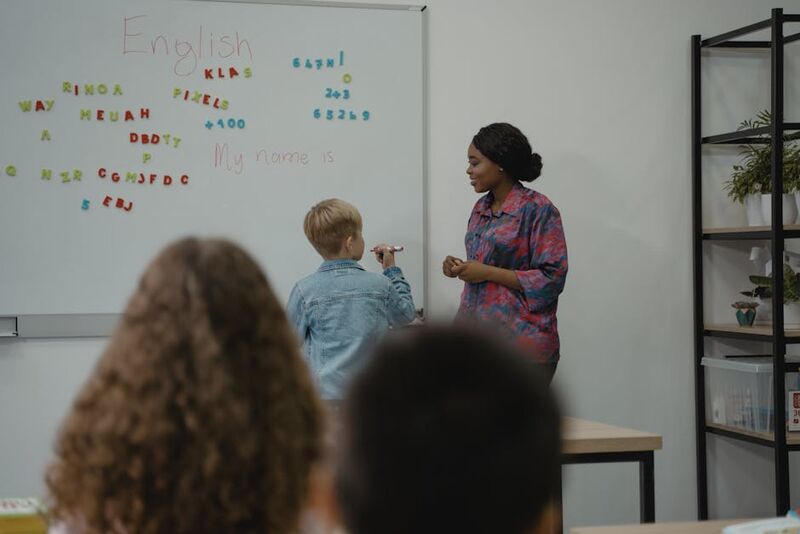
Vocabulary Review Warm Up Activities for English Class
11. Hot Seat
Time: 5 minutes | Level: Pre-intermediate+ | Class size: Any
Similar to Backs to the Board, but with a twist — one student sits in the “hot seat” facing the class while the teacher shows a word to everyone else. The class gives one-word clues, one student at a time. The hot seat student pieces the clues together to guess the target word.
The constraint of one-word clues forces the class to think strategically about which single word best communicates the meaning — a higher-order vocabulary skill than simply defining a word.
12. Vocabulary Bingo
Time: 5–7 minutes | Level: All | Class size: Any
Students draw a 4×4 grid and fill it with 16 vocabulary words from recent lessons (their choice from a master list of 20–25 words). The teacher reads definitions, example sentences, or synonyms. Students mark the matching word. First to complete a row wins.
Giving students choice over which 16 words to include adds a strategic element that standard bingo lacks. Students must recall all 25 words well enough to choose their best 16 — and that recall process is itself a review activity.
13. Word Races
Time: 3–5 minutes | Level: All | Class size: Teams
Display a prompt on the board: “Write as many words as you can related to [topic] in 2 minutes.” Teams brainstorm and write words. After time’s up, compare lists — teams only score points for words that no other team wrote. This pushes students beyond the obvious vocabulary and into deeper recall of less common terms.

Digital and Technology-Based ESL Warm Ups
14. Kahoot Quiz Blitz
Time: 5 minutes | Level: All | Class size: Any with devices
Create a 5-question Kahoot reviewing yesterday’s material. The competitive, game-show format gives an adrenaline boost that no paper worksheet can match. Keep it to 5 questions maximum — the point is warm up, not assessment.
Pro tip: let last week’s winning student create this week’s Kahoot. It shifts the cognitive load to the student (who must deeply understand the material to write good questions) and gives you one less thing to prepare.
15. Caption This
Time: 3–5 minutes | Level: Intermediate+ | Class size: Any
Project a funny, interesting, or ambiguous image on the screen. Students write the best caption they can in 60 seconds. Share anonymously and vote on the best one. This warm up activity targets creative language use, humor in a second language, and concise writing — all in three minutes.
For lower levels, display a simple photo and ask students to write three sentences describing what they see. Same activity, different output — and equally effective as an ESL writing warm up.
How to Choose the Right ESL Warm Up Activity

Not every warm up fits every class. The right choice depends on four factors:
Energy level of the class. Monday morning with tired adults? Start with something physical like This or That or Question Ball. Post-lunch with hyperactive teens? Channel that energy into Pictionary Relay. Matching the warm up to the room’s energy — rather than fighting it — makes the transition to your main lesson smoother.
Connection to the lesson. The best warm up activities for ESL students preview the lesson’s vocabulary, grammar structure, or topic without explicitly teaching it. If today’s lesson covers past tense, a “What did you do last weekend?” speed dating round primes students for the grammar point naturally.
Class size and space. Speed Dating needs room for desk rearrangement. Word Association works in a packed room of 40. Pictionary needs a board. Match the activity to your physical constraints.
Variety. The warm up activities in this article give you three weeks of different openers without repeating once. Rotate between categories — a speaking warm up Monday, a vocabulary game Tuesday, a digital activity Wednesday — to keep students guessing and engaged.
Common Mistakes Teachers Make With Warm Ups
After observing hundreds of ESL classrooms across Asia and the Middle East, the British Council’s classroom practice research team identified three patterns that undermine warm up effectiveness [4]:
Running too long. A warm up that stretches past 7 minutes stops being a warm up and starts eating into lesson time. Set a timer. When it goes off, stop — even mid-activity. Students learn that warm ups are fast-paced, which increases urgency and participation in future sessions.
No connection to the lesson. A warm up about weekend activities before a lesson on medical vocabulary wastes the priming opportunity. Even a loose connection (“Before we learn hospital vocabulary, tell your partner about the last time you visited a doctor”) bridges the warm up to the lesson content.
Always using the same activity. Students tune out when they can predict exactly what’s coming. The novelty effect — where new activities naturally generate more attention and engagement — applies to warm ups just as much as main activities. Aim for at least five different classroom management techniques in your warm up rotation.
Building Your Personal Warm Up Library
The teachers who never stress about the first five minutes of class are the ones who maintain a running list of warm up activities organized by type. Here’s a simple system that works:
Create four categories in a notebook or digital doc: Speaking, Vocabulary, Grammar, and Energy/Fun. Every time you try a warm up that lands well with your students, add it to the relevant category with a note about which level and class size it worked best with. Within a semester, you’ll have a personal library of 30+ tested activities that you can pull from without any preparation.
Pair this with a rotation schedule — speaking warm ups on Mondays and Wednesdays, vocabulary on Tuesdays, grammar on Thursdays, and a fun wildcard on Fridays — and you’ll never again stand in front of a class wondering how to start.
The five minutes you invest at the beginning of every lesson pay off exponentially in student engagement, participation, and language output throughout the class. Start building your warm up toolkit with the 15 activities above, and watch your lessons transform from slow-starting slogs into high-energy learning sessions from the very first minute.
Sources
- Cambridge TKT Framework — Teaching Knowledge Test guidelines on lesson structure and warm up functions in language teaching.
- TESOL Journal — Peer-reviewed research on ESL/EFL classroom practices and student participation outcomes.
- University of Waterloo Drawing Effect Study — Research demonstrating superior memory retention through drawing compared to writing or reading.
- British Council Classroom Practice Research — Observational research on effective language teaching practices across global contexts.
- Bridge Education Group — Practical ESL warm up activity ideas and teacher training resources.






 EN
EN  ZH
ZH  ZH_CN
ZH_CN  KO
KO  VI
VI  FR
FR  AR
AR  ES
ES  HI
HI  PT
PT  BN
BN  RU
RU  JA
JA  TR
TR  DE
DE  IT
IT  PL
PL  ID
ID  TH
TH  FA
FA  UK
UK  TL
TL  HE
HE  UR
UR  SW
SW  RO
RO  NL
NL  MS
MS  TA
TA  PS
PS  HU
HU  EL
EL  SV
SV  NB
NB  NN
NN  DA
DA  CS
CS  SR
SR  AM
AM