

How to Reduce Teacher Talk Time: 8 Proven Tips
In a 60-minute lesson with 15 students, a teacher who talks for half the class leaves each learner roughly two minutes to speak. That single stat, drawn from the British Council’s own training material, is the whole argument for reducing teacher talk time. Language is a skill you build by using it, and a student who spends the hour listening to you isn’t building anything. The goal isn’t silence at the front of the room — it’s shifting the balance so the people who need the practice are the ones doing the work.

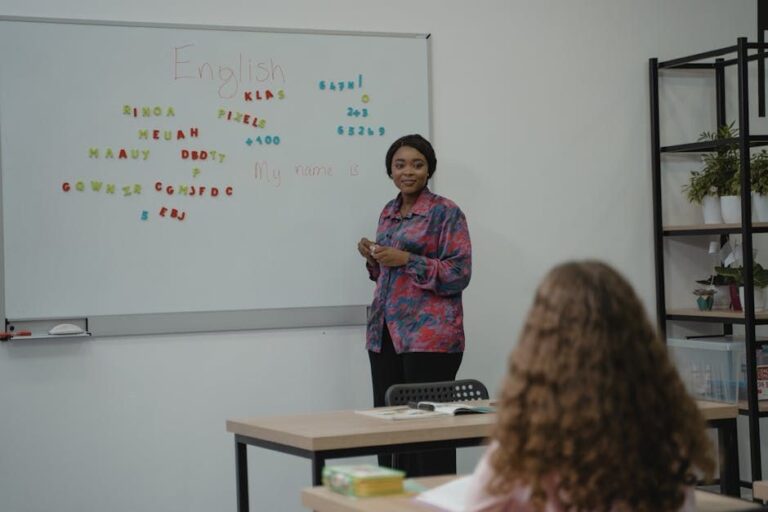
The default classroom shape — teacher at the front, students receiving. Reducing teacher talk time flips it.
What Is Teacher Talk Time (and Why It Matters)?
Teacher talk time (TTT) is the proportion of a lesson the teacher spends talking rather than the students. Its counterpart is student talking time (STT). The two are a zero-sum split: every minute you spend explaining, echoing, or narrating is a minute your students aren’t producing language. In a communicative classroom, that trade-off almost always favours the students.
Here’s the part most teachers miss. Reducing teacher talk time isn’t about talking less for its own sake — plenty of TTT is useful. Well-graded teacher speech is a source of comprehensible input, and in a monolingual class overseas you may be the only authentic English a learner hears all week. The problem is the other kind of talk: the rambling instructions, the questions you answer yourself, the running commentary nobody asked for. That’s the talk worth cutting.
How Much Should Teachers Talk? The 30% Rule
A widely cited benchmark in TEFL training is roughly 30% teacher, 70% student across a typical communicative lesson. In a one-hour class, that’s about 15 to 18 minutes of teacher talk total — spread across your setup, modelling, feedback, and the odd clarification. It’s a target, not a law. A grammar-heavy lesson for beginners will skew higher; a fluency-focused conversation class for advanced learners should skew far lower, sometimes down to 10%.
Don’t obsess over hitting an exact percentage mid-lesson. The number is a mirror, not a stopwatch. Record one of your classes on your phone, then listen back and time yourself. Most teachers are genuinely shocked — the honest figure is usually closer to 60 or 70% than they’d ever guess.

When talk time creeps past 60%, students slide into passive listening — the opposite of practice.
1. Cut Your Instructions in Half
Instructions are where TTT quietly balloons. A teacher means to say “Work in pairs, ask your partner three questions” and instead delivers a ninety-second monologue with three restatements and a personal anecdote. Learners stop listening after the first sentence anyway. Plan your instructions like a text message: the fewest words that get the task moving. Then check they landed with a quick “What are you going to do first?” instead of “Do you understand?” — which only ever earns a polite nod.
2. Ask, Don’t Tell (Elicit Everything You Can)
Eliciting is the single most effective habit for cutting teacher talk time. Instead of explaining that “used to” describes past habits, put three example sentences on the board and ask the class what they notice about the verb. Instead of defining a word, ask if anyone can. When students generate the answer, two things happen: they talk more, and they remember it better because they did the mental work. Your job shifts from information-giver to question-asker — and questions are short.

Eliciting turns a five-minute explanation into a two-minute exchange the students drive.
3. Build In Pair and Group Work by Default
The mechanical fix for low STT is structural: put students in pairs and small groups for every task that doesn’t strictly need the whole class. A shy learner who won’t say a word in front of thirty peers will happily talk to one partner. Pair work multiplies speaking opportunities instantly — in a 20-student class, ten conversations run at once instead of one. Set the task, model it once, then step back and let the room get loud.

Ten pairs talking at once beats one student answering while the rest watch.
4. Stop Echoing Your Students
Echoing is the habit of repeating what a student just said. A learner answers “It’s an apple,” and you reply “Right, it’s an apple.” It feels supportive, but it’s pure padding — it doubles your talk, trains students to speak quietly because you’ll repeat them anyway, and steals airtime. Break the habit by nodding, giving a thumbs-up, or simply moving to the next student. If the class genuinely didn’t hear an answer, ask the student to say it again louder. Let them fill the silence, not you.
5. Get Comfortable With Silence
Most teachers wait about one second after asking a question before they jump in to rephrase, hint, or answer it themselves. Learners processing a second language need far longer — five to ten seconds is normal. That pause feels agonising from the front of the room, but it’s where the thinking happens. Count to ten in your head before rescuing anyone. Nine times out of ten a student answers before you finish counting, and the silence you were afraid of turns into speech.
6. Use Gestures and Visuals Instead of Words
A lot of routine teacher talk can be replaced with a signal. A hand cupped to your ear means “louder.” A rewind gesture means “say it again.” A flat palm timeline on the board explains a tense faster than a paragraph. Concept-check a piece of vocabulary with a picture rather than a definition. Every routine you can turn into a gesture is talk you never have to spend, and it keeps the lesson moving without breaking the flow of English.

Set the task clearly, then hand it over — collaboration only happens in the space you leave for it.
7. Delay Your Corrections
Interrupting a speaking activity to correct grammar does two bad things: it stops the student mid-flow and it hands you the microphone. During fluency tasks, jot errors on a notepad and run a short correction slot at the end, on the board, with the whole class fixing them together. That keeps students talking during the activity and turns error correction itself into a student-led task. It pairs naturally with the way we cover error correction in ESL — the timing matters as much as the fix.
8. Let Students Lead the Routines
Hand off the jobs you’d normally narrate. Students can check answers with each other before open-class feedback. They can explain a task to a latecomer. A stronger learner can model the activity instead of you. Nominate a student to run the warmer. Every classroom routine you delegate is talk that leaves your column and enters theirs — and students who run the room are students who are engaged in it.

Engagement follows ownership — students who run the routines stay in the lesson.
Signs You’re Talking Too Much
You don’t always need a recording to diagnose runaway TTT. A few tells give it away fast. You finish your own questions before students can answer. You rephrase instructions three times. You catch yourself narrating what students are doing while they do it. Your voice is the only one in the room for stretches longer than a minute during a “speaking” activity. Any one of these is a cue to close your mouth and open the floor.

The quiet test: during a “speaking” task, whose voice fills the room?
The Case for Some Teacher Talk
Here’s the mild heresy: the crusade against teacher talk has gone too far in some training rooms. A teacher who never talks isn’t a great facilitator — they’re just absent. Graded, purposeful teacher talk models pronunciation, delivers listening practice cleaner than any audio track, and exposes learners to language slightly above their level. The British Council makes this point directly: in the right context, TTT is a valuable source of authentic input, not a sin to be stamped out.
So don’t chase zero. Chase quality. The test for any sentence you’re about to say is simple: does this help my students produce or understand more language, or am I just filling the air? Cut the second kind ruthlessly and keep the first. That distinction, not a stopwatch, is what separates a quiet teacher from an effective one.
Watch: Reducing TTT in Action
This short walkthrough shows the mindset shift in a real classroom — putting students at the centre and trimming teacher talk down to what actually helps.
Start With One Habit
Don’t try to fix all of this at once — you’ll just add “monitor my talk time” to the list of things overloading your working memory mid-lesson. Pick one habit for a week. Record a class, listen back, and count. Then swap echoing for a nod, or trade one explanation for an elicitation. Small changes compound: a teacher who trims instructions and stops echoing has already handed students a third of the lesson back. Once your talk time drops, the natural next move is filling that space with the right tasks — start with our guide to فعالیتهای گفتاری ESL, and keep the room running smoothly with these راهبردهای مدیریت کلاس درس.
منابع
- British Council TeachingEnglish — Teacher talking time — Definition of TTT/STT and the case for reducing it without eliminating it.
- Bridge — What Is TTT When Teaching English? — The 30% teacher / 70% student benchmark and practical reduction techniques.
- JIMMYESL — 15 Tips to Limit Teacher Talk Time — Eliciting, pair work, and instruction-cutting strategies for the ESL classroom.
- The TEFL Academy — Teacher Talk Time vs Student Talk Time — Balancing TTT and STT across different lesson types.
Looking for free ESL worksheets? Browse our full collection — printable resources for every level and age group. Browse Free Worksheets →
Students can access free worksheets and reading materials at 18KEnglish.com.








 FA
FA  EN
EN  ZH
ZH  ZH_CN
ZH_CN  KO
KO  VI
VI  FR
FR  AR
AR  ES
ES  HI
HI  PT
PT  BN
BN  RU
RU  JA
JA  TR
TR  DE
DE  IT
IT  PL
PL  ID
ID  TH
TH  UK
UK  TL
TL  HE
HE  UR
UR  SW
SW  RO
RO  NL
NL  MS
MS  TA
TA  PS
PS  HU
HU  EL
EL  SV
SV  NB
NB  NN
NN  DA
DA  CS
CS  SR
SR  AM
AM