

TPR Challenge: Commands in Sequence | Advanced TPR Worksheet PDF
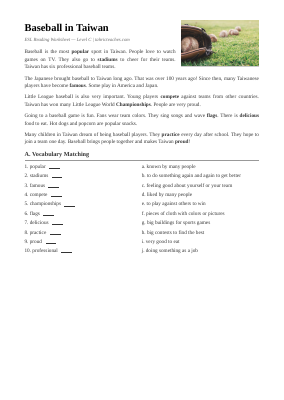
A free advanced TPR worksheet (Level F, Grades 6–9) for a 45-minute Total Physical Response lesson adapted for older learners, run as a team competition with yoga, a direction maze and a cooking demonstration. It is the practice sheet for our lesson guide TPR Examples: 15 Best Total Physical Response Activities and follows its stages in order. Every part gives students an example or a model first, and the teacher command script and answer key are on the last page.
Free and classroom-ready: student pages first, then the Teacher Page with the command script and answer key.
How to Run This TPR Lesson
- Minutes 0–3, warm-up: Teacher Says as a team elimination game, with the sheet face down.
- Minutes 3–13, modelling block: act out the ten target verbs while students only watch.
- Minutes 13–28, group response (Parts A–D): match the verbs, a scored Teacher Says listening check, a five-pose TPR yoga sequence to number, then Stand Up, Sit Down on command grammar.
- Minutes 28–38, activity rotation (Parts E–F): a listen-and-draw direction maze and the cooking demonstration (peel, slice, pour, stir).
- Minutes 38–45, production (Parts G–I): students write command chains and lead the class (the Classroom Roleplay Reverse), then write the ten verbs from memory.
Key words (MOE Level 2–3): stretch · bend · balance · fold · step · lift · peel · slice · pour · stir
Student Worksheet Preview
Examples: How TPR Works
• A negative command starts with Don’t: “Don’t step on the mat with your shoes.”
• A command chain joins several commands, and sequence words show the order: “First, peel the banana. Next, slice it. Then pour in the yogurt. Finally, stir it.”
• Direction words and numbers make a command exact: “Take two steps forward and turn left.”
A. Watch and Match: Ten Target Verbs
You watched your teacher act out each verb. Now match each verb to its meaning.
- stretch ____
- bend ____
- balance ____
- fold ____
- step ____
- lift ____
- peel ____
- slice ____
- pour ____
- stir ____
- a. to move one foot to a new place
- b. to make a liquid flow out of a cup or bottle
- c. to take the skin off a fruit
- d. to mix something by moving a spoon around in it
- e. to reach your arms or legs out as far as they go
- f. to make your knees or body curve instead of staying straight
- g. to stay steady without falling, often on one foot
- h. to bend your body forward from the waist
- i. to move something, such as your knee, up higher
- j. to cut food into thin, flat pieces
B. Teacher Says: Team Challenge
Your teacher gives eight commands. Do the action only if the command starts with “Teacher says.” Then write ✓ if you moved or ✗ if you stayed still. Anyone who moves by mistake is out for that round.
C. TPR Yoga: Listen and Number
Do each pose as you hear it, then number the steps 1–5 in the order you heard them.
D. Stand Up, Sit Down: Check the Commands
Listen to each sentence. Stand up if it is true and sit down if it is false. Then write T or F.
- ____ You stir soup with a spoon.
- ____ You slice bread with a pencil.
- ____ You peel a banana before you eat it.
- ____ When you bend your knees, your legs stay straight.
- ____ “Sit down” is a command.
- ____ “Please you stand up” is a correct command.
- ____ A command usually starts with a verb.
- ____ In “First, stretch. Next, bend,” you bend before you stretch.
- ____ “Finally” tells you about the last step.
- ____ “Don’t step back” tells you to step back.
E. Direction Maze: Listen and Draw
Put your pencil on the star and face the top of the page. Listen to your teacher’s directions and draw your path one square at a time. Draw an X where you stop, then write the square (for example, C5).
| A | B | C | D | E | |
| 1 | |||||
| 2 | |||||
| 3 | |||||
| 4 | |||||
| 5 | ★ |
Now give your partner a path of your own with three commands, using a number and a direction in each one. Your partner draws it on the back of the page.
F. The Cooking Demonstration
Your teacher acts out a recipe while you copy each step at your desk. Then complete the recipe with the words in the box, using each word once.
Szóbank: First, slice, put, pour, stir, Peel, Stretch, Don’t
- ______________, peel the banana.
- Next, ______________ it into rounds with a plastic knife.
- Then ______________ the rounds in the bowl.
- After that, ______________ in the yogurt.
- Finally, ______________ it twice with a spoon.
- ______________ the banana before you slice it, because nobody wants to eat the skin.
- Change “You should stretch your arms” into a command: “______________ your arms.”
- Make this command negative: “______________ step on the yoga mat with your shoes.”
G. Be the Teacher: Write Commands
Model: “Can you please lift your knee?” → “Lift your knee.” Write your answers on the lines.
- Turn this question into a command: “Can you please balance on one foot?”
- Fix this command: “Please you fold forward.”
- Write a command that uses a direction word (left, right, forward or back) and a number.
- Write a yoga chain of four commands that uses First, Next, Then and Finally.
- Write a chain of five commands for your team, using at least three of the ten verbs. Be ready to lead it.
H. Classroom Roleplay Reverse: Lead the Class
Now you are the teacher. Work with your team and a partner.
- Give your chain from Part G, number 5, to your team while everyone, including your teacher, follows. Did anyone do the steps in the wrong order?
- Guide a partner along a short path between the desks with direction commands, then switch.
- Which was harder for you, following commands or giving them? Explain why.
I. Exit Challenge
Cover the page and write all ten verbs from memory. Then circle the three that were hardest to act out.
Teacher Command Script and Answer Key (click to reveal)
Teacher Command Script — 45-minute lesson (do not hand out):
Three rules for the whole lesson: never translate a command, and if students look lost, mime it harder. Let them follow each command many times before they lead, and do not stop a student who is leading to fix mistakes; say the correct form quietly at the end. Reuse these ten verbs as a five-minute warm-up in at least three more lessons this week, and present TPR to teens as a memory boost rather than a children’s game.
Minutes 0–3, warm-up (Teacher Says, team elimination): students act only when a command starts with “Teacher says.” Anyone who moves without it sits down, and the team with the most players still standing after three rounds wins a point.
Minutes 3–13, modelling block (students watch, no talking, no writing): say and act out each verb three or four times: stretch your arms up, bend your knees, balance on one foot, fold forward, step your right foot back and lift your left knee, then, with a banana, a bowl and a spoon (real or mimed), peel, slice, pour és stir.
Minutes 13–28, group response: call the verbs in mixed order and stop modelling once the class is confident. Hand out the sheet for Part A. Part B: 1 “Teacher says, stretch your arms up.” 2 “Bend your knees.” 3 “Teacher says, balance on your left foot.” 4 “Teacher says, fold forward.” 5 “Lift your right knee.” 6 “Teacher says, step back.” 7 “Stir your soup.” 8 “The astronaut says, slice the bread.” Part C, read once while students do each pose: “First, raise your arms and stretch up high. Next, fold forward and touch your knees. Then step your right foot back. After that, bend your left knee. Finally, lift your arms and balance.” Part D: stand for true, sit for false.
Minutes 28–38, activity rotation: Part E, Direction Maze (five minutes): “Start on the star, facing the top of the page. Take two steps forward. Turn right and take two steps forward. Turn left and take one step forward. Turn left again and take three steps forward. Stop and draw an X.” Then Part F, the Cooking Demonstration (five minutes): “Peel the banana, slice it into rounds, put them in the bowl, pour in the yogurt, stir twice.” Students mime each step at their desks, then complete the recipe.
Minutes 38–45, production (students lead): students write their chains in Part G, then in Part H team leaders give their chains while the class, and you, follow. End with Part I, when one student writes the ten verbs on the board with no help.
A. Watch and Match: 1-e, 2-f, 3-g, 4-h, 5-a, 6-i, 7-c, 8-j, 9-b, 10-d
B. Teacher Says: 1 ✓, 2 ✗, 3 ✓, 4 ✓, 5 ✗, 6 ✓, 7 ✗, 8 ✗ (the astronaut is not the teacher).
C. TPR Yoga: raise/stretch 1, fold 2, step back 3, bend 4, lift and balance 5; the last-step word is “Finally.”
D. Stand Up, Sit Down: 1-T, 2-F (you slice with a knife), 3-T, 4-F (they curve), 5-T, 6-F (“Please stand up”), 7-T, 8-F (you stretch first), 9-T, 10-F (it tells you not to)
E. Direction Maze: C5 → C3 → E3 → E2 → B2, so the X is on B2. Partner paths will vary.
F. The Cooking Demonstration: 1-First, 2-slice, 3-put, 4-pour, 5-stir, 6-Peel, 7-Stretch, 8-Don’t
G. Be the Teacher (model answers):
- Balance on one foot.
- Please fold forward. (Drop “you”: a command has no subject.)
- Take three steps forward and turn left.
- First, stretch your arms up. Next, fold forward. Then bend your knees. Finally, balance on one foot.
- Stand up, step back, lift your right knee, balance, sit down. (Part H answers vary; Part I = the ten verbs in Part A.)
Built from the lesson in “TPR Examples: 15 Best Total Physical Response Activities”; the worksheet contains no statistics or factual claims.
© Tahric Teaches | tahricteaches.com







 HU
 EN
 ZH
 ZH_CN
 KO
 VI
 FR
 AR
 ES
 HI
 PT
 BN
 RU
 JA
 TR
 DE
 IT
 PL
 ID
 TH
 FA
 UK
 TL
 HE
 UR
 SW
 RO
 NL
 MS
 TA
 PS
 EL
 SV
 NB
 NN
 DA
 CS
 SR
 AM