

10 ESL Speaking Activities That Transform Your Classroom
ESL speaking activities help students build confidence, improve fluency, and practice real-world conversation skills. Teachers who prioritize speaking practice see faster progress in their students’ ability to communicate naturally. This guide covers ten proven activities that work across proficiency levels—from beginners to advanced learners.

Why Speaking Practice Matters in ESL Classrooms
Many ESL students can read and write English at a higher level than they can speak it. This gap exists because traditional classrooms often emphasize grammar drills and written exercises over oral communication. Research from the American Council on the Teaching of Foreign Languages shows that students need regular, low-pressure speaking opportunities to develop fluency. When teachers create a supportive environment for speaking practice, students overcome the fear of making mistakes and start using English more naturally.
Speaking activities also help students internalize grammar patterns without memorizing rules. When learners use new vocabulary in conversation, they remember it better than when they simply write it down. The affective filter—a term coined by linguist Stephen Krashen—drops when students feel comfortable, allowing faster language acquisition.
1. Dua Kebenaran dan Satu Kebohongan
Students write three statements about themselves: two true, one false. Classmates ask questions to identify the lie. This activity works for all levels because students control the complexity of their statements. Beginners might say “I like pizza” while advanced learners describe travel experiences or personal achievements. The game format reduces anxiety and encourages natural questioning.
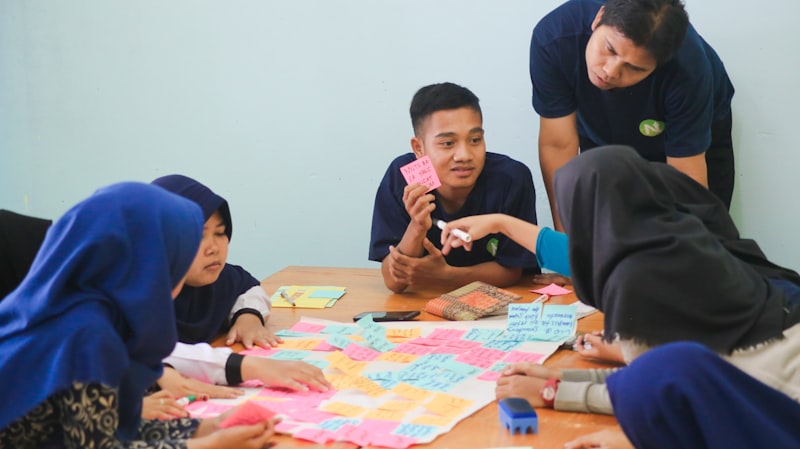
2. Find Someone Who…
Create a grid with prompts like “Find someone who has visited another country” or “Find someone who plays an instrument.” Students walk around asking classmates questions until they complete the grid. This structured mingling activity forces students to initiate conversations with multiple partners. It works especially well for practicing question formation and building classroom community. Provide sentence frames for lower levels: “Do you _____?” and “Have you ever _____?”
3. Picture Description Pairs
Pair students and give each a different image, placed face-down. Without showing their pictures, students describe what they see while partners draw based on the description. After five minutes, they compare the drawing to the original image. This activity develops descriptive vocabulary and teaches students to give clear, specific instructions. Use images with multiple details—street scenes, classrooms, or landscapes work well.

4. Four Corners Debate
Label classroom corners with options: “Strongly Agree,” “Agree,” “Disagree,” “Strongly Disagree.” Read a statement like “Homework should be banned” or “Social media improves communication.” Students move to their chosen corner and discuss their reasoning in small groups. Select one student from each corner to present their group’s perspective. This activity builds argumentation skills and teaches students to support opinions with evidence. It also incorporates movement, which helps kinesthetic learners stay engaged.
5. Desert Island Scenario
Give each student a slip of paper with a random item drawn on it (or have them draw their own). Tell students they’re stranded on a desert island and only half the class can survive. Each person must convince the group why their item makes them essential for survival. A student with a “mirror” might argue it can signal planes, start fires, or check for injuries. This activity encourages creative thinking and persuasive speaking.

6. Speed Debate (Timed Speaking)
Divide the class into two teams. A student from Team A speaks on a given topic for 45 seconds without hesitating. Team B listens for grammatical errors, vocabulary mistakes, or long pauses. If Team B catches an error, they earn a point. Then Team B sends a speaker. Topics can range from simple (“Describe your morning routine”) to complex (“Should universities be free?”). This activity builds fluency under pressure and trains students to think in English rather than translating from their first language.
For a helpful video demonstration of this and other speaking activities, watch this ESL teaching resource:
7. Role-Play Scenarios
Assign students real-world situations: ordering food at a restaurant, asking for directions, job interviews, or making complaints. Provide dialogue cards for beginners with key phrases. Intermediate and advanced students can improvise based on the scenario. Role-plays prepare students for practical English use outside the classroom. They also allow students to practice cultural norms like polite refusals or small talk. After each role-play, the class discusses what worked and suggests improvements.

8. Story Chain (Collaborative Storytelling)
Bring four students to the front. Three sit in a row, one stands behind them as the “controller.” The controller holds cards with random nouns (e.g., “bicycle,” “thunderstorm,” “grandmother”). Student 1 starts telling a story. After 30-60 seconds, the controller hands a noun card to Student 2, who must incorporate that word and continue the story. The narrative shifts between students until the story concludes. This activity builds spontaneous speaking skills and teaches students to connect ideas fluidly.
9. Would You Rather?
Present students with choices: “Would you rather live in the mountains or by the ocean?” Beginners can answer in one sentence using “I would rather… because…” Advanced students can debate the pros and cons of each option. This simple activity generates surprising discussions and reveals personality differences. It also introduces comparative structures naturally. Adjust difficulty by changing the choices—easy options like “pizza or pasta” for beginners, philosophical dilemmas like “fame or wealth” for advanced learners.

10. Verbal Exit Tickets
Before students leave class, ask them to answer a question aloud—either to you or a partner. Questions can review lesson content (“What’s one new word you learned today?”) or check comprehension (“Explain the difference between ‘borrow’ and ‘lend'”). This quick formative assessment reinforces learning and builds a daily speaking habit. It also gives shy students a low-stakes opportunity to speak. Provide sentence starters for support: “Today I learned…” or “One thing I found difficult was…”
How to Support Reluctant Speakers
Some students avoid speaking activities because of anxiety or perfectionism. Lower the affective filter by celebrating effort over accuracy. Allow think time before calling on students. Pair hesitant speakers with encouraging partners. Use sentence frames and visual supports to scaffold responses. Never force a student to speak in front of the whole class before they’re ready—start with pair work and gradually build to larger groups. When students see that mistakes are part of learning, they participate more freely. For more strategies on building student confidence, see our guide on student engagement techniques.

Practical Tips for Running Speaking Activities
Model the activity before students begin. Demonstrate with a volunteer or pre-record a video example. Set clear time limits—use a timer visible to the class. Monitor pairs and small groups, but avoid hovering. Take notes on common errors for a mini-lesson later, rather than interrupting to correct. After the activity, ask students to reflect: “What was easy? What was challenging?” This metacognitive step helps learners notice their progress. Pairing speaking activities with vocabulary games reinforces new words through repetition.
Integrate speaking practice into every lesson, not just designated “speaking days.” A five-minute Turn and Talk after explaining a grammar point activates the language immediately. Use conversation practice techniques to create a classroom culture where speaking feels natural, not forced.
When to Use These Activities
Use Two Truths and a Lie or Find Someone Who as icebreakers at the start of a semester. Four Corners and Desert Island work well mid-lesson when students need movement. Speed Debate and Role-Play suit exam preparation or test-review days. Would You Rather makes an excellent warm-up or time-filler. Verbal Exit Tickets work every day. Vary activities to match lesson objectives—use Picture Description when teaching prepositions of place, Story Chain when reviewing past tenses.
Assessing Speaking Progress
Track fluency, accuracy, and range separately. Fluency measures how smoothly students speak without long pauses. Accuracy tracks grammar and pronunciation errors. Range evaluates vocabulary diversity. Don’t grade every speaking activity—high-stakes assessment kills spontaneity. Instead, observe patterns over time. Record students periodically and have them self-assess using a rubric. Notice when students self-correct, use new vocabulary, or initiate conversations unprompted. These indicators show real progress better than formal tests.
Adapting for Online Classes
Most of these activities translate to video calls with minor adjustments. Use breakout rooms for pair work and small groups. Share images on screen for Picture Description. Post Would You Rather polls in the chat. Record role-plays for later review. The key challenge online is ensuring all students participate equally—call on quieter students directly and rotate breakout room partners frequently.
Common Mistakes to Avoid
Don’t let advanced students dominate discussions—set turn-taking rules. Avoid correcting every error during fluency activities; note mistakes for later review. Don’t skip the modeling phase—students need to see what success looks like. Resist the urge to speak for students who struggle; give them wait time instead. Don’t use the same few activities repeatedly; variety maintains engagement.
Final Thoughts
Speaking practice transforms ESL classrooms from quiet, teacher-led spaces into active learning environments. Students gain confidence when they realize they can communicate successfully in English. These ten activities require minimal preparation but deliver measurable results. Start with one or two favorites, then expand your repertoire. The goal isn’t perfect English—it’s helping students find their voice in a new language.
Sumber
- Edutopia: 12 Fun Speaking Games for Language Learners — Teacher-tested activities for building oral fluency
- Continental Press: 7 Fun and Effective ESL Speaking Activities — Research-backed strategies for lowering the affective filter
- American Council on the Teaching of Foreign Languages — Research on oral proficiency development
- TEFL Lemon: ESL Speaking Activities for Teens and Adults — Activity ideas for mixed-level classrooms





 ID
ID  EN
EN  ZH
ZH  ZH_CN
ZH_CN  KO
KO  VI
VI  FR
FR  AR
AR  ES
ES  HI
HI  PT
PT  BN
BN  RU
RU  JA
JA  TR
TR  DE
DE  IT
IT  PL
PL  TH
TH  FA
FA  UK
UK  TL
TL  HE
HE  UR
UR  SW
SW  RO
RO  NL
NL  MS
MS  TA
TA  PS
PS  HU
HU  EL
EL  SV
SV  NB
NB  NN
NN  DA
DA  CS
CS  SR
SR  AM
AM