

IELTS Speaking Test: 7 Essential Drills
A student who writes a Band 7 essay in the same exam sitting can walk out of the speaking room with a 5.5, and the gap almost never comes down to grammar. It comes down to silence — the two or three seconds where a student searches for a word, loses the thread of an answer, and the examiner marks it against fluency and coherence before the sentence even finishes. IELTS speaking examiners work from four public band descriptors, and none of them reward correctness sitting alone; they reward sustained, self-repaired speech under time pressure. The seven drills below are built around that reality. Each one targets a specific part of the test — the 4-5 minute interview, the 2-minute cue card monologue, or the two-way discussion — and a specific scoring criterion, so a single 50-minute class can rotate through two or three without turning into a vocabulary quiz.
What the IELTS Speaking Test Examiner Is Actually Scoring
Before drilling anything, a class needs to understand the four categories an examiner marks against, because most students prepare as if only one of them exists — usually vocabulary. The official band descriptors split the score four ways, each worth exactly a quarter of the final mark:
- Fluency and coherence — speaking at length without unnatural pauses, and linking ideas logically
- Lexical resource — range of vocabulary and the ability to paraphrase when a word is missing
- Grammatical range and accuracy — variety of sentence structures, not just correctness
- Pronunciation — stress, intonation, and individual sounds, judged on intelligibility rather than accent
A student stuck on Band 6 usually has decent grammar and passable pronunciation but loses marks twice over on fluency and lexical resource — they hesitate, then repeat the same three adjectives to cover the gap. That is the specific failure pattern the drills below are designed to break.

A visible timer keeps every drill honest and mirrors real exam pressure.
Drill 1: The 4/3/2 Fluency Squeeze
Pair students up. Student A talks about the same cue card topic three times in a row — four minutes, then three minutes, then two minutes, with a new partner or the same one each round. The content stays constant; the time shrinks. By round three, a student who was pausing every ten seconds in round one is forced to compress and prioritize, which is exactly the skill a real cue card task rewards. Run the reverse for the listening partner: they check off a short list of connector words (first, then, after that, what really stood out was) each time they hear one, which keeps them engaged instead of just waiting their turn.
This drill maps directly onto Part 2 of the real test, where students get one minute to prepare and up to two minutes to speak on a single cue card. Most classes only ever practice the two-minute version once. Running it three times at shrinking lengths teaches students what their own “reduced but complete” answer sounds like, which is the skill that actually shows up on test day.
Drill 2: Part 1 Rapid-Fire Warm-Up
Part 1 questions are personal and low-stakes — hometown, work, hobbies — but students still freeze on them because they’ve never answered in under three seconds. Set a phone timer for 45 seconds and fire six to eight Part 1 style questions at a student in a row, allowing only a two-second gap before the next one lands. No cue cards, no notes. The goal isn’t a polished answer; it’s proving to the student that they can produce a complete sentence on demand, which builds the confidence that keeps Part 1 from souring their whole test.
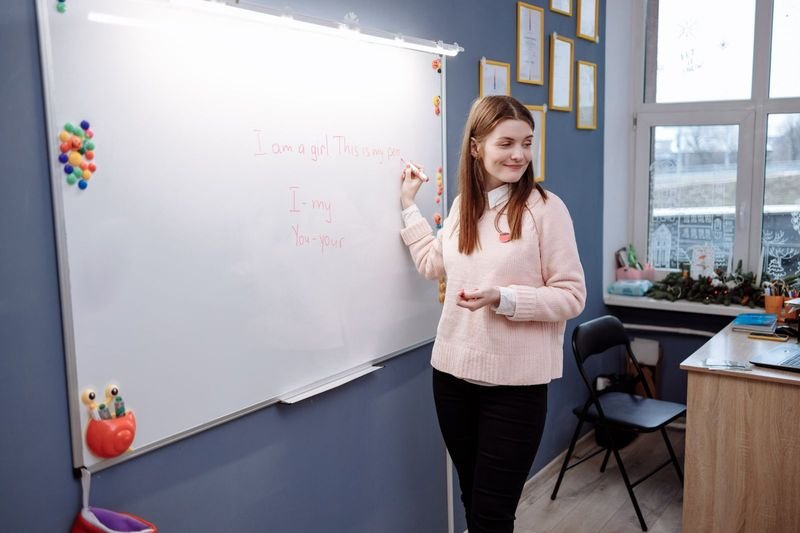
Rapid-fire Part 1 questions train instant, complete-sentence responses.
Run this drill at the very start of class, before students have had time to get comfortable, so the discomfort of answering cold becomes familiar rather than something they only feel on exam day. Rotate who asks the questions — a stronger student firing questions at a weaker one gets useful listening practice too.
Drill 3: One-Minute Cue Card Note Sprint
Give students a cue card and exactly sixty seconds to prepare, but restrict notes to five words maximum, no full sentences. The real test gives one minute of prep time with a pencil and paper, and students who write full sentences during that minute end up reading instead of speaking — a habit examiners can hear immediately because it kills natural stress and intonation. Training students to jot only keywords (childhood, grandmother’s kitchen, smell of bread, moved away, still miss it) forces them to construct sentences live, which is closer to how the actual monologue sounds when it scores well.
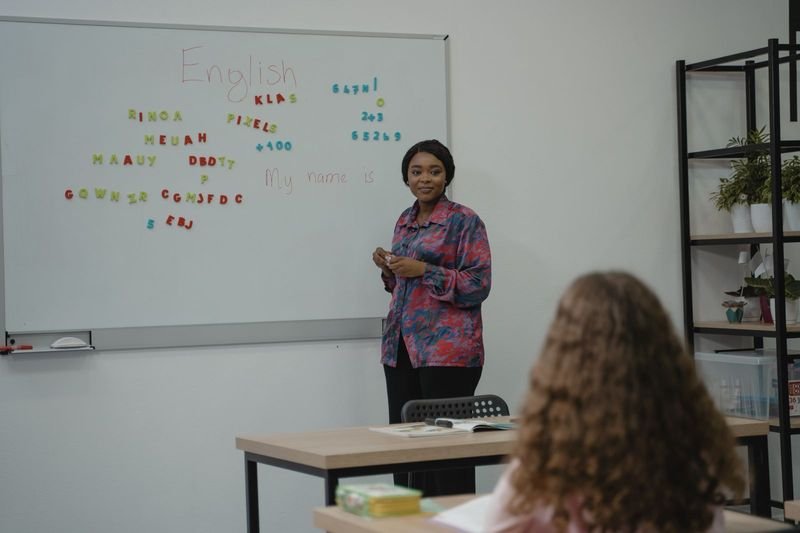
Keyword-only notes during the one-minute prep window keep answers natural instead of read aloud.
After the sprint, have two or three students deliver their two-minute answer from notes while the rest of the class tracks a single thing: did the speaker ever stop and restart a sentence rather than pushing through with a filler word? That single metric teaches self-monitoring faster than general feedback does.
Drill 4: Paraphrase Ping-Pong
Lexical resource isn’t about knowing rare words — it’s about not repeating the same five when the obvious one slips away. Write ten common IELTS topic words on the board (important, difficult, interesting, expensive, popular) and have students go around in a circle, each giving a different paraphrase for the same word before it’s someone else’s turn. “Important” becomes “crucial to me,” “something I can’t do without,” “a real priority.” The moment a student repeats a phrase already used, they’re out and the next student has to keep the round alive.
Eliciting techniques that pull vocabulary out of students rather than feeding it to them work here too — ask what a student would say instead of “important” before offering an alternative yourself, and the paraphrase sticks longer.

Paraphrase drills build the flexible vocabulary lexical resource actually rewards.
Drill 5: The Opinion Sandwich for Part 3
Part 3 punishes one-sentence answers hardest. An examiner asking “Do you think social media has changed the way young people communicate?” is waiting for a developed response, not a yes. Teach the opinion sandwich: a direct answer, a reason, and either a concrete example or a brief counter-thought — four to six sentences minimum. Model it once, then hand students a stack of abstract Part 3-style questions and have them build the sandwich out loud, timing each answer to make sure it runs past twenty seconds.

Part 3 discussion practice rewards developed, multi-sentence answers over quick opinions.
Discourse markers earn their keep in this drill specifically. Phrases like “having said that,” “what’s interesting is,” and “on the other hand” do two jobs at once: they signal organization to the examiner and buy the speaker half a second to think of the next clause. Ban “I think” as the only opener a student is allowed to use, and the sandwich structure improves within a single class period.
Drill 6: Self-Record and Band-Score Playback
Pronunciation is the criterion students improve on fastest once they can actually hear themselves, and the slowest without that feedback loop. Have students record sixty seconds of a Part 2 answer on their phone, then listen back with a simple three-item checklist: did the pitch of my voice rise and fall naturally, did I stress the right syllable in longer words, and did any single sound get flattened or dropped. Most students have never heard their own recorded voice speaking English and the reaction — usually somewhere between surprise and mild horror — is itself useful; it’s the same reaction an examiner has when word stress lands in the wrong place.

Self-recorded playback lets students hear pronunciation habits an examiner would flag.
Run this drill every two weeks rather than daily. The value is in comparing a recording from week one against week six, not in the single recording itself — students who can hear their own improvement stay motivated through what is otherwise a slow, unglamorous skill to train.
Drill 7: Examiner Voice Swap
Put students in the examiner’s seat for one round. Give them a script of real Part 1 and Part 3 questions and have them interview a partner, following up naturally when an answer runs short. Students who have asked the questions notice, almost immediately, how thin a one-sentence answer sounds from the other side of the table — a lesson that lands harder coming from their own experience than from a teacher repeating “say more” for the tenth time. This also exposes a detail that’s easy to miss from the student’s chair: examiners aren’t hunting for mistakes, they’re listening for whether a conversation can sustain itself without their help.
Scoring These Drills Without a Certified Examiner
Most classroom teachers running IELTS prep aren’t certified examiners, and that’s fine — the goal of in-class scoring isn’t a perfectly calibrated 6.5 versus 7.0, it’s catching the specific habit holding a student back. A workable shortcut: score each of the four criteria on a simple 1-3 scale (needs work, developing, strong) rather than trying to reproduce the official 9-point scale. A student who’s “strong” on grammar and pronunciation but “needs work” on fluency knows exactly which drill to repeat, which is more useful to them than a single number that averages the problem away.

Simple three-point feedback per criterion is more actionable than a single overall score.
Compare that scorecard week over week rather than lesson over lesson. Speaking scores move slowly, and a teacher who expects visible progress after one class will burn out faster than the students will improve. Three to four weeks of these drills, run consistently, tends to move a genuinely stuck Band 5.5 student into 6-6.5 territory before it moves anyone into the 7s — the top of the scale takes longer because grammatical range and idiomatic pronunciation both take repeated exposure to shift.
Three Mistakes That Cap Students at Band 6
The first is memorizing full answers for common topics. Examiners hear memorized chunks constantly, and a rehearsed paragraph that doesn’t quite fit the actual question asked drags fluency and coherence down rather than protecting it. The second is over-correcting grammar mid-sentence, which technically demonstrates self-correction but, done more than once or twice in an answer, reads as hesitation and costs more in fluency than it gains in accuracy. The third, and the one that’s hardest to unlearn, is treating Part 3 like Part 1 — answering an abstract discussion question with the same short, personal-opinion length that works fine for “What’s your hometown like?” and falls flat on “How has technology changed the way older and younger generations communicate?”
None of these three get fixed by more vocabulary study. They get fixed by the kind of timed, criterion-specific repetition the seven drills above are built around — the same repetition that turns general speaking fluency work into exam-specific results. Teachers who’ve run a full course of general Aktivitas berbicara ESL already have most of the raw material; these drills just point it at the four boxes an examiner is actually ticking.
Book the first IELTS mock speaking test two weeks earlier than feels comfortable. Students perform worse under real time pressure the first time regardless of preparation, and a class that’s already absorbed that shock in week three has a much steadier nerve by exam day.
Sumber
- IELTS Speaking Band Descriptors (public version) — official four-criteria scoring rubric
- Understanding the IELTS Speaking Band Descriptors — IDP IELTS, plain-language breakdown of each criterion
- Classroom Practice for IELTS Speaking Parts 1 and 3 — TEFL.net, classroom activity ideas for exam speaking practice









 ID
ID  EN
EN  ZH
ZH  ZH_CN
ZH_CN  KO
KO  VI
VI  FR
FR  AR
AR  ES
ES  HI
HI  PT
PT  BN
BN  RU
RU  JA
JA  TR
TR  DE
DE  IT
IT  PL
PL  TH
TH  FA
FA  UK
UK  TL
TL  HE
HE  UR
UR  SW
SW  RO
RO  NL
NL  MS
MS  TA
TA  PS
PS  HU
HU  EL
EL  SV
SV  NB
NB  NN
NN  DA
DA  CS
CS  SR
SR  AM
AM