

SLIFE Students: 8 Proven Strategies
A 12-year-old named Yudi arrived at a Massachusetts school system straight from the Congo. His family spoke French, his academic records were missing entirely, and within a day the intake team suspected he’d missed years of formal schooling. That case, documented in the state’s 2024 SLIFE guidance, isn’t rare — it’s the exact profile ESL teachers everywhere are increasingly seeing walk through the door. These students often function two or more years below grade-level expectations in literacy and numeracy, not because they can’t learn, but because nobody’s taught them yet. Treat them like a struggling native English speaker and you’ll misdiagnose the problem every time.
What “SLIFE” Actually Means in Your Classroom
SLIFE stands for Students with Limited or Interrupted Formal Education — English learners who either received no formal schooling, had significant gaps in it, or attended school so inconsistently (shortened days, unreliable access) that foundational skills never got built. Massachusetts defines the group as English learners aged 8 to 21 who enrolled in a U.S. school after grade 2, or who were out of the country for six months or more without attending school during that time. The label isn’t a diagnosis or a judgment on ability — it’s a flag that a student needs support beyond standard English learner services, because the gap isn’t just language, it’s schooling itself.
The causes behind that gap are rarely about the student. Massachusetts’ SLIFE guidance lists migration, civil unrest, natural disasters, refugee displacement, isolated geography, lack of transportation, gender-based restrictions on schooling, and economic hardship as the recurring factors behind interrupted education. None of them predict low ability. Many SLIFE bring strong oral language skills, transferable home-language literacy, and a level of resilience most of their classmates have never had to develop.

1. Screen Through a Conversation, Not a Placement Test
A written placement test tells you almost nothing about a SLIFE student except that they can’t yet do written tests in English. What actually works is a structured conversation — with an interpreter if needed — covering where the student went to school, for how long, in what language, and what interrupted it. Massachusetts’ model uses a short pre-screener at enrollment followed by a longer SLIFE interview once a gap looks likely. You’re not trying to catch a disability. You’re trying to find out what the student already knows how to do, in any language, so you stop re-teaching skills they already have.
Nadia, a 12-year-old from Afghanistan referenced in the same state guidance, turned out to love puzzles, finger-weaving patterns, and math — information that only surfaced because her teacher sat down with an interpreter instead of handing her a test. That single conversation shaped her entire placement plan.

2. Build Oral Language Before You Push Written Work
Push a SLIFE student into writing before their oral English is solid and you’ll get silence, not slow progress. Daily, sustained oral practice has to come first — and a student who stays quiet during this stage isn’t necessarily struggling. They may be working hard on listening comprehension without the confidence to speak yet, which looks identical to disengagement from across the room. This is the same quiet-doesn’t-mean-stuck pattern covered in our piece on foreign language anxiety, and it’s worth treating SLIFE silence with the same patience rather than assuming low proficiency.
The video below breaks down one language-development routine built specifically for SLIFE classrooms — worth the eight minutes if oral-language-first instruction is new to your planning.

3. Turn the Home Language Into a Bridge, Not a Barrier
Banning the home language doesn’t speed up English — it just removes the one tool a SLIFE student can actually use to think. Students who already read and write in their first language transfer that skill into English faster than anyone starting from zero. Even oral-only home language skills still give a student a scaffold: a word in Haitian Creole or Cape Verdean Creole can anchor a new English word long before the student can produce a full English sentence about it.
This is also where content-area teaching earns its keep. Running vocabulary and grammar through real content — a science topic, a current event, a classroom routine — gives SLIFE students something to attach new language to instead of memorizing it in isolation. Our guide to content-based instruction covers how to build that into a lesson without slowing down the rest of the class.
4. Make Every New Concept Visual
A SLIFE student arriving with gaps in literacy is often also missing the academic habits that native English-speaking classmates absorbed years ago — things like reading a chart, following a numbered list, or scanning a page for headings. Visual scaffolding fixes this faster than explanation does: picture cards, labeled diagrams, color-coded steps, and a classroom word wall that gets referenced constantly, not just displayed. The goal is a classroom where a student who can’t yet read the instructions can still follow what’s happening by looking around the room.
Keep the visuals consistent across subjects. A SLIFE student relearning what a “step,” a “category,” or a “main idea” looks like shouldn’t have to decode a new visual system every time they change classes.

5. Assign a Peer Buddy on Day One
Every SLIFE student benefits from one assigned classmate whose job is simply to make the day navigable — showing where the bathroom is, what the bell schedule means, what to do when the teacher says “pair up.” It costs nothing and does more for first-month confidence than almost any curriculum decision. If you can match a buddy who shares a home language, even better, but don’t hold out for a perfect match. A patient classmate with basic English is still more useful than no buddy at all.
Pair the buddy system with an actual school orientation — a walkthrough of the building, not just a schedule handed over at the front desk. Students who’ve had their education interrupted by displacement are often also navigating an unfamiliar country, and the two kinds of disorientation compound each other.

6. Separate Age-Appropriate Placement From Literacy Level
A 14-year-old SLIFE student reading at a first-grade level still belongs with other 14-year-olds socially — pulling them down to an elementary classroom to match their literacy skill does real damage to confidence and does nothing for the gap itself. The better fix is a dedicated literacy track that runs alongside age-appropriate placement. The U.S. Department of Education’s Newcomer Toolkit specifically recommends designing a separate literacy course for students with interrupted formal backgrounds rather than folding them into standard grade-level reading instruction and hoping it works out.
In practice, that can mean a double block of ESL with intensive literacy focus, plus extra support from content teachers trained to work with English learners in math and science — not a watered-down curriculum, just more scaffolding layered onto the same grade-level goals.
7. Use an Oral-to-Written Bridge for Literacy
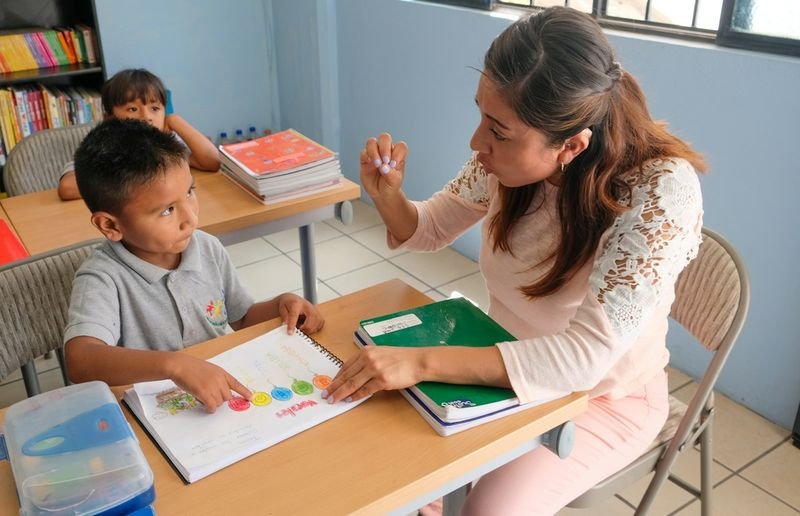
One technique documented by Massachusetts’ SLIFE Community of Practice involves a student named Mateo, who told his classmates a story in a mix of English and Spanish during a small-group discussion. He then retold the same story a second time while a teacher or peer transcribed it word for word. Mateo practiced reading back his own transcribed words — text that matched exactly how he already spoke. That’s the core idea behind what ESL teachers call the Language Experience Approach: literacy instruction built from the student’s own oral language instead of a disconnected textbook passage.
It works because the student isn’t decoding unfamiliar vocabulary and unfamiliar grammar at the same time. The words are already theirs. All that’s new is seeing them on a page.

8. Watch for Trauma Signals and Loop in Support Early
Factors behind interrupted education — war, displacement, housing insecurity, chronic illness — don’t stay behind a student once they’re enrolled. A SLIFE student who seems withdrawn, easily startled, or inconsistent day to day may be dealing with something that a literacy gap alone doesn’t explain. Flag it to a counselor or support team early rather than assuming it will resolve once the English improves. Academic support and emotional support for these students aren’t separate tracks; they run on the same timeline.
This doesn’t mean treating every quiet SLIFE student as a trauma case — most aren’t, and assuming otherwise is its own kind of mislabeling. It means not ruling it out just because a student is making steady academic progress on paper.
Ke Mana Harus Melangkah Selanjutnya?
Most of what makes SLIFE instruction work isn’t a new curriculum — it’s a shift in what you assume a quiet, behind-grade-level student actually needs. Start with the conversation instead of the test, keep oral language ahead of written work, and don’t let age placement and literacy level fight each other. None of this works in isolation, either — loop in your school’s support staff and co-teachers early, the same way we cover in co-teaching with local teachers, so the SLIFE student isn’t relying on one overloaded ESL teacher to carry the entire plan.
Sumber
- Massachusetts Department of Elementary and Secondary Education — Students With Limited or Interrupted Formal Education (SLIFE): Guidance for Identification, Services, and Support (June 2024) — definitions, identification criteria, and classroom vignettes.
- U.S. Department of Education — Newcomer Tool Kit — program design guidance for students with interrupted formal education.




 ID
 EN
 ZH
 ZH_CN
 KO
 VI
 FR
 AR
 ES
 HI
 PT
 BN
 RU
 JA
 TR
 DE
 IT
 PL
 TH
 FA
 UK
 TL
 HE
 UR
 SW
 RO
 NL
 MS
 TA
 PS
 HU
 EL
 SV
 NB
 NN
 DA
 CS
 SR
 AM