
Corrective Feedback in ESL: 9 Techniques That Work
Corrective feedback in ESL is the single classroom move that decides whether students walk out fluent or fossilized. After twenty years teaching English in Taipei cram schools, I can tell you the worst lesson I ever gave wasn’t the one where I corrected too much — it was the one where I corrected nothing, sent the kids home happy, and watched them repeat the same broken pattern for a year. Corrective feedback in ESL is the deliberate, calibrated act of letting students know — sometimes loudly, sometimes silently — that a form needs to change. Done well, it accelerates acquisition. Done badly, it shuts mouths.

This guide walks through nine techniques I actually use, when each one fits, and the tradeoffs nobody mentions in pre-service training. Every example is field-tested with real Taiwanese students from kindergarten to adult conversation classes.
What Corrective Feedback in ESL Actually Means
Corrective feedback is any teacher response that indicates a learner utterance contained a linguistic error. Lyster and Ranta’s 1997 observational study of French immersion classrooms — still the most-cited paper in the field — identified six categories that have become the standard taxonomy: recasts, explicit correction, elicitation, clarification requests, metalinguistic feedback, and repetition. Subsequent research added written feedback variants and peer-mediated approaches.
The research consensus, as summarized in Bitchener’s 2005 study published in the Journal of Second Language Writing, is that feedback works. The harder question is which type, for which error, with which student. Beginners need different feedback than C1 adults. Grammar errors warrant different treatment than discourse errors. A student who freezes when corrected needs a softer hand than one who shrugs it off.
The truth most teacher-training programs skip is that no single technique wins. The skilled ESL teacher carries all nine in their pocket and pulls the right one in the right moment. Below are the nine, ranked roughly by how often I reach for them in a typical week.
1. Recasts: The Default Move (and Its Hidden Cost)
A recast is when the teacher repeats the student’s utterance in correct form without flagging that anything was wrong. Student says “He go to store yesterday.” Teacher replies, “Right, he went to the store yesterday — what did he buy?” The conversation flows. The model is offered. Nobody is embarrassed.
Recasts are the most common form of corrective feedback in the wild, accounting for over half of teacher correction moves in most classroom studies. They are also, according to Lyster’s follow-up research, among the least noticed by students. Learners often interpret the recast as a confirmation of meaning rather than a correction of form — they take the “right” at face value and miss the grammar.
I still use recasts heavily with low-level kids who would shut down under direct correction. But for high-intermediate students working on a target structure, recasts are too soft. If you want them to notice the correction, you need to make it impossible to miss.

2. Explicit Correction: When Clarity Beats Subtlety
Explicit correction names the error and supplies the fix. “We don’t say ‘he go.’ We say ‘he went’ because it’s past tense.” It is unmistakable, easy to record in a notebook, and — when delivered with warmth — surprisingly well tolerated by adult learners who paid to be corrected.
The risk is interruption. If you stop a student mid-flow every time they misuse a preposition, you teach them that fluency is dangerous. Reserve explicit correction for the target form of the day — the structure you actually taught in the warm-up — and let smaller errors slide until later. My rule: explicit correction works best in controlled practice and presentation stages, not during free conversation.
One more thing. Explicit doesn’t mean cold. The tone is “let me help you with this,” not “you got that wrong.” Students hear the difference.
3. Elicitation: Pull the Correction Out of the Student
Elicitation reframes the error into a prompt. Student says “I have went to Japan three times.” Teacher pauses and says, “I have…?” with rising intonation, eyebrow raised, waiting. Nine times out of ten the student self-corrects to “been.” If they don’t, you escalate to a hint: “Have plus past participle. Have b…?”
Elicitation is the technique that produces the strongest acquisition gains in Lyster’s data, because the student does the cognitive work. The downside is time. A single elicitation move can take fifteen seconds, and in a class of twelve, that adds up. I use elicitation when I’ve already taught the form and want to verify it’s stuck.
If you want a deeper toolkit for prompting students into producing the right form, my guide to concept checking questions in ESL shows you 35 examples you can drop into any lesson.
4. Delayed Correction: The Whiteboard Trick I’ve Used for 20 Years
This is the technique I would not teach without. During fluency activities — discussions, role-plays, presentations — I stop interrupting completely. Instead I sit at the back of the room with a notepad and write down every interesting error. At the end of the activity, I copy six to eight errors onto the whiteboard, anonymous, and the class works together to fix them.
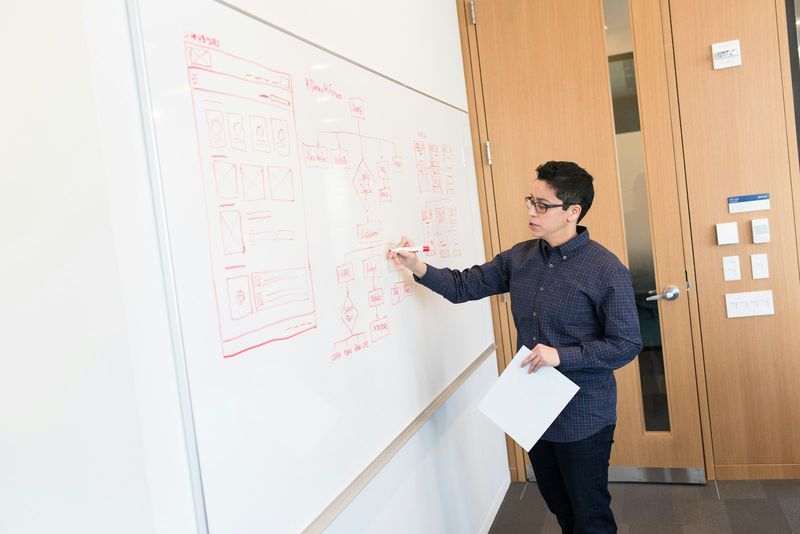
Delayed correction solves the central tension of feedback. It lets students experience real fluency without interruption, then turns their mistakes into the lesson content itself. Students cannot identify who said what, so nobody is embarrassed. And because they fix the errors as a group, the cognitive engagement is high.
The format matters. Write the error exactly as the student said it. Below it, draw an arrow and leave the correction blank. Then call on volunteers. If the class is stuck, give the metalinguistic hint — “this one is a verb tense problem” — and let them try again. Save five minutes at the end of every fluency activity for this. It is the single change that moved my advanced students the fastest.
5. Written Corrective Feedback: Direct vs. Indirect
Written feedback splits into two camps. Direct feedback supplies the correct form on the page: the teacher crosses out “he go” and writes “went” above it. Indirect feedback only marks the location of the error — usually with a code like VT for verb tense or SP for spelling — and asks the student to figure out the fix.
Bitchener’s 2005 study found that combining direct written feedback with a brief one-on-one conference produced significantly better retention than written-only correction. The pattern matches what I see in my own classes: students who get a single sentence of personal explanation alongside the written mark almost always self-correct that error on the next draft. Students who only see red ink usually repeat it.

For lower levels, go direct. They lack the metalinguistic vocabulary to decode error codes. For intermediate and above, indirect feedback with an error-code key on the wall produces stronger long-term gains because it forces the student to engage with the rule. My own marking ratio is roughly 70 percent indirect, 30 percent direct, weighted by what each error is teaching.
6. Peer Correction: Teaching Students to Catch Each Other
Peer correction is the most under-used technique in private-school ESL because teachers worry students will reinforce each other’s mistakes. In practice, with a structured rubric, the opposite happens. Students who learn to spot errors in their partner’s writing become measurably better at spotting them in their own.

The rubric is everything. Don’t say “find the mistakes.” Say “check three things: verb tense, subject-verb agreement, and prepositions of time. Mark each with the matching letter.” Constrain the search. A student given a focused checklist will outperform a teacher with a red pen on those three categories — and the writer who receives the feedback hears it differently from a peer than from a teacher. Pair this with structured discussion using ideas from my ESLスピーキング活動 guide and the social pressure does the rest.
7. Self-Correction: The Cue-and-Wait Method
Self-correction is the destination. Every other technique on this list is a scaffold toward the moment a student says “He go… I mean, he went” without any teacher input. To get there, you cue and wait.
The cue can be a gesture: a circular hand motion that the class learns means “back up and try again.” It can be a single word: “tense?” or “agreement?” It can be a sound: “ehhh?” with a slight head tilt. The wait is the hard part. Three full seconds feels like an eternity. Take it anyway. Most students will produce the correction in those three seconds if you let them.

Students who learn to self-correct under classroom pressure carry that skill into real conversation. Students who only ever hear the teacher’s recast outsource the noticing to someone who isn’t there once the bell rings.
8. Clarification Requests: “Sorry, Can You Repeat That?”
Clarification requests are the most natural form of corrective feedback because real-world conversation partners use them constantly. You signal that the message didn’t get through — “I’m sorry?” or “What was that?” — without specifying what was wrong. The student rebuilds the utterance, usually fixing the error in the process.
This works beautifully for pronunciation errors and word-order tangles. It fails for tense errors, because the meaning usually got through even though the grammar was off, and the student has nothing to clarify. Use clarification requests for the kind of mistake that genuinely breaks communication — that is what trains students to monitor for intelligibility, the metric that matters most outside the classroom.
9. Metalinguistic Feedback: Coding Errors With Symbols
Metalinguistic feedback names the rule without supplying the fix. “There’s a problem with the article in sentence two.” “You need the past participle here.” It demands more from the student than explicit correction but less than full elicitation.

I rely on metalinguistic feedback for any structure I have explicitly taught. The phrasing matches the rule we covered in class, which reactivates the original presentation. If a student looks blank when I say “present perfect,” that tells me the original lesson did not stick — useful diagnostic information I would never get from a recast. Pair metalinguistic feedback with targeted practice from a quick warm-up routine like the ones in my ESL grammar games collection and the form usually locks in within a week.
When to Correct — and When to Let It Go
The four variables that decide whether to correct any specific error are: lesson stage, error type, student affect, and frequency. In presentation and controlled practice, correct nearly everything connected to the target form. In free production, correct only what blocks comprehension or matches the target form. Errors that are above the student’s current proficiency — a beginner reaching for the past perfect — get noted in your delayed-correction notepad and tactically ignored in the moment.
Affect matters more than most ESL training programs admit. A student who has been silent for three weeks and finally produces a flawed sentence should not be corrected on that sentence. A student who has been winging it confidently for months should be corrected on every sentence that touches the target form. Read the room. The same error from two different students warrants two different responses.
Frequency is the cleanest filter. If three students make the same error inside ten minutes, stop and address it as a class. If one student makes a one-off slip on something they usually get right, log it and move on. The errors worth correcting are the ones that repeat. The rest is noise.
A Sample Lesson: How These Techniques Fit Together
Here is a real sequence I teach in my Saturday adult class, targeting the present perfect for life experiences.

Warm-up is a quick concept-check on the rule. Presentation uses explicit correction — every error on the target structure is named and fixed. Controlled practice (a have-you-ever survey in pairs) uses elicitation, because students should now be able to self-correct with a nudge. Free practice (a five-minute speed-dating round about travel) uses delayed correction; I sit out and take notes. Wrap-up puts six errors on the whiteboard and the class fixes them together. Homework is a paragraph; I mark it with metalinguistic codes and they bring back a revised version next week.
That sequence walks every student from “I never use this form” to “I use it without thinking” in roughly three lessons. The techniques are sequenced from most supportive to least supportive on purpose. That progression — not the technique itself — is what produces durable acquisition. Pair this approach with the principles in my guide to コミュニケーション重視の言語教育 and you have a complete framework for moving students from accuracy to fluency without losing either.
Pick two techniques you don’t currently use. Try them next week. Notice which students respond and which freeze. Adjust. Corrective feedback in ESL is a craft, not a script — the teachers who get it right are the ones who keep experimenting until something clicks.
情報源
- Bitchener, J. (2005). The effect of different types of corrective feedback on ESL student writing. Journal of Second Language Writing, 14(3), 191–205. — Foundational study on combining written feedback with conferencing.
- Lyster, R., & Ranta, L. (1997). Corrective feedback and learner uptake. Studies in Second Language Acquisition, 19(1), 37–66. — The classic taxonomy of six feedback types every teacher should know.
- Edutopia — A Strategy for Giving Corrective Feedback to ELLs. — Practical classroom routines that pair correction with confidence building.
- U.S. Department of State — Strategic Corrective Feedback in the EFL Classroom. — Free professional development resource summarizing SLA research for working teachers.
- CARLA (University of Minnesota) — Types of Corrective Feedback. — Concise reference sheet defining each technique with sample teacher language.
Looking for free ESL worksheets? Browse our full collection — printable resources for every level and age group. Browse Free Worksheets →
Students can access free worksheets and reading materials at 18KEnglish.com.





 JA
JA  EN
EN  ZH
ZH  ZH_CN
ZH_CN  KO
KO  VI
VI  FR
FR  AR
AR  ES
ES  HI
HI  PT
PT  BN
BN  RU
RU  TR
TR  DE
DE  IT
IT  PL
PL  ID
ID  TH
TH  FA
FA  UK
UK  TL
TL  HE
HE  UR
UR  SW
SW  RO
RO  NL
NL  MS
MS  TA
TA  PS
PS  HU
HU  EL
EL  SV
SV  NB
NB  NN
NN  DA
DA  CS
CS  SR
SR  AM
AM