
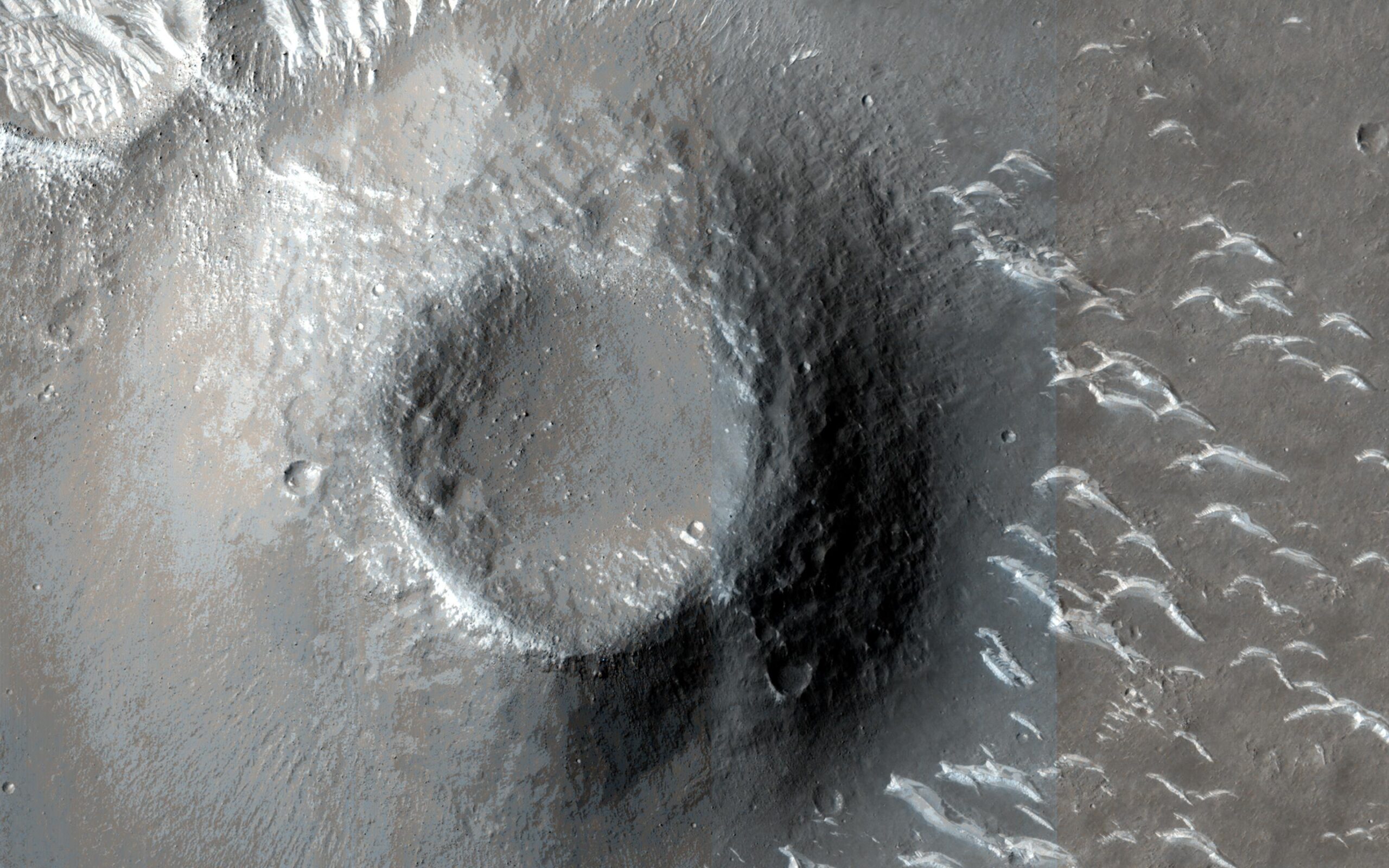
“What China Found on Mars — Part 2: Modern Water, Dunes & the Habitability Question”
What China Found on Mars
Part 2: Modern Water Signs, Sand Dunes & Could Life Exist?
ESL Science Worksheet | Grades 9–12
읽기 지문
Most people assume Mars is completely dry today. After all, the surface looks like a cold, lifeless desert — reddish rocks, howling dust storms, and no liquid water in sight. But China’s Zhurong rover has revealed something surprising: signs of water activity that may be far more recent than scientists expected.
Water in the Dunes — A Shocking Find
As Zhurong rolled across Utopia Planitia, it analyzed sand dunes using its spectrometer. The results were startling. The dune surfaces were rich in:
- Hydrated sulfates — minerals that form when sulfur compounds react with water
- Hydrated silica (opal-CT) — a form of opal that contains water in its crystal structure
- Ferrihydrite — an iron oxide mineral that typically forms in the presence of water
- Possible chlorides — salt-like minerals associated with evaporated water
These are not the minerals you’d expect on a completely dry planet. They are hydrated minerals — compounds that chemically bonded with water molecules when they formed. Their presence suggests that liquid water existed in these dunes in Mars’ relatively recent past.
How Does Water Form in a Desert?
You might wonder: how can liquid water exist on a planet where the average temperature is −60°C (−76°F) and the atmosphere is 100 times thinner than Earth’s?
The answer: salt.
Salts mixed into Martian soil act as a powerful antifreeze. When frost or snow falls on salty sand, the salt lowers the freezing point enough to create thin films of briny liquid water — even at temperatures far below 0°C. This process is called deliquescence.
Here’s the cycle Zhurong’s data revealed:
- Frost or snow falls on salty dune surfaces
- Salt causes it to partially melt, forming saline (salty) liquid water
- The liquid soaks into the sand and reacts with minerals
- As temperatures rise, the brine evaporates — leaving behind hydrated minerals like opal and ferrihydrite
- The dried crust cracks from shrinkage
- The cracks fill again with the next frost cycle — creating distinctive polygonal ridges on the surface
These polygonal surface patterns were visible in Zhurong’s surface imagery — a telltale signature of repeated freeze-thaw cycles involving liquid water.
How Recent Is “Recent”?
This is where things get truly remarkable. Previous estimates suggested Mars lost its liquid water roughly 2–3 billion years ago. But data from Zhurong pushed that timeline dramatically forward.
A study published in National Science Review concluded that water activity on Mars may have continued until as recently as 750 million years ago — more than a billion years later than previously thought. This means:
- Mars was wet and potentially habitable far longer than we knew
- The transition from wet to dry Mars was slower and more gradual
- Water may still exist in some form below the surface today
Pitted Cones and Mud Volcanoes
Zhurong also spotted strange geological features: pitted cones — small conical hills with a depression (pit) at the top. On Earth, similar features are associated with mud volcanoes, which form when pressurized water or gas forces its way up through soft sediment.
The presence of pitted cones on Mars suggests that water or ice once existed beneath the surface in the Utopia Planitia region — and that underground pressure occasionally pushed it toward the surface, much like a muddy volcanic vent.
What Does This Mean for Life?
Astrobiology is the science of studying the potential for life beyond Earth. Zhurong’s findings are highly relevant to this field. Here’s why:
1. Liquid water is essential for all known life. Every living organism on Earth requires liquid water to survive and reproduce. Finding evidence that Mars had abundant liquid water — and may still have traces of it — makes Mars a more plausible candidate for past (or even present) microbial life.
2. The timeline overlap matters. Life on Earth appeared roughly 3.5–3.8 billion years ago. Mars appears to have had liquid water at that same time. If life arose on Earth under those conditions, it’s worth asking: could it have arisen on Mars too?
3. Subsurface refuges. Even today, Mars may harbor liquid water deep underground — kept liquid by geothermal heat and dissolved salts. Some scientists speculate that if Martian microbial life exists, it has retreated underground to survive.
4. Utopia Planitia as a target. Because Zhurong’s landing site shows evidence of ancient ocean floors, buried beaches, and recent water chemistry, it is now considered one of the most important regions on Mars for future sample-return missions.
The Broader Picture
Zhurong’s discoveries don’t prove life existed on Mars. But they systematically close the gap between “Mars was always dry and dead” and “Mars was wet enough, long enough, to possibly support life.” Each piece of evidence — ancient beaches, hydrated dune minerals, polygonal frost patterns, mud volcano cones — builds a stronger case that Mars and Earth were far more similar than we once thought.
As Hai Liu, the Guangzhou University scientist, put it: “This strengthens the case for past habitability in this region on Mars.”
Section A: Vocabulary
Define each term in your own words, based on the passage.
- Hydrated mineral: _____________
- Deliquescence: _______________
- Saline: __________________
- Ferrihydrite: _________________
- Polygonal ridges: _____________
- Pitted cones: ________________
- Mud volcano: ________________
- Astrobiology: ________________
- Deliquescence cycle: ______________
- Geothermal heat: ________________
Section B: Comprehension Questions
- Name three types of hydrated minerals Zhurong found in Martian sand dunes. Why is their presence significant?
- Explain the role of salt in creating liquid water on Mars. How does this process work?
- Describe the five-step cycle that Zhurong’s data revealed involving frost, salt, and mineral formation on Martian dunes.
- What is the updated timeline for water activity on Mars, according to the National Science Review study? Why is this surprising?
- What are pitted cones, and what do they suggest about Mars’ geological past?
- Why is the timing of water on Mars significant for the question of whether life could have existed there?
Section C: Fill in the Blank
단어 목록: 750 million / deliquescence / ferrihydrite / opal-CT / −60°C / polygonal / astrobiology / pitted cones / saline / subsurface
- Mars has an average surface temperature of _____, making liquid water seem impossible.
- The process by which salt causes frost to melt into liquid is called _____.
- The brine (salty liquid) that forms on Martian dunes is called _____ water.
- _____ is a form of iron oxide that typically forms only in the presence of water.
- _____ is a form of opal that contains water in its crystal structure.
- When the briny water evaporates, its crust dries, shrinks, and cracks into _____ ridge patterns.
- Conical hills with depressions at the top, called _____, suggest underground water or gas pressure.
- Water activity on Mars may have continued until _____ years ago — far longer than expected.
- The science of studying the potential for life beyond Earth is called _____.
- Scientists believe that if microbial life exists on Mars today, it may have retreated to _____ environments.
Section D: Data Analysis
Study the timeline below and answer the questions.
“` MARS WATER TIMELINE ━━━━━━━━━━━━━━━━━━━━━━━━━━━━━━━━━━━━━━━━━━━━━━━━━━ 4.0B yrs ago → Mars has liquid water ocean (ancient estimate: still accepted) 3.5B yrs ago → Life appears on Earth 3.4B yrs ago → Mars ocean largely evaporates / freezes 2.5B yrs ago → (Old estimate: Mars loses all liquid water) 0.75B yrs ago → (New estimate from Zhurong: last significant water activity) Present → Mars surface: dry, frozen, thin atmosphere ━━━━━━━━━━━━━━━━━━━━━━━━━━━━━━━━━━━━━━━━━━━━━━━━━━ “`
- By how many years did Zhurong’s findings push back the estimated end of liquid water on Mars? ______
- How long after life first appeared on Earth did Mars still have significant water activity? ______
- What is the overlap period (in years) when both Earth had early life AND Mars may have had liquid water? ______
- Based on this timeline, write one sentence arguing that Mars could have had life, and one sentence arguing it probably did not.
For life: __________________
Against life: __________________
Section E: Critical Thinking
Answer in 4–6 sentences each.
- Extraordinary claims require extraordinary evidence is a famous principle in science. Applying this principle: how strong is the current evidence for past life on Mars? What additional evidence would be “extraordinary enough” to convince most scientists?
- If briny water can still form on Mars through deliquescence today, why haven’t we detected active microbial life on the surface? What challenges would any organism face on the Martian surface right now?
- China succeeded on its first Mars landing attempt. The U.S., USSR/Russia, and Europe all had failures before succeeding. What does it mean for global science that more countries are reaching Mars? Is space exploration better as collaboration or competition? Defend your view.
Section F: Extended Essay (Choose One)
Write a well-organized essay of 3–4 paragraphs.
Option 1 — The Case for Life: Using evidence from BOTH Part 1 and Part 2 of this worksheet series, construct the strongest possible argument that Mars once harbored microbial life. Address at least three pieces of evidence, explain what would need to be true for life to have existed, and acknowledge the limits of the current evidence.
Option 2 — The Next Mission: You are a planetary scientist advising NASA or ESA on the next Mars mission. Based on everything Zhurong has found, where should the next rover land, and what should it look for? Design your mission rationale using specific details from the passage.
Option 3 — Comparative Planetology: Mars and Earth are neighboring planets that formed from the same materials at roughly the same time. Yet one became a living world and one became a desert. Using evidence from this worksheet, explain what Mars had, what it lost, and why the difference matters for how we understand Earth’s own fragility.
Source: Based on findings from China’s Tianwen-1 mission (Zhurong rover), 2021–2025. References: Space.com, Science Advances, National Science Review, PNAS, The Debrief, EarthSky.




 KO
KO  EN
EN  ZH
ZH  ZH_CN
ZH_CN  VI
VI  FR
FR  AR
AR  ES
ES  HI
HI  PT
PT  BN
BN  RU
RU  JA
JA  TR
TR  DE
DE  IT
IT  PL
PL  ID
ID  TH
TH  FA
FA  UK
UK  TL
TL  HE
HE  UR
UR  SW
SW  RO
RO  NL
NL  MS
MS  TA
TA  PS
PS  HU
HU  EL
EL  SV
SV  NB
NB  NN
NN  DA
DA  CS
CS  SR
SR  AM
AM