

10 Proven Classroom Management Strategies for ESL
In a 2023 Pew Research Center survey, 49% of American teachers rated the behaviour of most of their students as only “poor” or “fair.” Now add a language barrier. When learners can’t fully understand your instructions, follow a fast conversation, or ask for help in English, the ordinary friction of a classroom multiplies. That is exactly why classroom management strategies matter more in an ESL room than almost anywhere else — and why the teachers who plan for behaviour spend far less time policing it.

What Are Classroom Management Strategies in an ESL Setting?
Classroom management strategies are the systems a teacher uses to keep a lesson running — how you set expectations, organise the room, get attention, structure activities, and respond to behaviour. In a general classroom, most of this rides on shared language. In an ESL classroom, it can’t. Your beginners may not understand “settle down, please” or “work with a partner,” so every routine has to be taught, modelled, and drilled the same way you’d teach a grammar point.
Researchers who study English-language teaching usually split management into three areas: the physical environment (seating, sightlines, materials), the psycho-social side (rules, feedback, incentives), and activity management (pacing, monitoring, and running pair or group work). The strategies below cover all three. The truth is, most “behaviour problems” in an ESL room aren’t defiance at all — they’re a student who got lost two instructions ago and checked out.
10 Classroom Management Strategies That Actually Work
These ten are ordered roughly the way you’d build a classroom: foundations first, then the moves you make lesson by lesson. You don’t need all ten running at full strength on day one. Pick the two or three that fix your biggest headache, get them automatic, then add more.
1. Teach the rules like you teach vocabulary
Posting a list of rules in English does nothing if half the class can’t read it fluently. Keep the rules to four or five, phrase them positively (“English only during games,” not “no Chinese”), and pair each one with a gesture or an icon. Then rehearse them. Have students act out “hand up to speak” on the first day. A rule a beginner has physically practised sticks; a rule they’ve only heard once is gone by Tuesday.

2. Build routines so the lesson runs itself
The same opening every day — greeting, quick warmer, then the objective on the board — tells learners what’s coming without a word of explanation. Routines carry enormous weight in a language classroom because they let students predict the shape of the lesson even when they can’t follow every sentence. Handing out books, forming groups, packing up: give each a fixed procedure and a signal, and you reclaim the ten minutes a day most classes lose to logistics.
3. Arrange the room around sightlines, not tradition
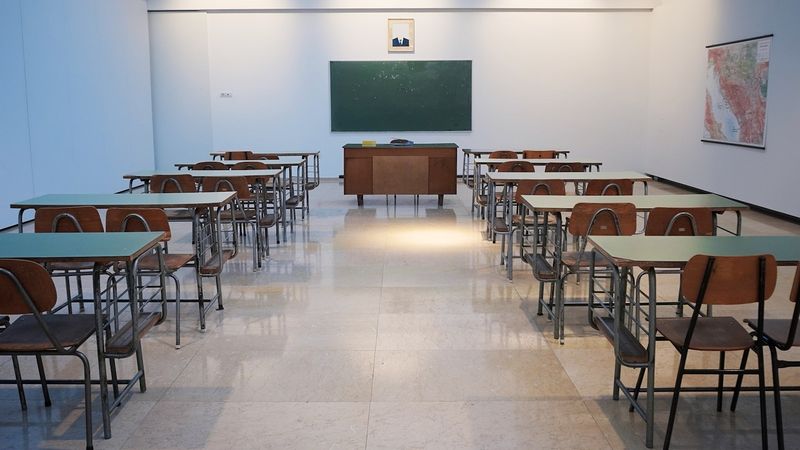
You should be able to make eye contact with every student, and every student should be able to see your mouth when you model pronunciation. Rows work for exams and heavy teacher-fronted input; a U-shape or clusters work for speaking practice. Whatever you choose, kill the blind spots — the back corner where a phone comes out is a seating-plan problem, not a discipline problem.
4. Use one clear attention signal — every single time
A raised hand, a chime, a call-and-response clap. Pick one, teach it explicitly, and never talk over the class to regain control. Shouting “okay, okay, listen” trains students that your voice is background noise. A silent signal that you wait out — arms folded until every hand is up — is slower for the first week and faster forever after. Nonverbal cues are gold in an ESL room precisely because they don’t depend on language the students may not have yet.
5. Reinforce the behaviour you want, out loud and specifically
“Nice work, table three — you switched to English the second I clapped” beats a generic “good job” and beats scolding the noisy table every time. Points, stamps, and team scoreboards work well with young learners because they make good behaviour visible and immediate. Positive-reinforcement research in EFL classrooms consistently links praise and clear incentives to higher engagement and lower anxiety. Catch them being good more often than you catch them being bad.
6. Structure talk time instead of hoping for it
“Discuss with your partner” produces silence from students who don’t yet have the language to launch. Give them the frame: a sentence starter, a role (“you ask, you answer, then switch”), a time limit, and a clear end signal. Well-designed pair and group activities are one of the strongest management tools you have, because a student who is busy talking is a student who isn’t disrupting.

7. Keep the pace tight and cut the dead air
Boredom is the number-one cause of misbehaviour in a language class, and dead air is where boredom lives. If you’re spending ninety seconds explaining an activity that takes two minutes to do, students will fill the gap themselves. Trim your instructions, model instead of describe, and lean on shorter activities with visible finish lines. This ties directly into managing your own airtime — see our guide to reducing teacher talking time for the mechanics.
8. Give instructions in chunks, then check they landed
A beginner cannot hold a five-part instruction in a second language. Break it into single steps, demonstrate each, and use concept-checking questions instead of “Do you understand?” — a question every student answers “yes” to whether they mean it or not. Ask “How many minutes? Do you write or speak? Alone or with a partner?” The thirty seconds this takes prevents the two minutes of chaos that follow a botched setup.
9. Differentiate so no one is stranded
Half your disruption comes from students who are lost and students who finished early. Both are bored. Prepare a simpler version and an extension for every core task, and have fast finishers help slower peers — teaching a point is the best way to cement it. Our breakdown of differentiated instruction strategies covers how to do this without writing three separate lesson plans.

10. Stay calm and keep the relationship intact
How you respond to a problem teaches the class more than the rule itself. Address the behaviour, not the child; use proximity — just standing near a distracted student often resets them — and handle bigger issues in a quiet word after class, never a public showdown a beginner can’t defend themselves in. Students work harder for a teacher they believe is on their side, and that goodwill is the cheapest classroom management tool there is.
What Causes Most Behaviour Problems in an ESL Classroom?
Studies of foreign-language classrooms point to three recurring triggers: academic difficulty (the work is too hard or the instructions unclear), attention-seeking, and unmet individual needs. Notice that two of the three are things you control. A task pitched at the right level with a clean setup removes most academic-difficulty disruption before it starts. That reframes the job: you’re not managing bad kids, you’re managing the conditions that make good kids act out.
The attention-seeking bucket is where relationships pay off. A student who gets positive attention for effort rarely needs to earn negative attention by acting up. This is also why gamifying parts of your lesson works so well — it channels the drive for attention into scoring points for the team instead of clowning for the class.
How Do You Manage a Class of Young Learners Versus Teens?
Young learners need shorter activity cycles, more movement, and heavy use of visuals and total physical response — a five-year-old cannot sit through a fifteen-minute grammar explanation, and expecting it guarantees a meltdown. Point systems and star charts land well here because the reward is concrete and immediate.
Teenagers respond better to autonomy and fairness. Rules imposed without reason invite pushback, so involve them in setting a few norms and be scrupulously consistent — a teen will forgive a strict teacher but never a hypocritical one. Save the public praise for effort rather than ability, which can embarrass older students in front of peers.

Common Classroom Management Mistakes to Avoid

The most common error is being reactive — waiting for problems and then punishing them, instead of designing lessons that don’t produce them. Close behind is inconsistency: a rule enforced on Monday and ignored on Friday is worse than no rule, because it teaches students that the line moves. Talking over noise, giving instructions in one long block, and negotiating with a disruptive student mid-lesson round out the list. Every one of them trades a calm classroom later for a shortcut now.
One more that hits new ESL teachers hard: defaulting to the students’ first language to keep order. It works in the moment and quietly kills the English environment you’re being paid to build. Keep classroom management in English wherever you can — the routines and signals above exist precisely so you don’t have to reach for a translation to run the room.
Watch: Classroom Management Strategies in Action
This short walkthrough from an experienced ESL teacher demonstrates several of the strategies above — signals, point systems, and nonverbal cues — in a real classroom setting.
پوښتل شوې پوښتنې
What is the single most important classroom management strategy? Prevention through clear routines. A classroom where students always know what’s expected and what comes next has very little left to disrupt.
How do I manage a class when students don’t understand my English? Lean on modelling and nonverbal signals over spoken instructions, break every direction into single steps, and check understanding with concept questions rather than “Do you understand?”
Should I use rewards and punishments? Favour rewards. Specific praise and visible point systems build the behaviour you want; punishment only tells students what to stop, not what to do instead, and it raises anxiety that hurts language learning.
How long does it take to see results? Give a new routine two solid weeks of consistent enforcement before you judge it. Most strategies feel slower at first and then save you time every lesson after.
Start with one strategy this week — the attention signal is the fastest win — and add another once it’s automatic. Well-run classrooms aren’t run by teachers with more authority; they’re run by teachers who removed the confusion and dead time that make students act out. For the next piece of the puzzle, work through our guide to cutting your teacher talking time, because the quieter you are, the busier — and better behaved — your students become.
سرچینې
- Pew Research Center — What’s It Like To Be a Teacher in America Today — 2023 survey data on student behaviour ratings by teachers.
- Journal of English Language Teaching and Linguistics — Exploring the Effects of EFL Classroom Management Strategies — research on positive management and learner engagement.
- Effective Classroom Management in the EFL Classroom — peer-reviewed overview of physical, psycho-social, and activity management.
Looking for free ESL worksheets? Browse our full collection — printable resources for every level and age group. Browse Free Worksheets →
Students can access free worksheets and reading materials at 18KEnglish.com.









 PS
PS  EN
EN  ZH
ZH  ZH_CN
ZH_CN  KO
KO  VI
VI  FR
FR  AR
AR  ES
ES  HI
HI  PT
PT  BN
BN  RU
RU  JA
JA  TR
TR  DE
DE  IT
IT  PL
PL  ID
ID  TH
TH  FA
FA  UK
UK  TL
TL  HE
HE  UR
UR  SW
SW  RO
RO  NL
NL  MS
MS  TA
TA  HU
HU  EL
EL  SV
SV  NB
NB  NN
NN  DA
DA  CS
CS  SR
SR  AM
AM