
English Idioms: School and Learning — 10 Expressions You Need to Know
Every classroom develops its own private vocabulary for the ups and downs of getting an education, and English has built up an especially colorful set of these expressions. When a student finally makes the grade, aces an exam, or admits to cramming the night before a test, they’re reaching for idioms that have circulated through schoolrooms, universities, and workplaces for well over a century. These phrases survive because they compress a whole scene — a train struggling up a hill, a lottery ticket with nothing printed on it, a kid sneaking off down an alley — into three or four words that every native speaker instantly understands.
This week’s idioms guide collects ten essential school and learning expressions, grouped by what they describe — meeting a standard, racing against the clock, choosing an approach to teaching, losing your train of thought, and finally getting through to the other side. For each one you’ll find a clear meaning, the real story behind where it came from, and two natural example sentences you can bring straight into your next lesson.

Why Teach School and Learning Idioms?
Idioms about school are some of the easiest to teach because every learner has lived through the experience they describe, whether that experience happened in Taipei, Toronto, or anywhere else. Ask a class whether they’ve ever had to cram for a test the night before, or whether they know someone who used to play hooky, and you’ll get instant recognition and usually a story to go with it. That built-in relevance makes these expressions stick faster than idioms tied to customs students have never encountered firsthand.
They also travel well beyond the classroom. A manager might say a new hire is a quick study, a colleague might warn that a new software platform has a steep learning curve, and a mentor might describe their own career as the school of hard knocks. Recognizing these expressions means recognizing how English speakers talk about learning anything, at any age, long after graduation. Below are ten of the most useful school and learning idioms, moving from meeting a standard all the way to coming out the other side.
Hitting the Books

1. Make the grade
Significado: To succeed, or to reach the standard required for something.
Origem: The phrase comes from nineteenth-century American railroad engineering, where a “grade” is the slope of track a train has to climb. A locomotive powerful enough to pull its cars up a hill without stalling or needing a second engine was said to “make the grade.” By the early twentieth century, newspapers and schools had borrowed the image figuratively, so that any student, employee, or plan that met the required standard was described the same way.
Exemplos:
- She studied every night for a month, determined to make the grade on the entrance exam.
- Only three of the fifteen applicants made the grade for the scholarship interview.
2. Ace an exam
Significado: To perform extremely well on a test, earning a very high score.
Origem: “Ace” borrows from card games, where the ace is the highest-ranking card in most Western decks, and from tennis, where an unreturnable serve is called an ace. American slang had turned “ace” into a verb for doing something perfectly by the mid-twentieth century, and it attached itself naturally to exams, interviews, and auditions — anywhere a top score was on the line.
Exemplos:
- He barely studied, yet somehow he aced the exam.
- If you review the practice questions tonight, you’ll ace the test tomorrow.
Racing the Clock

3. Cram for a test
Significado: To study intensely over a short period of time, usually the night before an exam.
Origem: “Cram” has meant to pack or stuff something tightly since Old English, and by the mid-1800s, students at Oxford and Cambridge were using it as slang for forcing large amounts of information into their heads right before an examination. The image of stuffing a suitcase too full carried over neatly to stuffing a brain too full, and the word has described last-minute studying ever since.
Exemplos:
- I stayed up until 3 a.m. cramming for my chemistry final.
- Cramming for a test the night before rarely works as well as studying a little each day.
4. A steep learning curve
Significado: A skill or subject that requires a lot of effort to learn in a short amount of time.
Origem: The “learning curve” dates to the 1880s, when psychologist Hermann Ebbinghaus graphed how quickly people improved at memorizing nonsense syllables with repeated practice. The concept was adopted by 1930s aircraft manufacturers tracking how production efficiency rose the more planes a factory built. In those original graphs, a steep curve actually meant fast learning, but everyday English later flipped the phrase to mean the opposite: something steep and difficult to climb.
Exemplos:
- Switching to the new accounting software was a steep learning curve for the whole office.
- The first month of medical school is a steep learning curve for almost every student.
Watch: School and Learning Idioms in Action
Want to hear these expressions explained by a native speaker? This video walks through everyday idioms about school and education — a useful listening follow-up to today’s lesson.
Old-School Methods, New Thinking
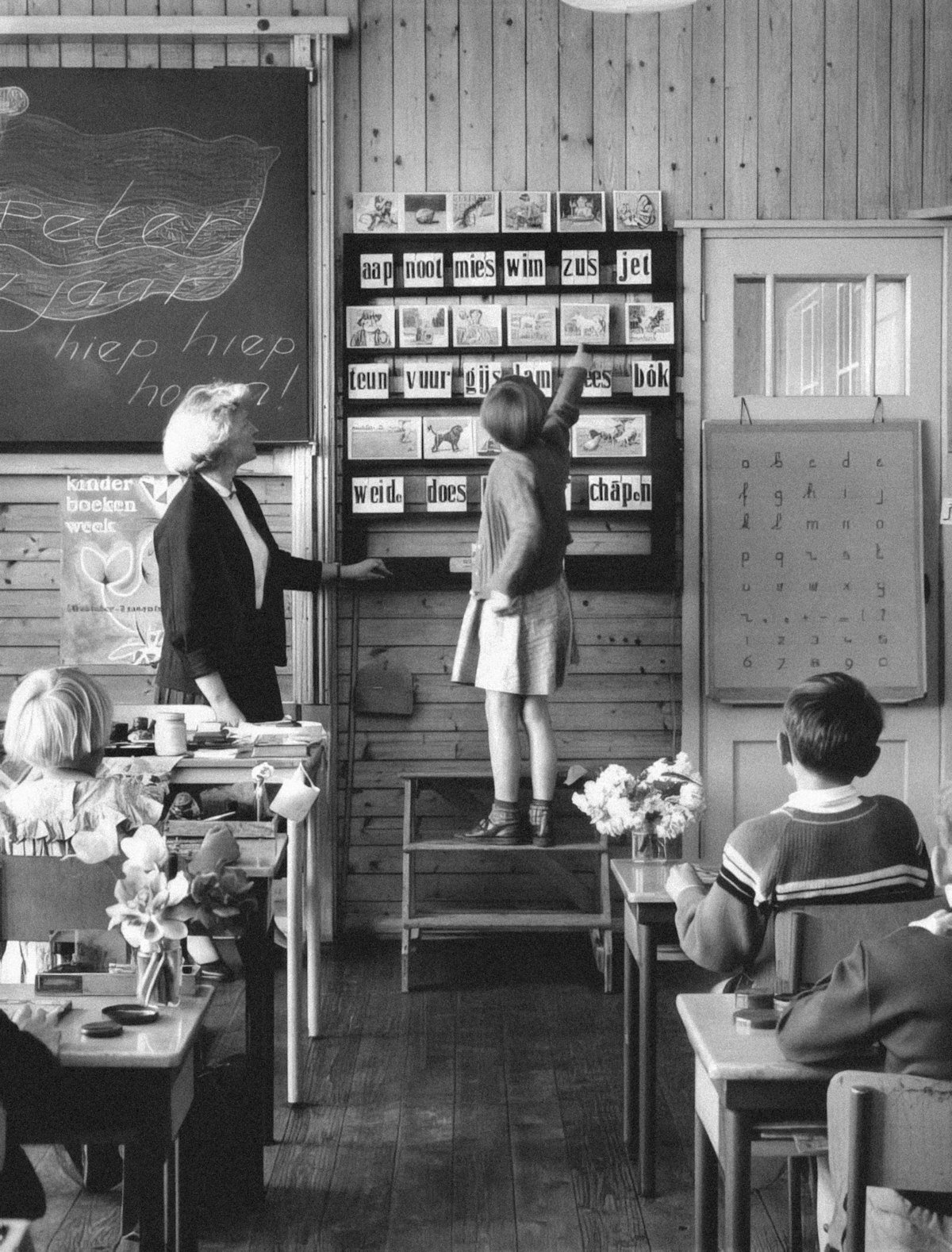
5. Old school
Significado: Traditional, old-fashioned, or based on methods from an earlier era — often used approvingly.
Origem: In nineteenth-century Britain, “old school” referred literally to the school a man had attended as a boy, and loyalty to it signaled a certain traditional, conservative outlook. American slang, especially within 1970s and 80s hip-hop culture, broadened the phrase into a general compliment for anything from an earlier, respected era — music, fashion, or a teacher’s classroom methods.
Exemplos:
- Her grandfather is old school; he still insists students memorize their multiplication tables by hand.
- This gym is old school — no machines, just free weights and a chalkboard of workouts.
6. Put your thinking cap on
Significado: To start thinking hard and seriously about a problem.
Origem: In medieval England, judges wore a solemn black “cap of judgment” when pronouncing a serious sentence, a tradition tied to the gravity of careful deliberation. By the nineteenth century, American teachers had softened that image into something playful, telling students to “put their thinking caps on” before a difficult question, and the encouraging classroom phrase has stuck ever since.
Exemplos:
- Before the quiz, the teacher told the class to put their thinking caps on.
- This riddle is tricky — you’ll need to put your thinking cap on for this one.
When Your Mind Goes Blank

7. Draw a blank
Significado: To be unable to remember or think of something, especially when put on the spot.
Origem: Eighteenth-century English lotteries sold tickets printed with either a prize or nothing at all; the losing tickets were literally called “blanks.” Drawing one from the box meant winning nothing, and by the nineteenth century the phrase had broadened to cover any search, including a mental one, that comes up empty.
Exemplos:
- She knew the answer the night before, but the moment the teacher called on her, she drew a blank.
- I drew a blank on his name even though we’d met three times before.
8. Play hooky
Significado: To skip school or work without permission or a valid excuse.
Origem: This is American slang from the mid-1800s, generally traced to the older expression “hook it,” meaning to escape or sneak away, related to “hooky” as something crooked or not straight — in other words, not going where you’re supposed to go. The phrase caught on in American schoolyards and has described unofficial absences ever since.
Exemplos:
- The two boys played hooky on the first warm day of spring and went fishing instead.
- He got caught playing hooky when his teacher called his mother to ask why he’d missed class.
Finishing What You Started

9. Quick study
Significado: Someone who learns or picks up new information unusually fast.
Origem: The phrase comes from the theater, where an actor’s memorized role is traditionally called their “study.” A performer who could learn a new part in record time was praised as “a quick study,” a label documented in English and American theater slang since at least the late 1800s. The expression later spread beyond the stage to describe fast learners in any field.
Exemplos:
- The new intern is a quick study — she picked up the entire filing system in a single afternoon.
- He’s always been a quick study with languages, picking up basic conversation within weeks.
10. School of hard knocks
Significado: Learning through difficult life experience rather than formal education.
Origem: This is American slang from the early twentieth century, popularized in vaudeville and working-class culture, where “knocks” meant hits or blows — setbacks, failures, hard luck. Instead of a classroom with books and teachers, the “school of hard knocks” teaches its lessons through struggle, and graduating from it means having survived enough hardship to know better.
Exemplos:
- He never finished college, but he learned business the hard way, through the school of hard knocks.
- Growing up, she had no mentors — everything she knows came from the school of hard knocks.
How to Practice School and Learning Idioms

The fastest way to make these idioms stick is to connect them to real memories students already have. Ask learners to describe a time they had to cram for a test, or to admit whether they ever played hooky and what happened when they got caught. A quick role-play works well too: have one student play a worried parent asking why their child’s grades slipped, and have the other answer using at least one idiom from today’s lesson — drew a blank, a steep learning curve, the school of hard knocks.
For homework, ask students to write a short paragraph about their most memorable school experience, trying to fit in as many of this week’s idioms as they naturally can. If you’re looking for more classroom-ready vocabulary, pair this lesson with our guide to multiple intelligences in ESL teaching or browse the rest of our English idioms series for more themed vocabulary lists. Master these ten expressions and your students will be ready to talk about every stage of learning — from making the grade to surviving the school of hard knocks — with real native-level color.









 PT
 EN
 ZH
 ZH_CN
 KO
 VI
 FR
 AR
 ES
 HI
 BN
 RU
 JA
 TR
 DE
 IT
 PL
 ID
 TH
 FA
 UK
 TL
 HE
 UR
 SW
 RO
 NL
 MS
 TA
 PS
 HU
 EL
 SV
 NB
 NN
 DA
 CS
 SR
 AM