

Reading Comprehension: Axolotls, the Smiling Water Animals | Elementary ESL Worksheet PDF
A free elementary ESL reading comprehension worksheet (Level C, Grades 3–5) about the axolotl, the smiling water animal that can grow back a lost leg and lives in the wild only near Mexico City. The story is not on page 1: students predict and learn the key words first, read with a job to do, then retell and sum up. It is the practice sheet for our lesson guide 15 Best ESL Reading Comprehension Activities and follows its stages in order.
Free and classroom-ready: student pages plus a full answer key with sources.
How to Run This Lesson
- Before reading, Part A: predict from the title and one picture, brainstorm water-animal words and write a question to read for.
- Before reading, Part B: ten MOE Level 1 key words, matched and then drawn as tiny pictures.
- Before reading, Part C: put four sentences in order using the clue words during, when, then and sometimes.
- While reading, Part D: the story, read with two colors: underline what you understand, circle what you don’t.
- After reading, Parts E–F: true/false and fill-in-the-blanks.
- After reading, Part G: a cause-and-effect chart filled in from memory, then checked.
- After reading, Parts H–I: answer the question from Part A, a six-word summary and a talk about the circled words.
Key words (MOE Level 1): smile · lake · grow · tail · hide · mud · night · fish · dirty · save
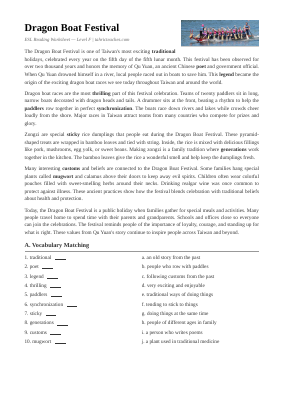
Student Worksheet Preview
Teacher: keep the three stages in order. Before reading (Parts A–C), students cover the story on page 2 with a sheet of paper. While reading (Part D), they mark the story with two colors. After reading (Parts E–I), they check, retell and sum up the story.
A. Before You Read: Predict
Look only at the title and the big picture at the top. Do not read the story yet.
- What kind of animal do you think this is? ______________________
- Where do you think it lives? ______________________
- Write every word you can think of about animals that live in water.
__________________________________________________________________ - Write one question you want the story to answer (for example, “What does it eat?”).
____________________________________________
B. Before You Read: Key Words
Match each word to its meaning. Then draw a tiny picture next to two of the words (for example, a moon next to night).
- smile ____
- lake ____
- grow ____
- tail ____
- hide ____
- mud ____
- night ____
- fish ____
- dirty ____
- save ____
- a. to go where others cannot see you
- b. an animal that lives and swims in water
- c. a big area of water with land all around it
- d. not clean
- e. to keep someone or something safe from harm
- f. soft, wet dirt
- g. the dark time when the sun is down
- h. to make a happy face with your mouth
- i. to get bigger
- j. the long part at the back of an animal’s body
C. Before You Read: Put the Sentences in Order
These four sentences come from one part of the story. Use the clue words during, when, then and sometimes to number them 1 to 4. Check your order when you read the story.
- ___ Then they open their mouths wide and suck in food.
- ___ During the day, axolotls hide in the mud.
- ___ Sometimes they also suck up little stones.
- ___ When night comes, they swim out to look for food.
D. While You Read: The Axolotl
Read the story with two colors. Underline the sentences you understand in one color, and circle the words you do not understand in another color. Example: if you do not know canals, circle it and look for its meaning in the same sentence.
The axolotl (say ACK-suh-LAH-tul) is a small animal that lives in water and always seems to smile. In the wild, it lives in only one place in the world: a few lakes and canals, which are long, narrow waterways, just south of Mexico City in Mexico. Its name comes from the language of the Aztec people, who lived in Mexico long ago, and it probably means “water monster.”
An axolotl can grow up to 12 inches long, which is about as long as a school ruler. It has a long tail, short legs and feathery gills on its head, which help it breathe under water. In the wild, most axolotls are gray-brown, but many pet axolotls are pink or white.
During the day, axolotls hide in the mud or among water plants, so other animals cannot catch them. When night comes, they swim out to look for food. Then they open their mouths wide and suck in insect eggs, small fish and other tiny water animals. Sometimes they also suck up little stones, which help grind up the food in their stomachs.
Axolotls also have a special power. If an axolotl loses a leg, it can grow a new one, and it can even fix a hurt heart. Scientists study axolotls to learn how they do this.
Sadly, wild axolotls are in big trouble. People have built houses near their lakes, and farms and factories have made the water dirty. People also put new fish called tilapia into the lakes, and these fish eat baby axolotls. A 2020 report by a world team of animal scientists said that only 50 to 1,000 grown-up axolotls were left in the wild. Now scientists and farmers in Mexico are working together to clean the water and save them.
E. After You Read: True or False
Write T (true) or F (false).
- ____ Axolotls live in water.
- ____ Wild axolotls live in lakes and canals near Mexico City.
- ____ An axolotl can grow up to 12 feet long.
- ____ Most wild axolotls are pink.
- ____ Axolotls look for food at night.
- ____ Axolotls eat insect eggs and small fish.
- ____ An axolotl cannot grow a new leg.
- ____ Tilapia are fish that help baby axolotls.
F. After You Read: Fill in the Blanks
Use the words in the box.
Word Bank: lake, mud, hide, tail, dirty, save
- An axolotl has a long ______________ and short legs.
- A wild axolotl lives in a ______________ or a canal near Mexico City.
- During the day, axolotls ______________ so other animals cannot catch them.
- They hide in the soft ______________ or among water plants.
- Farms and factories have made the water ______________.
- Scientists and farmers are working to ______________ the axolotls.
G. After You Read: Cause and Effect Chart
Fill in the chart without looking at the story. Then check your answers in the story. Cause 1 is done for you.
People built houses near the lakes.
Farms and factories
____________________
New fish called tilapia
____________________
H. After You Read: Answer the Questions
Answer in full sentences.
- Look at the question you wrote in Part A. Did the story answer it? Write the answer, or write where you could look for one.
- Where do wild axolotls live?
- Why do axolotls hide during the day?
- Why do scientists study axolotls?
- Why are there so few wild axolotls today? Give two reasons from the story.
I. After You Read: Sum It Up and Talk
Work with a partner.
- Six-word summary: write the whole story in exactly six words. Example about a different story: “A gift from France turned green.”
______________________________________________ - Look at the words you circled in Part D. Ask your partner what they mean, and then ask your teacher about any words you both still do not know.
- What could people do to help axolotls? Tell your partner one idea.
Answer Key (click to reveal)
A. Predict: Answers will vary. The story says the axolotl is a small water animal that lives only in a few lakes and canals just south of Mexico City.
B. Key Words: 1-h, 2-c, 3-i, 4-j, 5-a, 6-f, 7-g, 8-b, 9-d, 10-e
C. Sentence Order: 3, 1, 4, 2 (During the day → When night comes → Then → Sometimes). D. While You Read: answers will vary; reteach the sentences and words students circled.
E. True/False: 1-T, 2-T, 3-F (12 inches, about as long as a school ruler), 4-F (most wild axolotls are gray-brown), 5-T, 6-T, 7-F (it can grow a new leg), 8-F (tilapia eat baby axolotls)
F. Fill in the Blanks: 1-tail, 2-lake, 3-hide, 4-mud, 5-dirty, 6-save
G. Cause and Effect Chart: Cause 2: farms and factories made the water dirty. Cause 3: tilapia eat baby axolotls. Effect: only 50 to 1,000 grown-up axolotls were left in the wild (2020 report). What people are doing now: scientists and farmers in Mexico are cleaning the water to save them.
H. Answer the Questions:
- Answers will vary. (Students who asked “What does it eat?” should answer: insect eggs, small fish and other tiny water animals.)
- They live only in a few lakes and canals just south of Mexico City in Mexico. (Source: National Geographic)
- They hide in the mud or among water plants so other animals cannot catch them. (Source: National Geographic)
- An axolotl can grow a new leg and fix a hurt heart, and scientists want to learn how it does this. (Source: National Geographic)
- Any two: people built houses near their lakes; farms and factories made the water dirty; tilapia eat baby axolotls. (Source: National Geographic; numbers: IUCN SSC Amphibian Specialist Group 2020, via San Diego Zoo Wildlife Alliance)
Sources: National Geographic, “Axolotl” (Animals: Amphibians); San Diego Zoo Wildlife Alliance Library, “Axolotl” fact sheet: Population & Conservation Status, citing the IUCN SSC Amphibian Specialist Group (2020).
© Tahric Teaches | tahricteaches.com






 EN
 ZH
 ZH_CN
 KO
 VI
 FR
 AR
 ES
 HI
 PT
 BN
 RU
 JA
 TR
 DE
 IT
 PL
 ID
 TH
 FA
 UK
 TL
 HE
 UR
 SW
 RO
 NL
 MS
 TA
 PS
 HU
 EL
 SV
 NB
 NN
 DA
 CS
 SR
 AM