

Drama Activities for ESL: 8 Theater Techniques That Work
Plenty of teachers try drama once, watch half the class freeze up, and never touch it again. The mistake is almost always starting with open-ended improvisation—the technique that demands the most from nervous speakers. Start with structured activities instead. A student who would never volunteer to “just speak” will happily interrogate a character sitting in the hot seat, because the rules are clear and the pressure is shared across the whole class. According to a meta-analysis published in Language Teaching Research, drama-based instruction produced significantly higher gains in speaking fluency and pragmatic competence compared to traditional pair work across 34 studies.[1]

Why Drama Works for Language Acquisition
Stephen Krashen’s input hypothesis gets most of the attention in teacher training, but his less-quoted corollary—that anxiety and self-consciousness block acquisition even when comprehensible input is available—explains why drama is so effective. Drama lowers that barrier by shifting identity. A student isn’t speaking as themselves; they’re speaking as a character. That psychological distance is exactly what many ESL learners need to take risks with language.
Dorothy Heathcote, the drama educator whose work shaped drama-in-education across the UK and beyond, argued that students speak differently when they have genuine dramatic stakes. They negotiate, persuade, justify, and argue—registers that grammar drills can’t produce on demand. Drama also generates what researchers call “pushed output”: language that is slightly beyond the learner’s current comfort zone, which is where acquisition happens fastest.[2] Put those two mechanisms together and you have a teaching tool that does things lectures and worksheets simply cannot.

1. Improvisation Scenes With a Constraint
Unstructured improvisation is a classroom disaster waiting to happen. The version that works in ESL gives pairs a firm constraint: a specific setting, a defined relationship between characters, and a single conflict to resolve. A scenario card might read: “You are two coworkers. One of you forgot to complete an important task. Decide what happens.” The constraint does the scaffolding work—students don’t have to invent the entire world, just speak within it.
The “Yes, And” rule from improv theater is genuinely useful here. Students must accept whatever their partner says and build on it, rather than blocking or ignoring it. This prevents the shutdown loops that happen when one student says something unexpected and the other responds with silence. A student who says “I left my homework at home” gets “Yes, and your teacher is standing right behind you”—suddenly there’s language to produce, under pressure, right now. That urgency is something no controlled exercise can replicate.

2. Hot Seating — Questioning a Character
Hot seating is one of the most teacher-accessible drama activities for ESL because the format is nearly identical to a class discussion—except one student takes on a role instead of speaking as themselves. Place a chair at the front of the room. The student in the hot seat becomes a character: a historical figure, someone from a text the class is reading, or a fictional person from a scenario you provide.
The rest of the class asks questions, and the student in the hot seat answers in character. The payoff is immediate: students generate dozens of authentic interrogative structures because they’re genuinely curious about the answers. It works at every level. Lower-level students ask simple “Where do you live?” questions; advanced students probe motivations and contradict the character’s logic. Set a clear time limit—8 to 10 minutes works well—and rotate so multiple students get the seat across the lesson. The student in the seat gets the richest speaking practice, but the questioners are producing just as much language in the aggregate.
3. Freeze Frames and Tableau
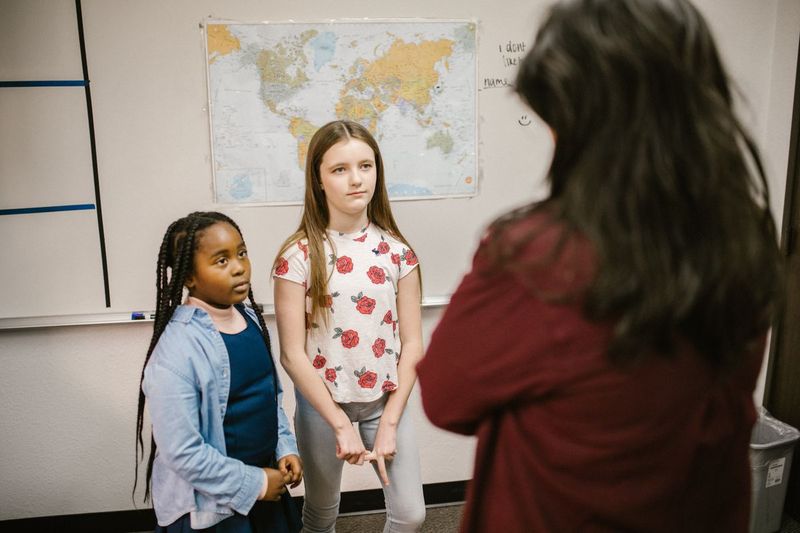
A freeze frame (or tableau) is a silent, frozen image created by a small group of students capturing a moment in a scene. The technique forces students to think about body language, spatial relationships, and narrative înainte they speak—which makes the language that follows much richer. After groups hold their freeze, other students describe what they see: “The person on the left looks angry. The one in the middle seems scared.”
Extend it by tapping a frozen student on the shoulder, which “unfreezes” just that person. They speak in character for 30 seconds, then freeze again. This variation combines the visual scaffold of the tableau with controlled production, and it’s particularly effective for teaching narrative past tense because students are naturally describing a frozen moment in time. It also works well with lower levels who find sustained speaking stressful—30-second bursts in a structured context are far less daunting than open-ended discussions.
4. Reader’s Theater
Reader’s theater is the easiest of these drama activities for ESL to prepare because the text este the script. Students read a dialogue or scene aloud with expression—no memorization, no costumes required, minimal setup. It works best with texts that have clear character voices and genuine conflict: news articles adapted into dialogue, scenes from graded readers, or purpose-written scripts. The critical move is assigning different readers to different roles, not having the whole class read in unison.
The research case for reader’s theater in language classes is strong on fluency. Repeated reading of the same script across multiple sessions produces significant gains in reading rate and prosody. The drama framing gives students a reason to practice the same text multiple times—something that feels repetitive in a traditional setting feels purposeful in rehearsal. After two or three run-throughs, even reluctant speakers find themselves producing at a pace and expressiveness that surprises them.[3]

5. Conscience Alley
One student plays a character facing a decision. The rest of the class forms two facing lines—the conscience alley. As the character walks slowly between the lines, students on one side whisper reasons to take one action; students on the other side whisper reasons against. The character then makes a decision and explains it to the class.
The target language here is opinion and persuasion: “You should…”, “Think about…”, “What if…”, “Remember that…”. Students produce these forms naturally because they’re trying to influence the character—there’s authentic intent behind every utterance. Pair it with a reading text where a character makes a moral choice, and the activity doubles as comprehension work. Students are more likely to have read carefully when they know they’ll need to argue a specific position from the text.

6. Dramatic Storytelling in Role
Give each student a character card with a name, an occupation, a location, and one secret. Put students in groups of three. Each group has 10 minutes to create a shared story in which all three characters appear—told in first person, not third. “I was walking down the street when…” forces possession, object pronouns, and simple past in ways that abstract grammar instruction doesn’t. Because students care about the story they’re creating, they self-correct more and produce more varied sentence structures than they do in controlled exercises.
The “secret” element is the engine. A student who knows their character’s secret has information to protect, which creates authentic evasion language: “I’d rather not say,” “That’s not the point,” “You don’t need to know that.” These pragmatic forms are almost impossible to teach through explanation but emerge naturally when there’s something genuinely worth hiding. For more structured speaking setups, see the ESL speaking activities resource and the full role play activities guide.
7. Pair Scenes With a Script Gap
Write a short dialogue between two characters—then remove every third or fourth line. Students receive the partial script and must improvise the missing lines to make the scene work. This sits between fully scripted reader’s theater and open improvisation: there’s a structure to lean on, but the missing lines require genuine decision-making about what fits contextually. It’s particularly effective for teaching connected discourse, because the improvised line has to logically follow what came before and set up what comes after—a constraint that forces cohesion in ways that free writing rarely does.
8. The Still-Image Debate
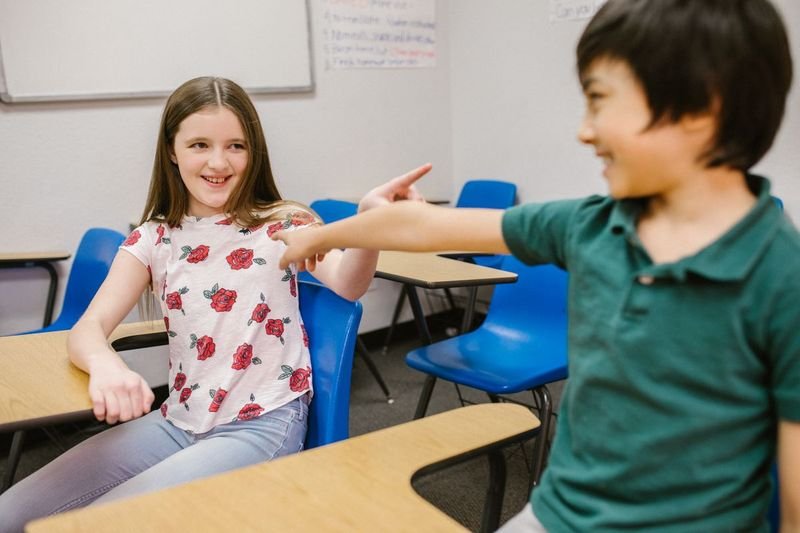
Groups create two freeze frames showing opposite sides of a controversial issue drawn from a photo, scenario card, or news headline. Each group presents their still images with explanation, then the class debates the broader issue. This combines the low-pressure entry point of tableau with the high-output language demands of argument—and it’s a natural companion to structured debate activities for classes that freeze up in open discussion. Students who won’t speak in a standard debate often find it much easier to start from a physical image they’ve already made together.
Handling the “I Don’t Want to Act” Problem
The objection isn’t really to acting—it’s to being watched and judged while performing. The fix is structural: use drama activities where the whole class participates simultaneously, so no single student is the focus. Improvisation pairs, conscience alleys, and simultaneous freeze frames work this way. Hot seating and reader’s theater performances—where one person or group is the center of attention—should come after students have already had 20 to 30 minutes of low-risk drama work in the same lesson.
Cultural context also matters more than teachers sometimes acknowledge. Students from educational backgrounds where classroom participation is always performative—where standing up means being evaluated—will take more time to relax into drama. Three or four structured drama lessons in, most resistant students are the ones asking whether there’s time for another round. The reluctance is almost always about trust and unfamiliarity, not inability.
Watch: Five Drama Games for Language Teaching
This Macmillan Education ELT webinar demonstrates five core drama techniques with commentary on the language acquisition rationale behind each one. A good primer if you’re introducing drama to a skeptical department head or want to see the techniques modeled before trying them in class:
Surse
- Lan, Y., et al. (2018). Dramatic activities and second language development. — Language Teaching Research. Meta-analysis of 34 studies comparing drama-based instruction to traditional pair work on speaking and pragmatic outcomes.
- Maley, A. & Duff, A. (2005). Drama Techniques, 3rd ed. — Cambridge University Press. Core text on drama techniques in ELT, including the theoretical basis from SLA research.
- Rasinski, T. & Griffith, L. (2011). Reader’s Theater and Building Fluency. — Reading Rockets. Overview of fluency gains from repeated dramatic reading with second language learners.









 RO
RO  EN
EN  ZH
ZH  ZH_CN
ZH_CN  KO
KO  VI
VI  FR
FR  AR
AR  ES
ES  HI
HI  PT
PT  BN
BN  RU
RU  JA
JA  TR
TR  DE
DE  IT
IT  PL
PL  ID
ID  TH
TH  FA
FA  UK
UK  TL
TL  HE
HE  UR
UR  SW
SW  NL
NL  MS
MS  TA
TA  PS
PS  HU
HU  EL
EL  SV
SV  NB
NB  NN
NN  DA
DA  CS
CS  SR
SR  AM
AM