
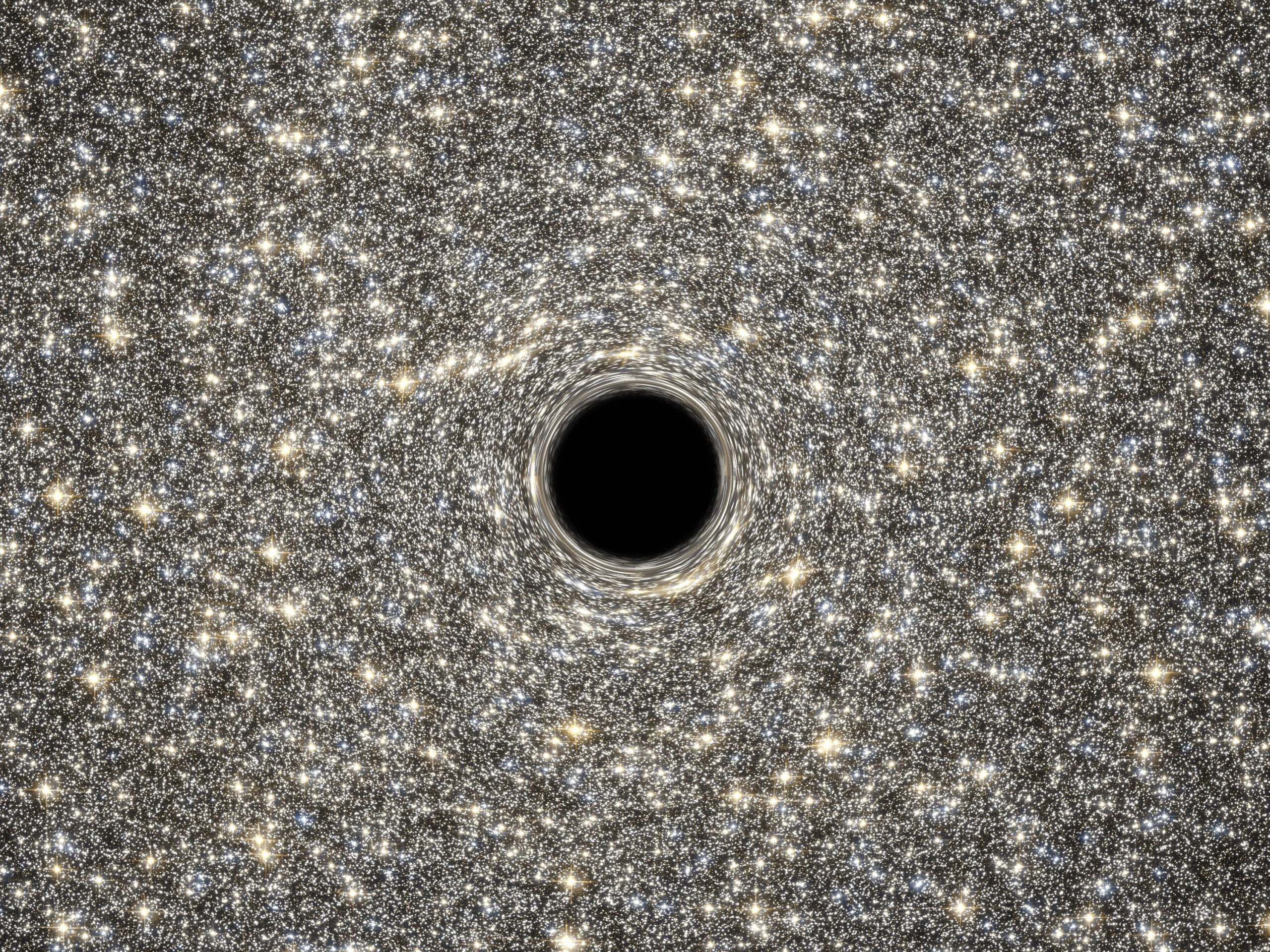
The Missing Link — Intermediate-Mass Black Holes
The Missing Link: Intermediate-Mass Black Holes
Читање одломка
The universe contains black holes of almost incomprehensible extremes. Some are relatively modest — the collapsed remnants of individual massive stars, containing between 5 and 50 times the mass of our Sun. At the opposite end of the spectrum sit supermassive black holes, residing at the centers of nearly every large galaxy, with masses ranging from millions to billions of solar masses. Between these two populations lies a largely empty region that has puzzled astrophysicists for decades: where are the intermediate-mass black holes?
Intermediate-mass black holes, or IMBHs, are defined as black holes with masses ranging from approximately 100 to 100,000 solar masses. Theoretically, they should exist. Stellar-mass black holes grow by consuming surrounding matter, and supermassive black holes must have originated somewhere — current leading theories suggest they may have grown from intermediate-mass seeds during the early universe. Yet IMBHs have been extraordinarily difficult to detect, and confirmed examples remain rare. In 2025, multiple independent lines of evidence have brought this elusive category of object into sharper focus.
A black hole, by definition, does not emit light. Matter that crosses the event horizon — the boundary beyond which nothing, not even light, can escape — is permanently trapped. This means that black holes can only be detected indirectly, through their effects on surrounding matter and spacetime. For stellar-mass black holes, X-ray emissions from the hot accretion disk — the superheated material spiraling inward around a black hole — provide a clear signal. For supermassive black holes, their gravitational influence on entire galaxies gives them away. For IMBHs, however, neither signal has been easy to isolate.
One of the most promising detection methods involves tidal disruption events, or TDEs. When a star passes too close to a black hole, the gravitational difference between the near and far sides of the star becomes so extreme that the star is torn apart — a process called tidal disruption. The debris from the disrupted star forms a temporary accretion disk, generating a bright flare of X-ray and ultraviolet radiation detectable by space telescopes. In 2025, astronomers identified TDEs consistent with black holes in the IMBH mass range, providing some of the strongest evidence yet for their existence.
Another avenue of discovery involves globular clusters — dense, spherical collections of hundreds of thousands of stars that orbit galaxies as satellite systems. Theoretically, IMBHs could form in globular clusters through the repeated merging of massive stars before they collapse into stellar-mass black holes. In 2025, astronomers studying the globular cluster M15 detected a group of “runaway stars” — stars moving at unusually high velocities relative to the cluster’s center. The most natural explanation for these ejections is the gravitational slingshot effect of a massive central object — likely an IMBH — interacting with nearby stars and flinging them outward.
Gravitational wave astronomy has also contributed to the search. When two compact objects merge — such as two black holes — they release ripples in spacetime called gravitational waves, detectable by observatories such as LIGO and Virgo. Several merger events detected in recent years have involved objects in the mass range of 100 to 300 solar masses, placing them firmly within the IMBH category. These events represent not just a detection but a glimpse of IMBH formation in real time.
The James Webb Space Telescope (JWST), launched in 2021, is contributing to IMBH research by observing the early universe with unprecedented clarity. Scientists hope that JWST will detect the environments in which IMBHs formed and provide constraints on the theoretical models that explain how black holes grow from stellar-mass origins to the supermassive giants observed today.
Understanding IMBHs is not merely an academic exercise. They may represent the critical link between stellar evolution and the formation of the supermassive black holes that anchor entire galaxies. Their discovery and characterization could resolve one of the most fundamental open questions in astrophysics: how does a black hole grow from the mass of a single star to the mass of a billion suns?
Вокабулар
- Intermediate-mass black hole (IMBH) — a black hole with a mass between approximately 100 and 100,000 times the mass of the Sun; theorized to be a “missing link” between stellar and supermassive black holes
- Tidal disruption event (TDE) — the destruction of a star by the extreme gravitational forces near a black hole, which produces a bright flare of radiation detectable by telescopes
- Gravitational waves — ripples in the fabric of spacetime produced by the acceleration of massive objects, such as two black holes merging; detected by LIGO and Virgo observatories
- Solar mass — the mass of our Sun, used as a standard unit when describing the masses of stars, black holes, and other massive objects (approximately 2 × 10^30 kilograms)
- Globular cluster — a tightly bound, roughly spherical collection of hundreds of thousands of ancient stars that orbits a galaxy as a satellite system
- Accretion disk — a rotating disk of superheated gas and matter that forms around a black hole as material spirals inward before crossing the event horizon
- Event horizon — the boundary surrounding a black hole beyond which the escape velocity exceeds the speed of light; nothing that crosses it can return
- Stellar-mass black hole — a black hole formed from the gravitational collapse of a massive star at the end of its life, typically containing 5 to 50 solar masses
- Supermassive black hole — an extremely massive black hole found at the center of most large galaxies, with masses ranging from millions to billions of solar masses
- X-ray emission — high-energy radiation produced by the extremely hot gas in an accretion disk surrounding a black hole; a key observational signal used to detect black hole activity
Питања за разумевање
1. How does the passage define intermediate-mass black holes? (Short answer)
2. Why are black holes impossible to detect directly?
- A) They absorb all light and cannot be photographed
- B) They are too small to be seen even by the most powerful telescopes
- C) They only exist in the early universe and no longer produce radiation
- D) They are hidden inside globular clusters far from our galaxy
3. What is a tidal disruption event (TDE), and why is it useful for detecting IMBHs? (Short answer)
4. What did astronomers studying globular cluster M15 discover in 2025?
- A) A stellar-mass black hole consuming a companion star
- B) Direct X-ray emissions from an IMBH accretion disk
- C) Runaway stars moving at unusually high velocities, likely ejected by an IMBH
- D) Gravitational wave signals matching an IMBH merger
5. What are gravitational waves, and what produced the ones relevant to IMBH research?
- A) Sound waves created when black holes consume nearby stars
- B) Ripples in spacetime produced when two compact objects such as black holes merge
- C) Electromagnetic pulses released during supernova explosions
- D) Radio signals emitted by spinning neutron stars
6. What is the accretion disk, and why does it emit X-rays? (Short answer)
7. Which telescope is currently being used to observe the early universe for evidence of IMBH formation?
- A) Hubble Space Telescope
- B) Chandra X-ray Observatory
- C) James Webb Space Telescope
- D) Very Large Array
8. According to the passage, why do scientists believe supermassive black holes may have originally formed from IMBHs? (Short answer)
9. Which of the following is NOT described in the passage as a method for detecting intermediate-mass black holes?
- A) Observing tidal disruption events
- B) Detecting gravitational waves from merging black holes
- C) Measuring the temperature of gas clouds near IMBHs
- D) Identifying runaway stars ejected from globular clusters
10. What fundamental question does the passage say IMBH research could help answer? (Short answer)
Critical Thinking
- The passage describes IMBHs as “elusive.” What specific properties of black holes in general make them difficult to detect? Why is the IMBH mass range particularly challenging compared to stellar-mass and supermassive black holes?
- Scientists use multiple independent detection methods — TDEs, runaway stars, gravitational waves, and JWST observations — to build a case for the existence of IMBHs. Why is converging evidence from multiple independent methods more convincing than a single strong result from one method?
- The event horizon is described as the point of no return — nothing can escape once it crosses this boundary. This is a theoretical prediction of Einstein’s general relativity. What does it mean for a scientific concept to be a “theoretical prediction”? How do scientists treat theoretical predictions that cannot be directly tested?
- Gravitational wave astronomy is a very new field — LIGO made its first detection in 2015. How might new detection technologies, like gravitational wave observatories, change our understanding of the universe in ways that older technologies could not? Can you think of other examples in history where a new type of observation opened up a new field of science?
- The passage raises the question: how does a black hole grow from the mass of a single star to billions of solar masses? Based on what the passage describes, propose a possible sequence of events. What would need to happen at each stage?
Fill in the Blank
- When a star passes too close to a black hole and is destroyed by gravitational forces, the event is called a ______, which generates a bright flare of X-ray radiation detectable by space telescopes.
- The boundary surrounding a black hole, beyond which the escape velocity exceeds the speed of light, is called the ______.
- Ripples in the fabric of spacetime produced when two black holes merge are called ______, and they can be detected by observatories such as LIGO and Virgo.
Extended Response
Prompt 1: Explain why intermediate-mass black holes are described as the “missing link” between stellar-mass and supermassive black holes. Using evidence from the passage, describe at least three different detection methods scientists are using to find IMBHs, and explain what each method reveals. Discuss why the search for IMBHs matters for our overall understanding of how galaxies form and evolve.
Prompt 2: The passage explains that a black hole can only be detected through its effects on surrounding matter and spacetime — it cannot be observed directly. Write an essay exploring the philosophical implications of this fact for science. How do scientists justify confidence in the existence of objects they cannot directly observe? What is the role of indirect evidence in science? Use examples from the passage and, if possible, from other areas of science you have studied.
Looking for free ESL worksheets? Browse our full collection — printable resources for every level and age group. Browse Free Worksheets →









 SR
SR  EN
EN  ZH
ZH  ZH_CN
ZH_CN  KO
KO  VI
VI  FR
FR  AR
AR  ES
ES  HI
HI  PT
PT  BN
BN  RU
RU  JA
JA  TR
TR  DE
DE  IT
IT  PL
PL  ID
ID  TH
TH  FA
FA  UK
UK  TL
TL  HE
HE  UR
UR  SW
SW  RO
RO  NL
NL  MS
MS  TA
TA  PS
PS  HU
HU  EL
EL  SV
SV  NB
NB  NN
NN  DA
DA  CS
CS  AM
AM