PPP Lesson Plan: The Complete 2026 Guide for ESL Teachers
A PPP lesson plan splits a 60-minute ESL class into three stages — Presentation, Practice, Production — and it is still the most widely used framework in CELTA and Trinity TESOL training rooms in 2026. The idea is simple: introduce target language clearly, drill it under controlled conditions, then let students use it in something close to real life. Done well, a PPP lesson plan gets a beginner from “I no understand” to a 30-second roleplay in under an hour. Done badly, it produces the exact AI-textbook lesson that students complain about online.
This guide walks through the three stages, a full B1 example, the common failure points, and when to throw PPP out for something else. It is written for the working teacher who has 25 minutes between classes to plan the next one.

What Is a PPP Lesson Plan, Exactly?
PPP stands for Presentation, Practice, Production. It is a three-stage framework for teaching a single chunk of language — usually a grammar point, a function (like making polite requests), or a small set of related vocabulary. The teacher introduces and demonstrates the target language first, has students practise it in controlled drills, then lets them produce the language in a freer, more communicative task.
The framework was popularised in the 1970s and 1980s alongside the spread of communicative language teaching, and the British Council still lists it as a default lesson shape for teacher trainees. It works because it mirrors how skill acquisition works in most domains: see it modelled, copy it under coaching, then perform it without coaching.
One thing the textbooks rarely admit: PPP is at its best with low-to-mid level learners and discrete language points. The more your target language is grammatically clean — present perfect, second conditional, comparatives — the better PPP fits. Once you move into discussion skills, fluency-building, or messy real-world tasks, other frameworks usually beat it.
The Three Stages Inside Every PPP Lesson Plan
Each stage of a PPP lesson plan has a different job, a different teacher role, and a different rough time budget inside a 60-minute class. Think of the proportions as roughly 15/25/20 minutes, with the first five minutes for a warmer and the final five for feedback.
- Presentation (10–15 min): Teacher introduces the target language in a clear context. Meaning first, then form, then pronunciation. Concept-check before you move on.
- Practice (20–25 min): Students drill the language in controlled tasks — gap-fills, transformations, substitution drills, choral repetition. Accuracy matters more than fluency here.
- Production (15–20 min): Students use the target language in a freer, more communicative task — a roleplay, a personalised speaking task, a writing prompt. Fluency takes priority over accuracy.
The most common misuse I see in observed lessons is rushing the presentation. Trainees panic about timing, blast through three example sentences, and then wonder why production collapses 35 minutes later. The presentation is the foundation. If it cracks, the whole plan does.
Presentation Stage: How to Introduce Target Language Without Lecturing
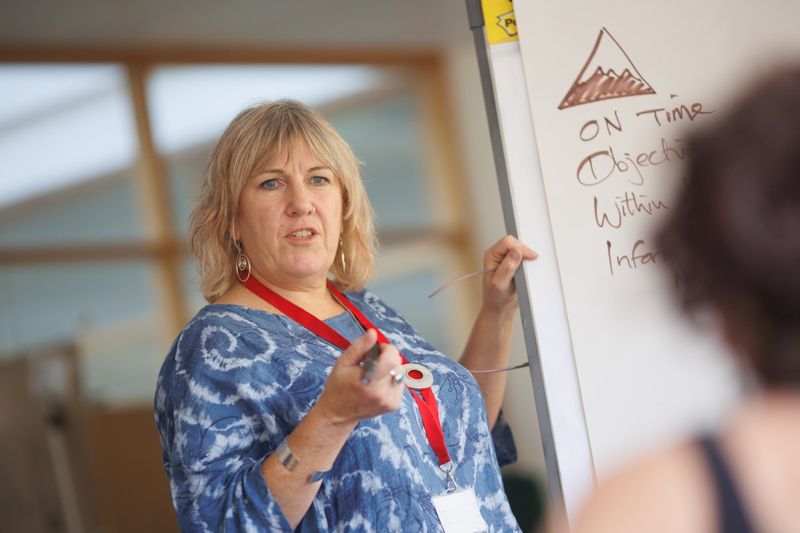
The point of presentation is to make the meaning, form, and pronunciation of the target language so clear that no student leaves the stage confused. The trap is doing this through a 12-minute monologue. Good presentation is mostly eliciting, modelling, and concept-checking — not explaining.
Start with context. A picture, a short story, a dialogue on the board, a 30-second roleplay. The context should generate the target language naturally, so students hear it before they are asked to produce it. Cambridge English’s teacher training materials call this “showing, not telling,” and it works because students remember situations, not rules. Build a board that captures the example sentence, marks the form, and highlights stressed syllables, then drill chorally before you go individual.
The non-negotiable bit is the concept-check question. Before moving to practice, ask 2–3 short yes/no or short-answer questions that test the meaning, not the grammar. For “used to + base verb,” good CCQs are: “Did this happen once or many times?” “Does it happen now?” “Was it in the past?” If a student misses even one, your presentation has not landed. Repeat the example, do not skip ahead.
Practice Stage: Controlled Drills That Don’t Bore Students to Tears
This is where most PPP lesson plans die. The standard advice is to run gap-fills and transformation drills, and most teachers do. The problem is that the average gap-fill exercise in a coursebook is a silent, individual, 8-minute slog that kills the energy you built in presentation.
Fix it by mixing modality. Run one short written task (a gap-fill or sentence transformation), one oral pair task (a substitution drill or back-to-board game), and one whole-class race (a board race, dictogloss, or running dictation). Three short controlled tasks of 5–7 minutes beat one 20-minute worksheet every time. The goal is repetition without monotony — students should produce the target structure at least 15–20 times in this stage, and they cannot do that in silence.

Accuracy is the priority here, so correct hot. Recast errors immediately, drill the corrected form, then move on. Save delayed error correction — the board feedback at the end — for the production stage.
Production Stage: Getting Students to Actually Use the Language
Production is what the whole lesson was building toward, and it is the stage most teachers shortchange. If your practice ran long, the temptation is to cut production to ten minutes and call it a roleplay. Resist it. A production task under 15 minutes is essentially extended practice, and students walk out without ever having used the language for communication.
The task itself should require the target language but not demand it explicitly. For “used to,” a productive task is “Tell your partner three things about your childhood that aren’t true anymore.” Students will reach for the target structure because the meaning requires it — not because the worksheet has a slot to fill. For functional language like making complaints, set up a hotel front desk roleplay with realistic constraints (the room is too small, the wifi is broken, the breakfast finishes at 9 AM).
Stand back. Monitor quietly. Take notes on errors but do not correct in the moment unless communication breaks down — fluency lives in the freedom to make mistakes. Save the corrections for a board-feedback round in the last three to five minutes, anonymising the errors so no one is singled out.
A Full PPP Lesson Plan Example: Teaching “Used To” at B1
Here is a 60-minute PPP lesson plan example that I have run with intermediate teen classes in Taipei dozens of times. Target language: used to + base verb for past habits and states that no longer apply. Level: B1.
Warmer (5 min): Show three photos of yourself from 10 years ago. Students guess: “What do you think has changed?” Elicit any “before vs now” structures students already know.
Presentation (12 min): Write one model sentence: “I used to live in Canada, but now I live in Taipei.” Elicit meaning through CCQs: “Did I live in Canada in the past? Do I live there now? Was this for a long time or once?” Highlight the form on the board: used to + base verb. Drill chorally and individually, marking the weak “to” in /juːstə/.
Controlled practice (20 min): Three tasks. (1) Six-item sentence transformation: “I lived in Canada for ten years” → “I used to live in Canada.” Pair check. (2) Back-to-board game with 8 prompts (“smoked / didn’t smoke now,” “had long hair / short now”). (3) Two-minute board race: teams write as many true “Our teacher used to…” sentences as they can.
Production (18 min): “Then and Now” speaking task. Students draw two columns in their notebooks — “When I was 8” and “Now.” They write five differences in note form, then tell a partner using only complete “used to” sentences. Rotate partners after four minutes for one extra round of fluency. Monitor for errors.
Feedback (5 min): Anonymised error correction on the board. Two correct sentences and two with errors — students fix them as a class.
That is a full ESL lesson plan template built around one grammar point, with every stage timed and every transition justified. Adapt the target language and the lesson scales to any A2–C1 level.
When PPP Falls Apart (And What to Do About It)
PPP is not a universal framework. It struggles in three situations, and pretending otherwise wastes lesson time.
It fails for higher-level discussion classes. By the time students hit C1, they need fluency practice, error correction, and exposure to authentic input — not a 15-minute drill of one grammar point. Task-based language teaching usually fits better there. The same is true for genuinely mixed-level classes where the presentation lands for half the room and bores the other half.
It also fails when the target language is messy. Discourse markers, idioms, register choices, conditionals with mixed time references — these do not slice cleanly into a 12-minute presentation. They emerge from authentic texts and need a text-based approach (TBA) or guided discovery instead.
The third failure mode is the teacher who treats PPP as a script. Real lessons need flex. If your concept-check questions reveal a gap, you spend another five minutes on presentation and trim the controlled practice. PPP is a frame, not a recipe.
PPP vs TBLT vs CLT: How to Choose
The three frameworks most working ESL teachers cycle through are PPP, Task-Based Language Teaching (TBLT), and Communicative Language Teaching (CLT). Picking between them is mostly a question of what the lesson is for.
Pick PPP when you are teaching a discrete grammar point or chunk of functional language to A1–B2 learners. Pick TBLT when the goal is completing a real-world task and the language emerges from the task itself — booking a hotel, planning a trip, negotiating a deal. Pick CLT when you want fluency and meaningful interaction to drive the whole class, especially at higher levels. For a deeper comparison, the breakdown in PPP vs TBLT vs CLT walks through head-to-head tradeoffs with example lessons.
The honest answer is that most experienced teachers blend all three. A Monday grammar class might be straight PPP. Tuesday’s conversation class shifts to CLT. Friday’s project lesson runs on TBLT. The frameworks are tools, not identities.
Common PPP Lesson Plan Mistakes Most Teachers Make
Watching trainee lessons for years, the same five mistakes show up in nearly every weak PPP lesson. Pre-screen yours for these before you walk into class.
- Skipping concept-checking. If you do not CCQ, you do not know whether the presentation landed. Three CCQs minimum, every time.
- Over-explaining grammar. If you are talking for more than four minutes straight in presentation, you have stopped teaching and started lecturing.
- Running silent practice. Long individual worksheets kill momentum. Break controlled practice into 3–4 short, varied tasks instead.
- Production that doesn’t require the target. If students can complete the production task in English they already know, the task is wrong. Re-design it so the target language is the easiest path.
- No board feedback. Skipping delayed error correction at the end wastes the data you collected while monitoring production.
For more on how to fix the deeper instructional habits, the wider review in ESL teaching methods compared covers what actually works in a 2026 classroom.
Adapting the PPP Framework for Online Teaching
The PPP framework translates to online classes, but the stages need re-balancing. Online attention spans are shorter, controlled practice needs more breakout-room movement, and production tasks have to survive screen-share fatigue.
Cut presentation by about a third — five to eight minutes maximum, with the model sentence visible on the screen the entire lesson. Use the chat box for fast CCQs (“Type 1 if past, 2 if present”) so you can read 12 answers in 15 seconds instead of nominating one student at a time. Move controlled practice into 4-minute breakout-room sprints with clear instructions on a shared slide. Production usually works best as a personalised speaking task in pairs, with the teacher dropping into rooms silently to monitor.
The single biggest online PPP failure I see is the silent gap-fill on a shared Google Doc — eight students editing one screen while the teacher waits. Replace it with synchronous oral pair work. Always.
Watch a Full PPP Lesson Plan Walkthrough
If you want to see a PPP lesson plan demonstrated end-to-end, the walkthrough below covers stage timing, board work, and concept-checking from a teacher trainer’s perspective.

Where to Take Your PPP Lesson Plan Next
The next step for any teacher serious about PPP is to stop planning in isolation. Record one of your own lessons, watch it back at 1.5x, and time the stages with a stopwatch. The gap between what you intended and what actually happened is where the teaching gains live. Most teachers discover they spent 22 minutes in presentation and 8 minutes in production — the inverse of what they planned.
After three or four self-recordings, swap a video with a colleague. Twenty minutes of honest peer feedback is worth more than any methodology course. The PPP framework is just scaffolding; the craft is in how you fill it.
ஆதாரங்கள்
- British Council TeachingEnglish — PPP — definition and stage breakdown of the PPP framework.
- Cambridge English ELT Blog — Comparing PPP and TBL — head-to-head framework comparison for working teachers.
- கேம்பிரிட்ஜ் ஆங்கில கற்பித்தல் கட்டமைப்பு — descriptors for lesson planning and delivery competencies at each teaching level.





 TA
TA  EN
EN  ZH
ZH  ZH_CN
ZH_CN  KO
KO  VI
VI  FR
FR  AR
AR  ES
ES  HI
HI  PT
PT  BN
BN  RU
RU  JA
JA  TR
TR  DE
DE  IT
IT  PL
PL  ID
ID  TH
TH  FA
FA  UK
UK  TL
TL  HE
HE  UR
UR  SW
SW  RO
RO  NL
NL  MS
MS  PS
PS  HU
HU  EL
EL  SV
SV  NB
NB  NN
NN  DA
DA  CS
CS  SR
SR  AM
AM