

ESL Dictation Activities: 7 Exercises to Build All Four Skills
Ruth Wajnryb’s 1990 book Grammar Dictation made a claim that quietly shifted how TESOL researchers thought about transcription tasks: the traditional dictation exercise, long filed under “boring grammar drill,” could be redesigned to generate genuine language acquisition. Three decades of classroom research have confirmed it. When you choose texts deliberately and add a reconstruction or comparison stage, dictation produces more grammar noticing per minute than most communicative activities — and it requires zero preparation time once you know the formats.
The seven activities below cover everything from a ten-minute warm-up to a full-period cooperative task. All of them work at A2 and above; the main variable is text complexity, not activity format.
Why Dictation Outperforms Most Grammar Drills
A gap-fill worksheet gives students language they can already partially produce. Dictation puts them in a harder position: they have to parse spoken input at near-natural speed, hold chunks in working memory, and transcribe accurately. That gap between current ability and task demand is where Richard Schmidt’s noticing hypothesis (1990) does its work — learners can’t acquire forms they haven’t consciously attended to, and dictation forces attention at the word, phrase, and sentence level simultaneously.
The practical bonus is data. Every error a student makes in a dictation transcript tells you something specific: missing article, wrong verb ending, mishearing a preposition. You get formative assessment built into the activity without any extra prep. Compare that to a speaking task, where errors disappear into the air the moment they’re spoken.
Text selection is the most important variable. A passage that naturally loads your target structure — four or five uses of present perfect in a 120-word paragraph about recent events, for example — teaches that structure more efficiently than a textbook exercise designed around it, because students encounter it in real syntactic context, not isolation.
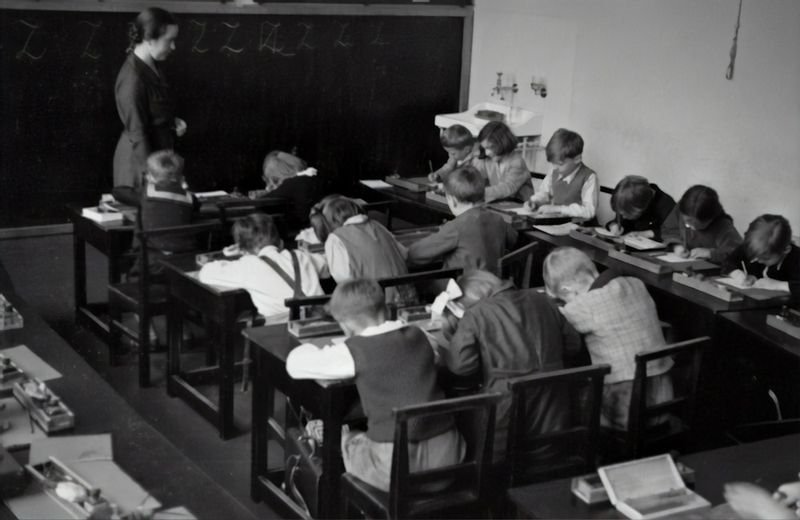
Students writing during a timed dictation exercise.
Activity 1 — Standard Dictation, Improved
Most of us learned this version: teacher reads the text three times, students write, papers are collected. It works, but it throws away the most valuable part of the activity.
The fix is adding a peer-comparison stage before you reveal the correct text. After students finish writing, they compare their transcription with a partner and mark any sentences where they disagree. Then you read the correct version aloud, one sentence at a time. They check their joint version, not just their individual one.
This changes the activity from passive transcription to active reasoning. Students argue about whether the verb was active or passive, whether “although” or “even though” was used, whether the sentence ended with a comma or a period. These micro-decisions are exactly what conscious grammar instruction rarely triggers.
Keep texts short — 80 to 120 words is enough for a 15-minute activity. Paragraph-length texts from news articles or graded readers work better than anything written specifically for dictation, because the language is natural rather than engineered for pedagogical clarity.
Pre-dictation instruction: previewing target vocabulary reduces transcription noise.
Activity 2 — Running Dictation
Post a 5-8 sentence paragraph on the wall outside the classroom door, or on the back wall if your room permits. Students work in pairs: one runner, one writer. The runner reads a chunk of text from the wall, walks back, and dictates it to the writer from memory. They continue until they’ve reconstructed the entire text, then swap roles for a second paragraph.
This activity genuinely covers all four skills in one go: the runner reads and speaks, the writer listens and writes, and both negotiate meaning when there’s a discrepancy (“did you say ‘despite’ or ‘in spite of’?”). That negotiation is a communication task layered on top of the transcription task.
Logistics: print the wall copy in 14-point font so runners don’t have to squint. Set a timer — eight minutes creates productive urgency. After time’s up, project the original text and pairs compare. The gaps between what they wrote and the original are your teaching points for the next five minutes.
This is the one dictation format that works especially well at lower intermediate levels, because the physical movement breaks the monotony and the memory component means even students who struggle with writing are still doing useful processing.

Running dictation encourages movement and natural communication between partners.
Activity 3 — Dicto-Gloss
Wajnryb designed dicto-gloss specifically to push students toward noticing grammatical form, not just meaning. Read a 100-150 word text at natural speed twice. Students write only key words — nouns, verbs, the occasional adjective — not full sentences. Then, in groups of three or four, they use those notes to reconstruct the full text as close to the original as possible in both grammar and meaning.
The reconstruction stage is where this activity earns its place. Groups disagree constantly: Was that verb active or passive? Did the writer use “which” or “that”? Was there an article before that noun? These are decisions that grammar exercises rarely force students to make in genuine communicative pressure. Each group writes their version on paper or a shared doc, then you display the original and compare.
The comparison is not a correction session — frame it as a language discussion. “Your group used past simple here; the original uses present perfect. Why might the author have chosen that?” That question produces better grammar instruction than any textbook explanation, because students have a stake in the answer.
Choose texts with a high density of your target structure. A 130-word paragraph about a company’s recent history will load present perfect naturally. A news account of a historical event will stack past simple and past continuous.

Active listening is the first skill dicto-gloss targets before reconstruction begins.
Activity 4 — Spot Dictation
Students receive a printed version of the text with specific words blanked out. As you read, they fill in only the missing words. The blanks are not random — they target whatever structure you’re focusing on. Teaching prepositions of time? Blank every “in,” “on,” and “at.” Working on verb endings? Remove all the third-person singular -s endings.
Spot dictation lowers the cognitive load compared to full transcription, which makes it the right choice for A2 classes where standard dictation produces mostly errors and frustration. It also makes the target structure impossible to ignore: when every blank is a preposition, students can’t accidentally succeed by tuning out the grammar.
One design principle worth keeping: blank items where only one answer is correct. If the blank can be filled with two equally acceptable options, acknowledge that explicitly and turn it into a class discussion point rather than treating one as an error.

Reconstruction tasks like spot dictation and dicto-gloss keep grammar learning anchored to real texts.
Activity 5 — Picture Dictation
Students listen to a spoken description and draw what they hear. The image complexity scales directly with level. At A2, you describe a simple scene using prepositions of place — “There is a tree on the left. There’s a house behind the tree.” Students draw and compare; mismatches show exactly which spatial prepositions aren’t landing.
At B1-B2, describe a diagram, data trend, or process — “Sales rose sharply in Q1, then fell gradually through Q3 before leveling off in Q4.” Students draw the graph, then write a two-sentence description of what they drew. That final written step closes the skill loop: listening → processing → producing. The written output shows whether they absorbed the vocabulary for describing trends or just approximated it visually.
Picture dictation works particularly well in business English contexts, where describing charts and processes is a genuine professional need. The activity isn’t a gimmick at those levels — it’s a direct rehearsal of a real communication task.
Clear setup instructions before any dictation task prevent procedural confusion from derailing the language focus.
Activity 6 — Dictation with Peer Correction
Run a standard dictation of five to seven sentences. Instead of collecting papers, have students exchange with a partner. Read the correct version one final time, pausing after each sentence while the corrector marks any differences between their partner’s version and what they hear.
Students are more rigorous proofreaders of someone else’s work than their own. The mild social dynamic of “my partner will read this” raises attention during the correction pass. More importantly, the corrector has to make an active decision — right or wrong, and why — which reinforces their own understanding of the target form in a way that simply seeing a corrected version doesn’t.
For quick formative data: after peer correction, ask students to raise their hands if their partner got sentence 3 wrong. You get a class-level accuracy picture in about thirty seconds, which tells you whether that structure needs another pass or whether most students have it.
This variant works well as a listening lesson closer — run it in the last 15 minutes as a check on whether the day’s input has been processed accurately.

Peer correction turns the comparison stage into an active language task rather than passive self-marking.
Activity 7 — Read-and-Report Cooperative Dictation
Give each student in a group of four a different sentence from the same paragraph, printed on a small card. Each person reads their sentence silently, then turns the card over and dictates only from memory to the group. The group reconstructs the full paragraph in the correct logical order.
This version adds a layer of discourse-level negotiation that the other activities don’t require. Students have to figure out which sentence comes first, which connectors link which ideas, whether sentence 3 follows sentence 2 logically. The activity is productive and conversation-heavy — pairs argue about cohesion, not just vocabulary.
It also surfaces a different kind of error: students who mishear or forget a clause make choices that break the text’s logic. When the group notices the paragraph doesn’t make sense, they have to go back and troubleshoot which card was mis-dictated. That process of finding and fixing a discourse-level error is valuable work that most ESL activities never create space for.
In larger classes, run this in groups of four with a shared answer sheet per group. Compare group reconstructions at the end — the differences between groups tell you which sentences caused the most uncertainty, and those sentences become your focus for a quick grammar debrief.
Adapting These Activities for Mixed-Level Classes
The same activity works across levels when you change text difficulty, not procedure. In a spot dictation, lower-level students get five blanks; higher-level students get twelve in the same paragraph. In a dicto-gloss, lower-level students are allowed to write more words during the listening phase — seven to ten key words instead of four or five. In running dictation, pair lower-level students together and give them a simpler text.
The principle is consistent: same physical activity for everyone, different level of linguistic challenge. Nobody is singled out as needing an easier version because from the outside, everyone is doing the same thing.
For more activity ideas that scale across levels, the ESL activities guide here covers research-backed approaches sorted by skill and CEFR level.
Three Mistakes Teachers Make with Dictation
Reading too fast. Natural native speed works only when the text is genuinely at i+1. If students are leaving blanks in more than a quarter of the text, slow down — that’s not cheating the activity, it’s appropriate scaffolding. Speed can increase on the second read-through.
Skipping the comparison stage. The most valuable moment in any dictation is when students see their version next to the correct one. Without that explicit comparison, the activity ends at transcription and never becomes feedback. Always project or read the correct version after students have finished writing.
Using dictation as a test. The moment dictation becomes high-stakes, listening quality drops and students focus on not failing rather than processing language. Keep it low-pressure. Errors are data, not failures — and they’re far more useful to you than a set of perfect papers from students who’ve shut down to avoid mistakes.
For a deeper look at how to build reading and listening comprehension into every lesson stage, the strategies guide covers the pre-, during-, and post-task framework that makes activities like dictation land better inside a complete lesson arc.
ஆதாரங்கள்
- Running Dictation — British Council Teaching English — practical guide to running dictation including variations and teacher tips.
- TESOL காலாண்டு — Schmidt, R. (1990). The role of consciousness in second language learning. Applied Linguistics, 11(2), 129-158. Foundation research on the noticing hypothesis.
- Running Dictation ESL Game — ESL Speaking — classroom implementation notes and passage suggestions for the running dictation format.








 TA
TA  EN
EN  ZH
ZH  ZH_CN
ZH_CN  KO
KO  VI
VI  FR
FR  AR
AR  ES
ES  HI
HI  PT
PT  BN
BN  RU
RU  JA
JA  TR
TR  DE
DE  IT
IT  PL
PL  ID
ID  TH
TH  FA
FA  UK
UK  TL
TL  HE
HE  UR
UR  SW
SW  RO
RO  NL
NL  MS
MS  PS
PS  HU
HU  EL
EL  SV
SV  NB
NB  NN
NN  DA
DA  CS
CS  SR
SR  AM
AM