7 Best Storytelling Activities for ESL
Pananaliksik mula sa TESOL Quarterly has consistently found that narrative tasks produce more complex grammar and wider vocabulary use than structured drills. Students use more subordinate clauses, more discourse markers, and more varied tense sequences when they’re telling a story than when they’re filling in a gap-fill. Yet most ESL classrooms still treat storytelling as a Friday filler or a reward for finishing early. These seven techniques treat it as the main event — because that’s exactly what it is when language acquisition is the goal.
Each activity below is built around a different storytelling mode: oral, visual, digital, collaborative, and personal. Rotate through them across a term and students get exposure to narrative structure from enough angles that it stops feeling like a lesson and starts feeling like a way of using English.

1. Story Circle — the Core Storytelling Activity ESL Classes Need
Every student contributes one sentence to a story built in real time. The teacher sets the opening line — “It was a quiet Tuesday in Taipei until the elevator made a sound nobody had heard before…” — then points to a student, who adds the next sentence and passes it on around the circle.
The constraint forces genuine listening. Students can’t zone out, because the story will land on them within minutes. At lower levels, keep sentence starters on the board: “Then suddenly…”, “But the real problem was…”, “Finally…” At upper-intermediate and above, remove the scaffolding and let the story go wherever it wants — that’s when the language becomes most interesting.
After the story ends, replay it from memory: go around the circle and ask each student to recall the sentence that came after theirs. This debrief isn’t just fun — it forces students to hold the story arc in working memory, which consolidates the grammar structures they heard in context. A five-minute debrief turns a speaking activity into a listening and grammar activity at no extra cost.
Story circles work well on day one of a unit, when students don’t yet know each other’s stories. The randomness of the premise levels the playing field — fluency matters less than creativity, and creativity is easier to access than grammar.
2. Picture Prompt Storytelling

A single compelling photograph can carry an entire lesson. Choose a photo with clear foreground action and an ambiguous background — something between “what’s happening right now?” and “what happened just before this?” — and ask students to tell the story from three time perspectives: before the photo, during it, and after.
Picture sequences work differently and demand more. Give each group four images in random order. They arrange the cards, negotiate the sequence, then narrate the final story. The negotiation is where the real language happens. “No, I think the woman is leaving because the door was already open — look at the handle” produces far more authentic grammar than any textbook dialogue.
The activity scales easily. For beginners, choose images with a clear single action and provide vocabulary on the board. For advanced learners, use abstract or ambiguous images where multiple interpretations are defensible — then debate which interpretation is best supported by the visual evidence. That debate generates argument language, hedge language, and concession language all at once.
One practical note: use your own photos when you can. A picture of the school canteen, a photo of the city where students live, or an image from a recent local event generates far more investment than a stock photo of strangers. Familiar context reduces cognitive load and frees up bandwidth for the language itself.
3. Story Retelling with Graphic Organizers
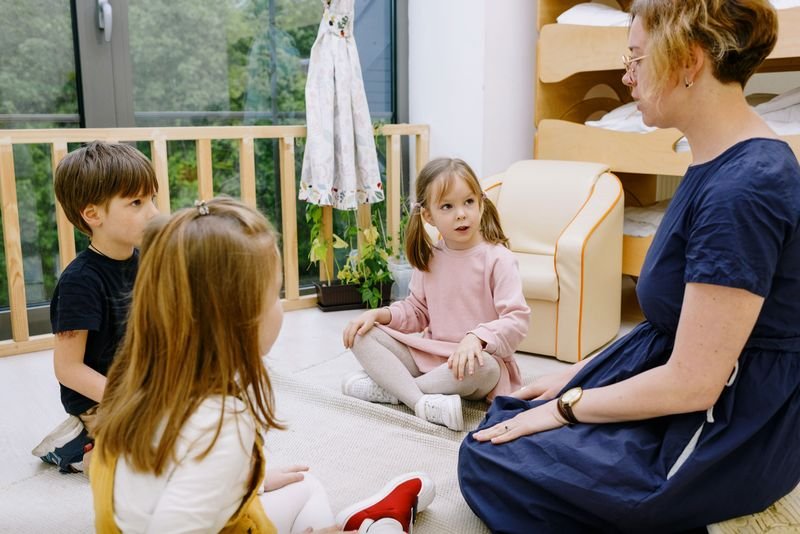
Read or play a short story — a graded reader excerpt, a two-minute audio clip, a teacher-narrated anecdote — then ask students to retell it from a graphic organizer rather than written notes. A five-box story map (Setting / Characters / Problem / Events / Resolution) gives them enough structure to reconstruct the narrative without simply reciting it word for word.
This builds two skills at the same time: listening comprehension and oral production. Students who struggle with reading thrive here because the retelling is spoken. And because every student’s retelling comes out slightly different — different word choices, different emphasis on which events mattered — the class can compare versions and discuss which felt most complete. That comparison generates metalinguistic awareness without a grammar lesson in sight.
Story retelling is one of the most effective ways to close the gap between passive vocabulary — words students recognize — and active vocabulary — words they use unprompted. Each retelling forces a decision: Can I borrow their exact phrase, or do I need my own words? That decision is where real acquisition happens. Pair this with extensive reading for a reading-to-speaking pipeline that compounds across a term.
Keep the source texts short. Two to three minutes of audio, or one page of graded reading, is enough raw material for a ten-minute retelling activity. Longer sources push the task toward memory rather than language production, which is a different skill entirely.
4. Digital Storytelling

Students script, record, and edit a two-to-three-minute narrated slideshow or video about a topic they choose themselves. The process touches every language skill: research and note-taking, scriptwriting, rehearsed speaking with natural prosody, and peer review on the final product.
The script-writing stage is where the language learning is concentrated. Students who would hand in a two-paragraph essay will write 300 words when they know it’s going to become something real — a video they’re proud to show. The authentic audience raises the standard in a way no rubric can replicate. Even if the only audience is their own classmates, the sense of public commitment changes what students are willing to put on the page.
Tools don’t need to be complicated. Google Slides with voice narration, Canva’s presentation mode, or the video camera on any phone all work. The technology is a delivery mechanism, not the point. What matters is that students own the story, the script, and the telling — all three.
Build in a peer-feedback round before the final recording. Give students a simple checklist: Is the opening sentence specific? Does the story have a clear ending? Can you follow the sequence without getting lost? Peer feedback at the draft stage produces better revisions than teacher corrections after the fact, and it gives the listener a reason to pay genuine attention.
5. Read-Aloud with Prediction Stops
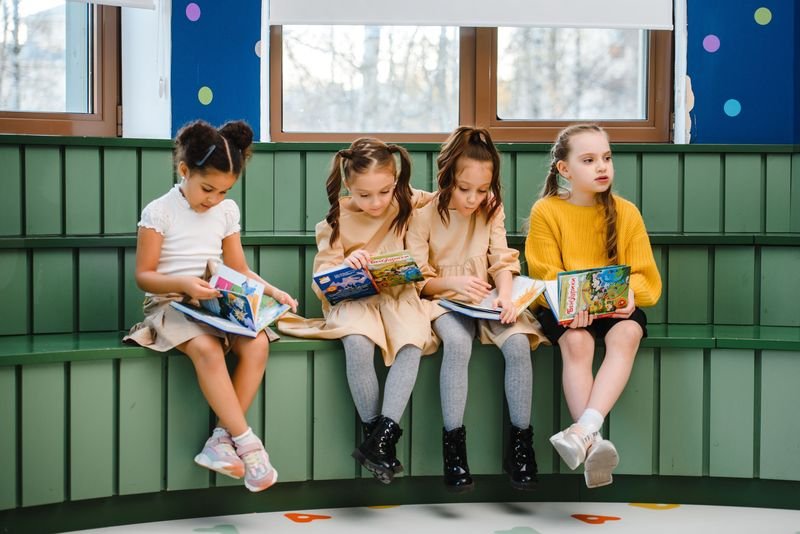
Read a story aloud and pause at three or four strategic moments — before a character makes a key decision, just as the central problem is revealed, right before the final turn — and give students 90 seconds in pairs to discuss what happens next. Then continue reading.
The activity creates genuine investment in the text. Students want to know if their prediction was right. That desire drives attention and vocabulary acquisition in a way that comprehension questions after the fact simply don’t. The gap between what they expect and what actually happens — what cognitive scientists call a prediction error — is one of the strongest signals for memory encoding. Stories exploit this naturally; good teachers exploit it intentionally.
Choose your pause points carefully. Stopping too early means students don’t have enough information to make a real prediction — they’re just guessing randomly. Stopping too late and the outcome is already obvious. The best pause point is when students have enough to make a reasonable case but not enough to be certain. That uncertainty is the engine that drives discussion.
Use this technique alongside speaking fluency activities — set a 60-second timer for the prediction discussion to add a fluency dimension to the comprehension task, so students are practicing both accuracy and speed in the same 90-second window.
6. Story Bag

Fill a bag with five random objects — a key, a small toy, a rubber band, an old photograph, a receipt from last week’s lunch. One student reaches in, pulls out an object, and starts a story. The next student pulls out an object and must incorporate it. By the time the fifth object appears, the story is usually surreal, collaborative, and entirely the students’ own.
Story Bag is high-energy and works well mid-lesson when attention is slipping. Because the objects are unpredictable, students cannot rehearse. They have to speak in the moment, which is exactly the condition that builds the kind of spontaneous language production that transfers to real-world communication. It shares DNA with the improvisation skills developed in drama activities for ESL — the main difference is that Story Bag needs no dramatic training to run.
The activity is forgiving for weaker students. Tell them in advance that their object just needs to appear somewhere in the story — it doesn’t need to drive the plot. A key can be found on the floor. A rubber band can hold a stack of letters together. Small contributions are still contributions, and they keep students in the game rather than waiting for their turn to be over.
Run it as a whole-class activity first so everyone understands the format, then move to small groups. Small-group Story Bag is noisier and more chaotic, but every student speaks far more — which is the point.
7. Personal Narrative Writing and Sharing

Ask students to write 150–200 words about a real moment: the first day they did something independently, a time they were genuinely embarrassed, a decision they still wonder about. Not invented, not a summary of someone else’s experience — a real event with specific sensory detail.
Personal narrative is the hardest of these seven techniques to execute well and the most rewarding when it lands. Students who feel their own experience matters produce writing that is more specific, more grammatically complex, and more coherent than students given a generic prompt — a pattern documented across L2 writing research for decades. The investment in the subject drives investment in the language. That’s not sentiment; it’s a measurable effect on output quality.
The sharing stage is where the language classroom earns its keep. Pair students to read their narratives aloud, then ask each listener to tell the class one surprising thing they learned about their partner. That retelling task creates a double accountability: the writer needs to write clearly enough to be understood, and the listener needs to pay close enough attention to report back. Both pressures are real, communicative, and purposeful.
For written feedback, start with voice and specificity rather than grammar. A student who writes “I was very scared” learns more from the question “What did scared feel like in your body — what did you notice first?” than from a correction to verb tense. Fix the tense in the revision stage; build the content first. Strong content gives students something worth saying correctly.
How to Sequence These Activities Across a Term
These seven techniques aren’t equal in cognitive or emotional demand, and sequencing matters. Picture prompts and Story Bag belong in the first two weeks of a unit — they’re low-stakes, high-energy, and show students that storytelling in English is more fun than threatening. Story circles work well once a class has enough rapport to be playful without anxiety. Prediction stops can run throughout the term as a warm-up tool.
From week three onward, introduce story retelling with graphic organizers to build the connection between listening and speaking. Save digital storytelling and personal narrative for the back half of the term, when students trust both their language ability and their audience. The vulnerability required for a personal narrative is real — students need to have earned some confidence before they’re ready to use it.
A practical arc that works in a 12-week term: weeks one and two use picture prompts and story circles. Weeks three to five introduce retelling and prediction stops. Weeks six through twelve rotate digital storytelling, personal narrative, and Story Bag, with story circles as a standing warm-up. By week twelve, many students stop waiting for the activity prompt — they start telling each other stories between tasks. That’s the goal: a classroom where English becomes the natural language for narrative, not a subject students study and set aside.
Mga Pinagmumulan
- TESOL Quarterly — Peer-reviewed journal on second language teaching; primary source for research on narrative task complexity and language output.
- Cambridge ELT Blog — Using Stories in the Language Classroom — Research-backed overview of storytelling as a core ESL pedagogy.
- System Journal — L2 Writing and Personal Investment — Research on how topic ownership affects writing complexity in second language learners.





 TL
TL  EN
EN  ZH
ZH  ZH_CN
ZH_CN  KO
KO  VI
VI  FR
FR  AR
AR  ES
ES  HI
HI  PT
PT  BN
BN  RU
RU  JA
JA  TR
TR  DE
DE  IT
IT  PL
PL  ID
ID  TH
TH  FA
FA  UK
UK  HE
HE  UR
UR  SW
SW  RO
RO  NL
NL  MS
MS  TA
TA  PS
PS  HU
HU  EL
EL  SV
SV  NB
NB  NN
NN  DA
DA  CS
CS  SR
SR  AM
AM