
Best ESL Conversation Activities: 15 Real Frameworks
Most ESL conversation activities die in the first ninety seconds. A teacher writes a topic on the board — “tourism” or “friendship” — pairs up the room, and within a minute half the class is asking for the bathroom while the other half is silently translating their first sentence in their heads. The activity wasn’t bad. The setup was.
Good ESL conversation activities aren’t free-talk prompts. They’re tightly scaffolded frameworks that force students to use specific language, give them a reason to listen to a partner, and hand them an exit ramp when they get stuck. Below are fifteen frameworks worth running in a real classroom this week — plus the planning moves that decide whether any of them actually work.
What Separates an ESL Conversation Activity From a Speaking Drill
A drill rehearses form. A conversation activity rehearses choice. The student has to decide what to ask, how to respond, and when to push back — and that’s the part Google’s IELTS Speaking band descriptors actually measure under interactive communication. If your activity removes those decisions, it’s a drill, no matter how chatty it looks.
The truth is, most “speaking” worksheets are dressed-up reading aloud. Real ESL conversation activities need three elements: an information gap (one student knows something the other doesn’t), a target language set students must use to bridge that gap, and a measurable output — a decision, a chart, a ranked list, a written summary. If you can’t name the output, the activity is filler.

15 ESL Conversation Activities That Get Students Talking
These are sequenced from lowest scaffolding to highest. Beginners need more structure; advanced classes need more decisions. Match the framework to the level, not the topic.
1. Find Someone Who — Spoken Version
Print a grid of ten statements (“…has been to three countries”, “…can cook a meal from scratch”). Students mingle, ask full questions, and write a classmate’s name in each cell. The information gap is built in: nobody can see anyone else’s answers. The British Council still rates this as one of the most reliable mingle activities for A2 to B1 groups because it forces yes/no question formation under mild time pressure.
2. The Two-Truths-One-Lie Interview
Each student writes three statements about themselves. Partners ask three follow-up questions before guessing the lie. The follow-ups are where the language work happens — without them, students just guess at random.
3. The Ranking Diamond
Give pairs nine items (jobs, qualities of a friend, things to take to a desert island) and a diamond-shaped grid. They must agree on a ranking — one item at the top, then two, three, two, one. The grid prevents the lazy “let’s just put them in a line” move and forces negotiation language.

4. Information Gap Maps
Student A holds a map with shops labeled; Student B’s map is blank. A describes; B draws and labels. Then they swap with a new map. This works at any level — A1 students practice prepositions, B2 students practice qualified descriptions (“it’s roughly halfway between…”).
5. The Role-Play With Hidden Goals
Standard role-plays fail because both students play the same script. Hand each student a separate card with a secret objective. One card says “you want a refund”. The other says “your manager has banned refunds this week, but you can offer a 30% discount”. Now there’s actual conversation, not recitation.
6. Picture Story Reconstruction
Cut a six-panel comic into pieces. Give each pair member three random panels they can’t show each other. They describe their panels until they can agree on the correct order. Then they stand up and act out the story for another pair.
7. Survey + Report
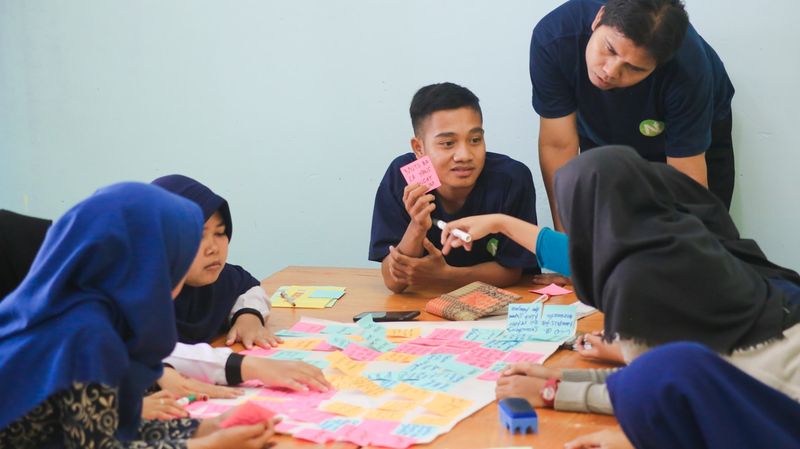
Pairs design a four-question survey, mingle to interview five classmates, then return to summarise findings out loud. The “report back” stage is what turns a speaking activity into a speaking activity — it makes students paraphrase rather than recite.

8. The Devil’s Advocate Debate
Pose a statement (“Schools should ban smartphones”) and assign students the side they personally disagree with. Three minutes prep, three minutes argument, two minutes free discussion. The forced switch removes the “I don’t have an opinion” cop-out that kills most debate activities.
9. Speed-Dating Question Rotation
Set two rows of chairs facing each other. Every ninety seconds, one row shifts. Each round has a new question prompt. Five rounds in twelve minutes means every student speaks to five partners — the introvert who froze in round one is usually warmed up by round three.
10. Story Cubes / Random Word Storytelling
Roll three picture cubes (or pull three random vocabulary cards). Pairs build a sixty-second story using all three elements, taking turns sentence-by-sentence. Good for narrative tenses, sequencing markers, and the dying art of just thinking on your feet.
11. The Job Interview Carousel
Half the class plays interviewers with role cards (tech recruiter, café manager, school principal). The other half rotates through, applying for each job. After three rotations, swap sides. Cambridge’s Teaching English to Speakers of Other Languages framework specifically flags structured role-play of this kind as the most reliable bridge from textbook English to workplace English.
12. Picture Description Battleship
Each student has a picture the other can’t see. Without naming the picture’s subject, they ask yes/no questions to figure out what their partner is looking at. Twenty questions max. Great for higher-level vocabulary and indirect questioning.
13. The Five-Minute Sales Pitch
Give each student a ridiculous product (a left-handed pencil, a self-stirring spoon, a glow-in-the-dark stapler) and four minutes to prepare a sales pitch. Pairs pitch each other, then vote on whose product they’d actually buy. The absurdity is what frees up creativity — students stop second-guessing their grammar.
14. Problem-Solving Scenarios
Hand groups a scenario card: “You’re stuck on a desert island with three items and one teammate is injured. What do you do?” Set a hard six-minute timer with a required decision at the end. Time pressure plus a forced output is what turns “discussion” into actual problem-solving talk.
15. Reverse Show-and-Tell
Instead of bringing in an object and describing it, students bring in an object and have partners ask questions until they can describe and explain its significance. Same physical task, completely different language demands — and far more talk time per student.

How to Scaffold ESL Conversation Activities for Mixed Levels
The single biggest mistake in mixed-level classes is asking everyone to do the same thing at the same time. The B1 student finishes in two minutes and disengages. The A2 student is still on the first sentence. The activity wasn’t broken — the grouping was.
Three scaffolding moves that work reliably across CEFR levels:
- Tier the prompt, not the topic. Same theme (“travel”), but stronger students get an abstract prompt (“Is tourism ever ethical?”) while weaker students get a concrete one (“Describe your best holiday”).
- Pre-load the language. Spend three minutes before any activity drilling the chunks students will need — “I think…”, “I’m not sure but…”, “Could you say that again?” Without this, lower-level students fall back on L1.
- Build in optional extensions. Always give finishers a follow-up task — write a summary, prepare to report back, design a counter-question. Otherwise the room turns into a noise complaint.
If you want a deeper bench of grouping and stage-by-stage moves, the 50 no-prep ESL activities for mixed-level classrooms guide pairs nicely with this list.
Common Mistakes Teachers Make With ESL Conversation Activities
The most expensive mistake is over-monitoring. Walking around with a clipboard correcting every grammar slip turns the room silent — students start performing for the teacher instead of communicating with each other. Better move: take notes silently for the first half of the activity, then run a five-minute board-based feedback round at the end.
The second most expensive mistake is skipping the demo. Modelling the first round with a strong student takes ninety seconds and saves four minutes of confused stares. Never explain an activity in words alone if you can show it.

Third: ignoring the closing stage. The conversation activity isn’t over when the timer rings — it’s over when students have heard their own language reflected back. A two-minute feedback loop on the board (good phrase, fixable phrase, missing word) is what makes the activity stick into next week.
When to Use Conversation Activities vs Structured Speaking Games
This is the call most teachers get backwards. Conversation activities work when students already have the chunks — they’re rehearsing fluency. Speaking games work when students need to acquire chunks — they’re rehearsing accuracy under playful pressure.
If your group can string sentences but freezes in real interaction, run frameworks 5, 8, 11, and 14 from the list above. If your group still hesitates at sentence level, start with the speaking-game angle in 20 ESL speaking activities that get quiet classes talking or the warmer-style starters in the ESL warm-up activities guide. Sequence matters more than novelty.
For richer listening input that feeds straight back into conversation work, the 15 ESL listening activities that hook every level set is a useful pairing — most students who struggle to speak actually struggle to hear, and the speaking gap closes once the listening one does.
A Short Video Walk-Through
This twelve-minute video from Etacude English Teachers demonstrates twenty speaking activity formats in action — useful for seeing pacing and setup with real students before you try a framework cold.
Часті запитання
How long should an ESL conversation activity last?
Eight to fifteen minutes for the main task, plus three minutes of pre-loading and three minutes of feedback. Beyond fifteen minutes, energy drops and students slip into L1 unless the framework has a built-in rotation (like Speed-Dating Question Rotation).
What’s the best ESL conversation activity for absolute beginners?
Find Someone Who, with pre-printed yes/no questions, not statements students have to convert. Beginners need the structure handed to them in full sentences — the work is in the asking, not the constructing.
Do ESL conversation activities work in one-to-one classes?
Yes, but the framework changes. Information gap maps, hidden-goal role-plays, and devil’s advocate debates all scale down to two people because the teacher takes the second role. Free-talk doesn’t scale down — it just becomes an interview.
How do I stop one student dominating the conversation?
Hand out “talking tokens” — three poker chips each. Every utterance costs a chip. When you’re out of chips, you have to listen. It feels gimmicky for ninety seconds and then it works.
Should I correct errors during conversation activities?
Not during the activity. Note them, then run a delayed-feedback board round at the end. Real-time correction interrupts the very fluency you’re trying to build.

The One Move That Triples Talk-Time Next Lesson
Pick one framework from the list, run it twice this week — same framework, different topic. The first run is wobbly because students are learning the format. The second run is when the language actually flows, because they’ve stopped thinking about the rules. Most teachers never get to run two because they’re chasing novelty. The frameworks that beat novelty are the ones students recognise on sight and dive straight into.
If you want a complete skill-by-skill scaffold for the rest of the lesson — warmers, practice, production, wrap-ups — the ESL Lesson Stage Toolkit sits alongside this list and tells you which framework fires at which stage of the hour.
Джерела
- British Council TeachingEnglish — Find Someone Who and mingle frameworks — A2–B1 mingle structures and grouping moves.
- Cambridge English TKT Glossary (PDF) — Definitions for interactive communication, information gap, and scaffolding terms used in CELTA and TKT frameworks.
- Edutopia — 12 Fun Speaking Games for Language Learners — Practitioner-tested speaking game formats from working language teachers.
- Oxford TEFL — Speaking Unplugged: 30 Activities for One-to-One Classes (PDF) — Materials-light frameworks for adapting conversation activities to small classes.
- Center for Applied Linguistics — Listening and Speaking Activities for Adult ESL Learners (PDF) — Adult ESL frameworks with explicit stage instructions.
- IELTS Speaking Band Descriptors — Official descriptors of interactive communication used to calibrate what conversation activities should actually develop.
Looking for free ESL worksheets? Browse our full collection — printable resources for every level and age group. Browse Free Worksheets →
Students can access free worksheets and reading materials at 18KEnglish.com.









 UK
UK  EN
EN  ZH
ZH  ZH_CN
ZH_CN  KO
KO  VI
VI  FR
FR  AR
AR  ES
ES  HI
HI  PT
PT  BN
BN  RU
RU  JA
JA  TR
TR  DE
DE  IT
IT  PL
PL  ID
ID  TH
TH  FA
FA  TL
TL  HE
HE  UR
UR  SW
SW  RO
RO  NL
NL  MS
MS  TA
TA  PS
PS  HU
HU  EL
EL  SV
SV  NB
NB  NN
NN  DA
DA  CS
CS  SR
SR  AM
AM