
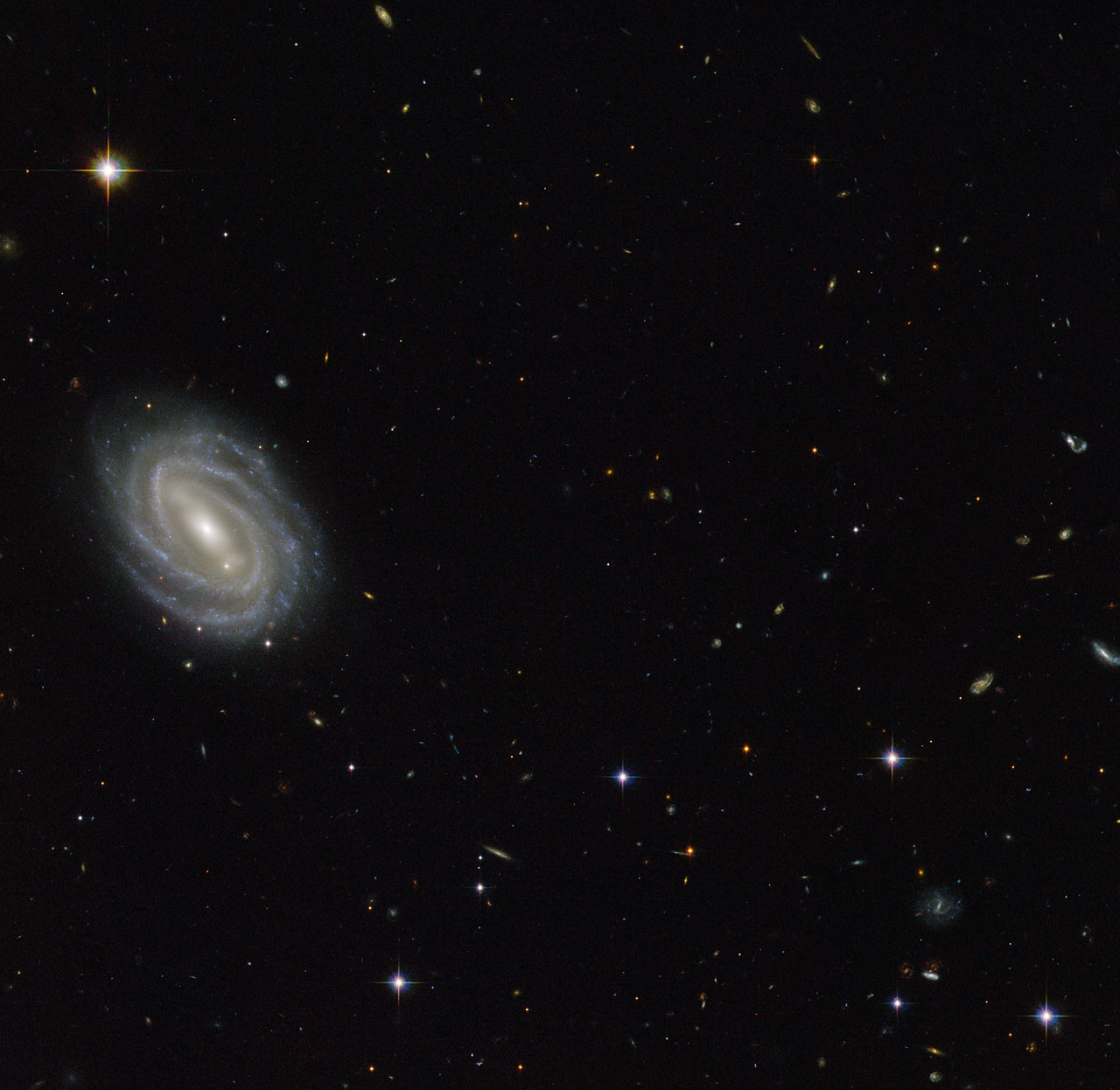
Evolving Dark Energy — DESI and the Changing Universe
Evolving Dark Energy: DESI and the Changing Universe
Уривок для читання
For more than a century, physicists have worked to understand the forces shaping the universe. Gravity pulls matter together. But something else is pushing the universe apart — and it is winning. Astronomers call this mysterious force dark energy, and a landmark instrument has now produced evidence that challenges everything scientists thought they knew about it.
The Dark Energy Spectroscopic Instrument, known as DESI, is mounted at the Kitt Peak National Observatory in Arizona, USA. Over the past several years, DESI has surveyed more than 15 million galaxies and quasars — the intensely bright cores of distant galaxies powered by supermassive black holes. By measuring the light from these objects, scientists have constructed the largest three-dimensional map of the universe ever created, spanning approximately 11 billion years of cosmic history.
To understand why this map is so significant, it is necessary to understand how astronomers use light to measure the universe. When a distant galaxy moves away from us, its light waves stretch. This stretching shifts the light toward the red end of the visible spectrum — a phenomenon called redshift. By measuring how much a galaxy’s light has shifted, scientists can calculate both how far away it is and how fast the universe was expanding at the time that light was emitted. This technique, called spectroscopy, is the core method DESI uses.
Within the galaxy data, DESI’s scientists looked for a specific pattern called baryon acoustic oscillations, or BAOs. These are regular, repeating ripples in the distribution of matter throughout the universe — essentially the frozen echoes of sound waves that existed in the hot, dense plasma of the early universe. BAOs leave a predictable “standard ruler” imprint on the large-scale structure of galaxies, allowing scientists to measure how the universe has expanded at different points in cosmic history.
The results were unexpected. According to the standard model of cosmology — known as the Lambda-CDM model — dark energy is a fixed, unchanging property of empty space itself, sometimes called the cosmological constant. This concept originated with Albert Einstein, who introduced it as a mathematical term in his equations of general relativity. For decades, observations appeared to confirm that dark energy remained constant over time.
DESI’s data tells a different story. The analysis suggests that dark energy may have been stronger in the ancient universe and has weakened over billions of years. In other words, dark energy may not be a fixed cosmological constant — it may be a dynamic force that evolves over time.
The statistical significance of this finding ranges from 2.8 to 4.2 sigma, depending on which datasets are combined. In physics, a result is generally considered a confirmed discovery only when it reaches 5-sigma significance — a threshold that indicates the probability of the result being due to random chance is less than one in 3.5 million. DESI’s current findings have not crossed that threshold, which means the result is compelling but not yet conclusive.
If future observations confirm that dark energy is evolving, it would represent one of the most significant paradigm shifts in the history of modern physics. The Lambda-CDM model — which has successfully explained a wide range of observations for decades — would need to be revised or replaced. Entirely new theoretical frameworks would be required to explain what dark energy actually is and why it changes.
The universe is not finished surprising us. DESI continues to collect data, and scientists expect that additional years of observation will either strengthen this result or reveal that the current signal is a statistical artifact. Either outcome will advance our understanding of the cosmos.
Словниковий запас
- Dark energy — a hypothetical form of energy thought to be responsible for the accelerating expansion of the universe; its nature is not yet fully understood
- Cosmological constant — a term introduced by Einstein representing a fixed energy density filling space uniformly; originally proposed to describe a static universe, later reinterpreted as dark energy
- Sigma significance — a statistical measure of how confident scientists are in a result; higher sigma values indicate lower probability that the result is due to chance (5-sigma = discovery threshold)
- Redshift — the stretching of light waves toward longer (redder) wavelengths as a source moves away from the observer; used to measure cosmic distances and expansion rates
- Quasar — an extremely luminous core of a distant galaxy powered by a supermassive black hole actively consuming surrounding matter
- Spectroscopy — the technique of analyzing the spectrum of light emitted or absorbed by an object to determine its composition, distance, and motion
- Cosmic expansion — the ongoing increase in the distances between galaxies throughout the universe, first observed by Edwin Hubble in the 1920s
- Lambda-CDM model — the standard model of cosmology, which incorporates dark matter, dark energy as a cosmological constant, and the Big Bang framework
- Baryon acoustic oscillations (BAOs) — regular, repeating patterns in the large-scale distribution of matter, caused by sound waves in the early universe; used as a standard ruler for cosmic measurements
- Paradigm shift — a fundamental change in the basic framework or assumptions within a scientific field, replacing an existing model with a new one
Питання для розуміння
1. What is DESI, and where is it located? (Short answer)
2. How many galaxies and quasars did DESI survey to build its map of the universe?
- A) 1.5 million
- B) 5 million
- C) 15 million
- D) 150 million
3. What is redshift, and why is it useful for mapping the universe? (Short answer)
4. What are baryon acoustic oscillations, and how do scientists use them?
- A) Explosions caused by dark energy colliding with matter
- B) Regular patterns in matter distribution used as a standard measurement tool
- C) Radio signals detected from distant quasars
- D) Vibrations in the fabric of spacetime near black holes
5. What does the Lambda-CDM model predict about dark energy?
- A) Dark energy decreases steadily over time
- B) Dark energy is a fixed, constant property of empty space
- C) Dark energy is produced by quasars
- D) Dark energy only exists near the edges of galaxies
6. What unexpected result did DESI’s data suggest about dark energy? (Short answer)
7. What does it mean for a scientific finding to reach “5-sigma significance”?
- A) Five independent research teams confirmed the result
- B) The finding has been published in five different journals
- C) The probability of the result being due to chance is less than one in 3.5 million
- D) The experiment was repeated five times with identical outcomes
8. DESI’s findings about dark energy currently have a sigma significance of:
- A) 1.2 to 2.0 sigma
- B) 2.8 to 4.2 sigma
- C) 5.1 to 6.0 sigma
- D) 7.3 to 8.9 sigma
9. Why would a confirmed change in dark energy require a paradigm shift in physics? (Short answer)
10. What will scientists do to determine whether DESI’s current findings are correct? (Short answer)
Critical Thinking
- The Lambda-CDM model has successfully explained many observations for decades. Why might scientists be reluctant to accept that it needs to be revised? What qualities of good scientific practice are demonstrated by requiring 5-sigma significance before declaring a discovery?
- DESI’s map spans 11 billion years of cosmic history. What does it mean to “look back in time” when observing distant galaxies? Why is the universe’s age and size relevant to understanding dark energy?
- Dark energy is described as “mysterious” throughout the passage. It cannot be directly observed — only its effects can be measured. How is this similar to or different from other scientific concepts that cannot be directly seen, such as gravity or electric fields?
- If dark energy is confirmed to be weakening over time, what might this suggest about the ultimate fate of the universe? Consider the relationship between dark energy and cosmic expansion.
- DESI’s discoveries depend entirely on technology — a large precision instrument measuring faint light from objects billions of light-years away. What does this tell us about the relationship between technological capability and scientific knowledge? Are there limits to what telescopes and instruments can reveal?
Fill in the Blank
- DESI used the technique of ______ to analyze light from millions of galaxies and measure how the universe expanded at different points in its history.
- According to Einstein’s original proposal, dark energy acts as a ______, representing a fixed energy density that does not change over time.
- DESI’s finding that dark energy may be weakening could require a ______ — a fundamental revision to the standard model of cosmology.
Extended Response
Prompt 1: Explain how DESI’s discovery challenges Einstein’s cosmological constant. In your response, describe what the cosmological constant predicted, what DESI’s data suggests instead, and why scientists have not yet declared this a confirmed discovery. Use scientific vocabulary from this worksheet in your answer.
Prompt 2: The passage ends with the statement: “The universe is not finished surprising us.” Based on the content of the passage, write a reflective essay discussing what this statement means in the context of scientific progress. Consider: What does it mean when our best scientific models are challenged? Is it a failure of science, or a sign that science is working correctly? Support your argument with specific examples from the passage.
Looking for free ESL worksheets? Browse our full collection — printable resources for every level and age group. Browse Free Worksheets →








 UK
UK  EN
EN  ZH
ZH  ZH_CN
ZH_CN  KO
KO  VI
VI  FR
FR  AR
AR  ES
ES  HI
HI  PT
PT  BN
BN  RU
RU  JA
JA  TR
TR  DE
DE  IT
IT  PL
PL  ID
ID  TH
TH  FA
FA  TL
TL  HE
HE  UR
UR  SW
SW  RO
RO  NL
NL  MS
MS  TA
TA  PS
PS  HU
HU  EL
EL  SV
SV  NB
NB  NN
NN  DA
DA  CS
CS  SR
SR  AM
AM