

How to Teach Prepositions: 9 Methods That Actually Stick
Ask any experienced ESL teacher to name the grammar topic that keeps coming back to bite advanced students, and the answer is almost always the same: prepositions. A C1 learner can write a flawless conditional and still email you about being “on the bus station at Friday.” That’s not a knowledge gap — it’s the natural result of how most teachers approach the topic. If you want to know how to teach prepositions in a way that actually sticks, the trick is to stop treating them like vocabulary lists and start treating them like the slippery, context-bound words they are. The methods below have worked across age groups, levels, and L1 backgrounds in twenty years of Taipei classrooms, and they all share one thing in common: they put meaning before form.

Why teaching prepositions feels impossible
English has around 150 prepositions, but only about 70 are in regular use. Worse, the rules teachers love to cite — “at” for points in time, “in” for enclosed spaces — break the second you reach an idiom. We sit on a sofa but in an armchair. We arrive at the airport but in Taipei. We’re on the bus but in the car. Linguists call this collocational arbitrariness, and it’s why grammar reference books punt with phrases like “you just have to learn them.”
The truth is, most preposition errors aren’t grammar mistakes — they’re memory mistakes. Students learned the word in the wrong context, or never anchored it to one in the first place. That reframe changes how you should be teaching, because memory has rules even when grammar doesn’t.
The four types every teacher should map
Before you plan your first preposition lesson, get the four functional categories straight in your own head. Students don’t need the labels, but you do — because the wrong category at the wrong CEFR level is what creates confusion.
- Prepositions of place — in, on, under, behind, between, next to. These show position. Always teach these first.
- Prepositions of time — at (6 p.m.), on (Monday), in (March). The “at-on-in” rules are usable but full of exceptions.
- Prepositions of movement / direction — to, into, through, across, along, towards. Easier to demonstrate physically than to explain.
- Prepositional collocations — depend on, look forward to, good at. These behave more like vocabulary than grammar.
Map your scope and sequence so place comes first, time comes second after students can produce locative sentences, and collocations get drip-fed through the rest of the course rather than crammed into one lesson.
1. Start with prepositions of place (and skip the master list)

The easiest way to teach prepositions is to start with the ones you can point to. A pencil on a desk, a book under a chair, a student next to the door. Spatial relationships are universal — every L1 has them — so the cognitive load is in mapping new sound to known concept, not in learning a new concept.
Begin with six: in, on, under, behind, in front of, next to. That’s it. Master those before you introduce between, above, below, near, beside, or among. Handing a beginner a list of twenty prepositions of place is the surest way to guarantee they remember none of them three weeks later.
2. Teach prepositions in context, never in isolation
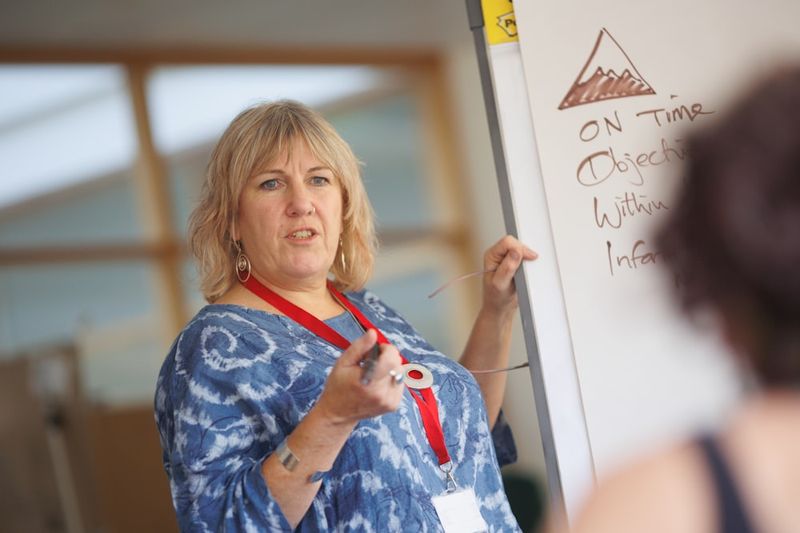
A preposition by itself means almost nothing. Show a student the word “at” with no sentence and ask what it means — even an advanced learner will hesitate. Show them “I’ll meet you at the corner at six,” and the meaning lands instantly.
Every preposition you introduce should arrive inside a complete sentence, ideally one that reflects something the student would actually say. “She lives in Taipei” beats “in = inside enclosed space” by a country mile, because the first one is reusable language and the second is a dictionary entry. Have students copy the example sentence into their notebook before you ever ask them to produce their own. That sentence becomes the anchor they’ll come back to when the rule gets fuzzy.
3. Demonstrate before you explain — the TPR move
For prepositions of place and movement, words come last. Show, don’t tell. Stand behind a chair. Walk around a desk. Put a marker under a book. Have a student do the same. Only after the meaning is physically clear do you write the preposition on the board.
This is Total Physical Response in action, and it’s the single most reliable method for the most concrete prepositions. For a deeper walkthrough of how to build TPR sequences into a lesson, see our guide on TPR examples. The principle: when the body experiences the meaning before the brain processes the word, retention jumps sharply.
4. Run picture-to-sentence drills

Once meaning is anchored physically, switch to two-dimensional input. A simple picture of a bedroom does more work than a worksheet. Point to the lamp. “Where is the lamp?” Student: “The lamp is on the table.” Point to the cat. “Where is the cat?” Student: “The cat is under the bed.”
Pictures buy you something the classroom can’t: visual referents for prepositions that aren’t easy to act out — between, above, in front of when the front isn’t obvious. Stock a folder of ten or twelve room scenes, street scenes, and park scenes that you can pull up in any lesson. They’ll outlast any single textbook.
5. Teach chunks, not isolated words

This is where most courses go off the rails. Students who memorise “in” as a single word will produce “in Monday” every time. Students who memorise the chunk “on Monday” — as one fixed unit, like a vocabulary item — will not.
So treat collocations like vocabulary. “At home.” “In the morning.” “On the bus.” “By car.” “For an hour.” These are lexical chunks, not grammar to be reasoned out. The lexical approach is what makes the difference between students who can recite the rule and students who use the right preposition without thinking. We dig further into chunking and collocation work in vocabulary teaching strategies, and the same principles apply directly here.
6. Drill the in / on / at contrast
For prepositions of time, the three musketeers — in, on, at — deserve their own dedicated lesson. Most learners’ L1 doesn’t make these distinctions the same way English does, so direct contrast helps the pattern crystallise.
- At + a precise time → at 7 p.m., at noon, at midnight
- On + a day or date → on Monday, on July 4th, on my birthday
- In + a longer period → in the morning, in March, in 2026, in the summer
Drill them in matched-pair sentences: “I get up at seven. I have class on Monday. I sleep in the afternoon.” Then mix them randomly so students have to choose, not recite. The contrast drill is short, brutal, and far more effective than another fill-in-the-blank worksheet.
7. Check understanding with concept questions
“Do you understand?” is the world’s worst question, because the answer is always yes whether the student gets it or not. Concept checking questions catch the silent misunderstanding. After teaching “I’ll see you at three o’clock,” ask: “Will I see you before three? Will I see you after three? Will I see you at four?” The student who says “Yes, no, no” has the concept. The student who hesitates has only the rule.
This works especially well for the dependent prepositions in collocations — “good at” vs “good in,” for example — where surface logic and English convention don’t match. For a full set of question templates you can drop into any preposition lesson, see concept checking questions.
8. Correct preposition errors lightly — and selectively

Heavy correction kills fluency on a topic this fragile. A student who’s interrupted every time they say “on Monday morning” instead of “on Monday in the morning” learns to fear the topic, not the rule.
Use delayed correction for free production: jot the error down, finish the activity, then run a focused board correction at the end. Use immediate correction sparingly — only during accuracy-focused drills where the whole point is precision. And accept that some prepositions will need to be re-taught three or four times before they’re permanent. That’s not a teaching failure. That’s how memory works.
9. Anchor everything to a “25 useful prepositions” list
The 25 most common English prepositions account for over 90% of preposition use in spoken English: of, in, to, for, with, on, at, by, from, about, as, into, like, through, after, over, between, out, against, during, without, before, under, around, among. Build your syllabus around this set rather than the textbook’s full inventory.
Pin a visual copy of the list to your classroom wall. Highlight five at a time as your “active” prepositions for the week. Recycle them into warm-ups, writing prompts, and exit tickets until they’re automatic, then highlight the next five. Six weeks gets you the full set with a depth of practice no textbook chapter can match.
How to explain prepositions to kids
Young learners don’t need explanations. They need games. The classic “Simon Says” with movement prepositions — “Simon says put your pencil under your chair, on your head, between your ears” — gets the meaning across faster than any whiteboard diagram. So does hide-and-seek with classroom objects: hide a toy, then ask “Is it on the shelf? Is it under the desk? Is it behind the curtain?” until they find it.
For seven-to-ten-year-olds, picture stories work best. Read a short story aloud and have students draw what they hear, paying attention to where things are. “The cat sat on the wall. A dog ran under the cat. A bird flew above the cat.” Their drawing becomes a comprehension check no quiz can match.
Watch this short explainer with your class
Snap Language Learner’s six-minute breakdown is one of the cleanest student-facing introductions on YouTube. Use it as a pre-class flip or a mid-unit consolidation — it pairs well with the picture-to-sentence drills above.
Practice the way memory actually works

Spaced repetition beats massed practice for everything, but especially for arbitrary form. A single sentence rewrite at the end of every lesson — “Write three sentences about your morning using at, on, in” — does more for long-term retention than a once-a-month grammar quiz. Make it a routine, not an event.
For older learners, a “preposition diary” works beautifully. Have students log one collocation they noticed in real English that week — from a song lyric, a film subtitle, a sign, an email. The act of noticing is the lesson. Cambridge’s research on usage-based grammar acquisition supports this: prepositions enter long-term memory most reliably through repeated, contextualised exposure rather than rule-based drilling.[1]
What I’d skip
Two things I’ve stopped doing entirely. First, the “preposition rules” poster with twelve exceptions in small print. Students stare at it, copy it, and never internalise a single line. Pictures and example sentences do the same work without the cognitive overhead. Second, the multiple-choice preposition test as your only assessment. It rewards pattern recognition, not production. A short writing task — “Describe your bedroom in five sentences” — tells you ten times more about what a student can actually use.
Prepositions reward the long game. Teach a small set deeply, recycle them obsessively, accept that mastery comes in months not weeks, and you’ll watch your students’ written English clean up across the board. Get the rest of your lesson architecture sharp too — our ESL lesson planning guide walks through how to slot recurring grammar like this into a sequence that builds.
ذرائع
- Cambridge ELT — Teaching Collocations in the Classroom — research-backed argument for chunk-based teaching of prepositional language.
- American English (US Department of State) — Teacher’s Corner: Prepositions — classroom-tested activity bank from the State Department’s English teaching program.
- British Council TeachingEnglish — Teaching Prepositions — practitioner-focused breakdown of context-first preposition instruction.
Looking for free ESL worksheets? Browse our full collection — printable resources for every level and age group. Browse Free Worksheets →
Students can access free worksheets and reading materials at 18KEnglish.com.








 UR
UR  EN
EN  ZH
ZH  ZH_CN
ZH_CN  KO
KO  VI
VI  FR
FR  AR
AR  ES
ES  HI
HI  PT
PT  BN
BN  RU
RU  JA
JA  TR
TR  DE
DE  IT
IT  PL
PL  ID
ID  TH
TH  FA
FA  UK
UK  TL
TL  HE
HE  SW
SW  RO
RO  NL
NL  MS
MS  TA
TA  PS
PS  HU
HU  EL
EL  SV
SV  NB
NB  NN
NN  DA
DA  CS
CS  SR
SR  AM
AM