
50 No-Prep ESL Activities for Mixed-Level Classrooms
Every ESL teacher knows the moment: the photocopier is jammed, the projector bulb is dead, half your class hasn’t done the homework, and one student finished the workbook three weeks ago. You need an activity right now — one that runs without materials, scales across proficiency levels, and keeps every student talking. This guide collects fifty activities that fit that brief. Nothing here needs prep, a worksheet, or a textbook. Each one has a built-in path for stretching stronger students and supporting weaker ones, so a mixed-level class moves together instead of splitting in two.
Why No-Prep, Mixed-Level Activities Matter
Most ESL activity lists assume a tidy classroom: one level, one textbook, materials printed in advance. Real classrooms are messier. You teach across A1 to B2 in the same room, a new student walks in halfway through term, or the schedule shifts and you lose your prep period. No-prep activities give you a stable spine when the rest of the lesson collapses. Mixed-level differentiation — adjusting the demand on the fly — keeps stronger students stretched and weaker students included, instead of bored or lost.
The fifty activities below are grouped by lesson moment: warm-ups, speaking and listening, vocabulary and grammar, reading and writing, and closure. Each section closes with a short differentiation note so you can scale up or down without rewriting the activity.
Warm-Ups (5–10 Minutes, Zero Materials)
- Two Truths and a Lie — students share three personal statements; classmates guess the false one.
- Word Association Chain — one student says a word, the next adds an associated word, and the chain continues around the room.
- Last Letter Words — each word must start with the final letter of the previous word, themed by topic.
- Alphabet Race — in pairs, students list a vocabulary item for every letter of the alphabet within three minutes.
- Find Someone Who — students mingle and ask yes/no questions to find classmates matching prompts you call out.
- Yesterday/Today/Tomorrow — each student shares one true sentence in past, present, and future tense.
- Question Ball — toss an imaginary ball; whoever catches it answers a question from the thrower.
- زمرے — name a category (jobs, weather, food) and students take turns listing items without repeating.
- Hot Seat — one student faces away from the board while teammates describe the word written behind them.
- Topic Ladder — start with an easy topic (weather), then climb to harder ones (regrets, politics), one sentence per student per rung.
Differentiation note: Stronger students must use a target structure (present perfect, second conditional). Weaker students get sentence frames written on the board (“I have never ___”).

Speaking and Listening Activities
- Information Gap — Partner A and Partner B each hold half the information about a picture or schedule and must talk to complete the missing pieces.
- Describe and Draw — one student describes an image only they can see while their partner draws it blind.
- Back-to-Back Drawing — same as above but with students sitting back-to-back, forcing clearer language.
- Spot the Difference — two students describe a scene from memory and find what each one forgot.
- Speed Dating — students rotate partners every ninety seconds, answering a new discussion question each round.
- Conversation Circles — inner and outer circle face each other; outer circle rotates one seat after each prompt.
- Just a Minute — students speak on a topic for sixty seconds without pausing, repeating, or hesitating.
- Show and Tell — students describe an object in their bag or pocket and answer three questions about it.
- Role-Play Card Draw — students pull two slips (a setting, a problem) and improvise a two-minute dialogue.
- Survey Bingo — students invent five questions, then mingle until they get a different classmate’s answer for each one.
Differentiation note: Pair stronger students with weaker ones as “language coaches.” The stronger student must paraphrase, not correct. Both get speaking practice and the weaker student gets a scaffold.
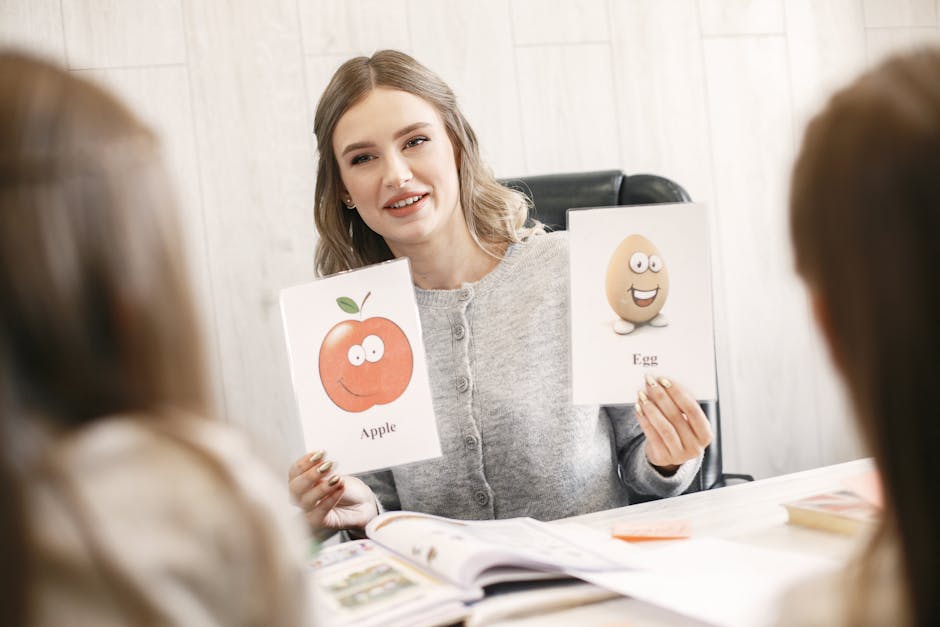
Vocabulary and Grammar Activities
- Vocabulary Pyramid — one student describes words at the top of a list while their partner guesses; switch roles each round.
- Hot Potato — students toss an imaginary potato while saying words from a category; whoever pauses too long is out.
- Definitions Game — students write definitions for target words; classmates match definitions to words.
- Word Bingo — students write nine self-chosen vocabulary words in a grid; you call out definitions and they cross matches.
- Sentence Builder — write five random words on the board; teams race to combine all five into one grammatical sentence.
- Grammar Auction — students “bid” on sentences and decide whether each one is correct or broken; winners explain why.
- Tense Charades — students act out a verb in a specific tense; classmates guess both the verb and the tense.
- Mingle and Match — half the class gets a sentence stem, the other half gets endings; everyone walks until pairs match.
- Concept Check Questions — students invent their own concept-check questions for new grammar and quiz each other.
- Error Hunt — write three sentences on the board with one error each; teams identify and correct them on whiteboards.
Differentiation note: Give weaker students closed-task versions (multiple choice) and stronger students open-task versions (produce your own). Same activity, two demand levels.

Reading and Writing Activities
- Running Dictation — a text is taped on the wall; runners read, sprint back to dictators, and the team reconstructs it.
- Dictogloss — you read a short text twice at natural speed; students take notes and reconstruct it in groups.
- Story Cubes (Improvised) — name six random objects; teams build a one-paragraph story using all six.
- Headline Match — read three headlines aloud; students predict the article topic and compare predictions afterward.
- Predict the Ending — read two-thirds of a short story; students write their own endings before hearing the original.
- Group Story Build — one student writes a sentence, folds the paper, passes it on; unfold at the end and read aloud.
- Five-Sentence Story — students write a complete narrative in exactly five sentences using a target tense.
- Letter to a Character — students draft a short letter to a person from a reading, giving advice or asking questions.
- Recipe Reading — students dictate a recipe to a partner who writes it; check for imperatives and sequencing language.
- Newspaper Headlines — write three odd headlines; students invent the article in a paragraph.
Differentiation note: Set a minimum word count for stronger students and a sentence frame count for weaker ones (“use three sentences with ‘because'”). Both produce; expectations differ.

Closure and Review Activities
- Exit Ticket Questions — each student writes one question about the lesson on a slip and hands it in as they leave.
- 3-2-1 Reflection — students state three things learned, two questions, and one thing they will use.
- Stand Up / Sit Down — read true/false review statements; students respond physically instead of speaking.
- Word of the Day Vote — students nominate their favorite new word and defend the choice in one sentence.
- Lesson Story Recap — each student adds one sentence to a chain story summarizing the lesson.
- Whip Around — going fast around the room, every student says one thing they learned in five words or fewer.
- Sketch Notes — students draw the lesson on a single sticky note with no words; classmates guess the topic.
- Snowball Toss — students write a question on paper, crumple it, toss; whoever catches answers aloud.
- Backchannel Board — leave the board open for two minutes; students write anonymous lingering questions.
- Praise Chain — each student names one classmate and one specific thing that classmate said well today.
Differentiation note: Closure should be the easiest moment in the lesson. Lower the language bar here — even your weakest student should leave the room having spoken successfully.

How to Differentiate Any Activity in Three Moves
Most teachers think differentiation means running two lessons at once. It does not. With these three moves you can stretch any activity above to fit a mixed group without splitting the class.
- Adjust the output, not the input. Everyone hears the same prompt. Stronger students respond with a paragraph; weaker students respond with one sentence using a frame.
- Change the role, not the content. In any pair task, designate one student as the speaker and one as the questioner. Both engage; demand level differs.
- Add a tier of challenge. Build in an optional “and now use the past perfect” or “and now justify your answer” twist. Stronger students opt in; the rest finish the base task.

Three Pitfalls to Avoid
No-prep does not mean no-thought. The activities above fail when teachers ignore three traps.
- Skipping the model. Even a no-prep task needs a thirty-second demonstration. Show one round with a strong student before releasing the class.
- Letting timing drift. Mingle and speaking tasks balloon if uncapped. Set a visible timer and stop the activity while it still has energy.
- Treating mixed-level as a problem. Stronger students who explain or coach learn more, not less. Design tasks so the stretch is built in, not bolted on.

Putting It Together
A strong no-prep lesson chains four or five of these activities together: a warm-up to set the language, a productive speaking task, a vocabulary or grammar focus, a short writing or reading moment, and a closure. Rotate them across the week so students stay surprised. Mixed-level classrooms do not need more materials — they need flexible activities with built-in stretch. Keep this list near your desk. The next time the photocopier dies, your lesson plan is already alive.
Sources and Further Reading
- TeachingEnglish — British Council — activity library and methodology articles for ESL teachers.
- BBC Learning English — short authentic listening texts useful for dictogloss and prediction activities.
- TESOL انٹرنیشنل ایسوسی ایشن — professional standards and journals on differentiated instruction.
- کیمبرج انگریزی — teaching frameworks, CEFR descriptors, and assessment resources.
- Wikipedia — Differentiated Instruction — overview of the underlying pedagogical model.
- Wikipedia — Communicative Language Teaching — context for why information-gap and task-based activities work.
Looking for free ESL worksheets? Browse our full collection — printable resources for every level and age group. Browse Free Worksheets →
Students can access free worksheets and reading materials at 18KEnglish.com.
Shop on Amazon
ESL Teaching Resources on Amazon →
As an Amazon Associate we earn from qualifying purchases.









 UR
UR  EN
EN  ZH
ZH  ZH_CN
ZH_CN  KO
KO  VI
VI  FR
FR  AR
AR  ES
ES  HI
HI  PT
PT  BN
BN  RU
RU  JA
JA  TR
TR  DE
DE  IT
IT  PL
PL  ID
ID  TH
TH  FA
FA  UK
UK  TL
TL  HE
HE  SW
SW  RO
RO  NL
NL  MS
MS  TA
TA  PS
PS  HU
HU  EL
EL  SV
SV  NB
NB  NN
NN  DA
DA  CS
CS  SR
SR  AM
AM