
Scaffolding in ESL: 8 Techniques to Support Struggling Students
In Vygotsky’s 1978 framework, every learner has a Zone of Proximal Development — the gap between what they can do alone and what they can do with help. For ESL teachers, that gap is exactly where the real work happens. When a student shuts down mid-task because the language is too hard, the problem usually isn’t motivation. It’s missing scaffolding in ESL. The eight techniques below give you a practical toolkit for bridging that gap without doing the thinking for your students.
What Scaffolding in ESL Actually Means
The term comes from construction: temporary supports that hold a building in place while it’s going up, then get removed once the structure can stand on its own. In language teaching, scaffolding works the same way. You’re not simplifying the task — you’re giving students what they need to complete a harder task than they could manage alone.
This matters because a common mistake is protecting struggling students by giving them easier tasks. Lower expectations don’t build language proficiency. They create a comfortable plateau. Scaffolding, done right, keeps the cognitive demand high while providing access to language tools the student doesn’t yet have internalized.

1. Sentence Frames and Starters
Sentence frames are one of the fastest ways to unlock student output. Instead of asking a lower-level student to construct a full response from scratch, you give them the grammatical skeleton and ask them to fill in the meaning.
Examples by function:
- Opinion: “I think _______ because _______.”
- Comparison: “_______ is similar to _______, but _______.”
- Cause and effect: “When _______, the result is _______.”
- Agreeing/disagreeing: “I agree with _______ because _______. However, _______.”
Choose frames that match your grammar focus. If you’re teaching present perfect, use “I have already _______, but I haven’t _______ yet.” Students get grammar practice and speaking practice at the same time, without staring at a blank page. Remove the frames once students start producing those structures naturally — not before. If a student still reaches for the frame after six weeks, they haven’t internalized the pattern yet.

2. Graphic Organizers
Graphic organizers give students a visual map before they write or speak. A student who can’t produce a paragraph from a blank prompt can often fill in a flowchart, a Venn diagram, or a simple T-chart — and then read that chart aloud or convert it into sentences.
Three organizers worth keeping in your toolkit:
- The Fishbone Diagram — ideal for cause-and-effect topics. Students list one main effect and contributing causes along the bones. Works well for reading comprehension and discussion prep.
- The Venn Diagram — for comparison writing. Even at low levels, students can fill in words and phrases. The overlap section often generates more language than the differences section.
- The 5W Chart — “Who, What, Where, When, Why” — a framework for any news article, story, or event. At higher levels, add “How” and “So what?”
Research supports this approach. A 2007 study by Stull and Mayer in the Journal of Educational Psychology found that graphic organizers improved learning outcomes most when students generated them rather than receiving pre-filled versions. Let students build their own charts, even messily — the construction is part of the learning.

3. Model Texts
Before asking students to write, show them what the finished product looks like. A model text activates real language — students see sentence structure, vocabulary, register, and organization all working together in context. That’s more useful than a rubric alone.
Three ways to use model texts without turning them into templates students just copy:
- Analyze before you imitate. Ask students to circle the topic sentence in each paragraph, underline transition words, or label where the writer states their opinion. This shifts the focus from copying to comprehension.
- Create partial models. Give students a text with some sections complete and others left blank. They must continue in the same style and register.
- Bad models work too. Show a poorly organized email or an unfocused paragraph. Ask students what’s wrong and how to fix it. Students tend to write stronger work when they’ve first identified weak writing.
For lower levels, a model as simple as a five-sentence paragraph about the teacher’s weekend — using the same structure you’re expecting — can unlock writing that a prompt alone never would.
4. Pre-Teaching Vocabulary
Nothing stops a reading or listening task faster than four unknown words in the first two lines. Pre-teaching key vocabulary before the main activity removes that friction without reducing the challenge of the text itself.
The rule: pre-teach only the words needed to access the task, not every unfamiliar word. Over-teaching vocabulary before a reading becomes its own bottleneck — students manage a word list instead of engaging with meaning.
A practical sequence:
- Choose five to eight words that are critical for comprehension (not just interesting).
- Introduce them with images, examples, and brief concept-check questions — not definitions.
- Have students use each word in a sentence before the reading begins.
- Leave unknown low-frequency words alone during the task. Students can look them up after.
Words learned through contextual use at multiple points — introduction, task, review — stick far better than words learned from a definition list.

5. Visual Supports and Word Walls
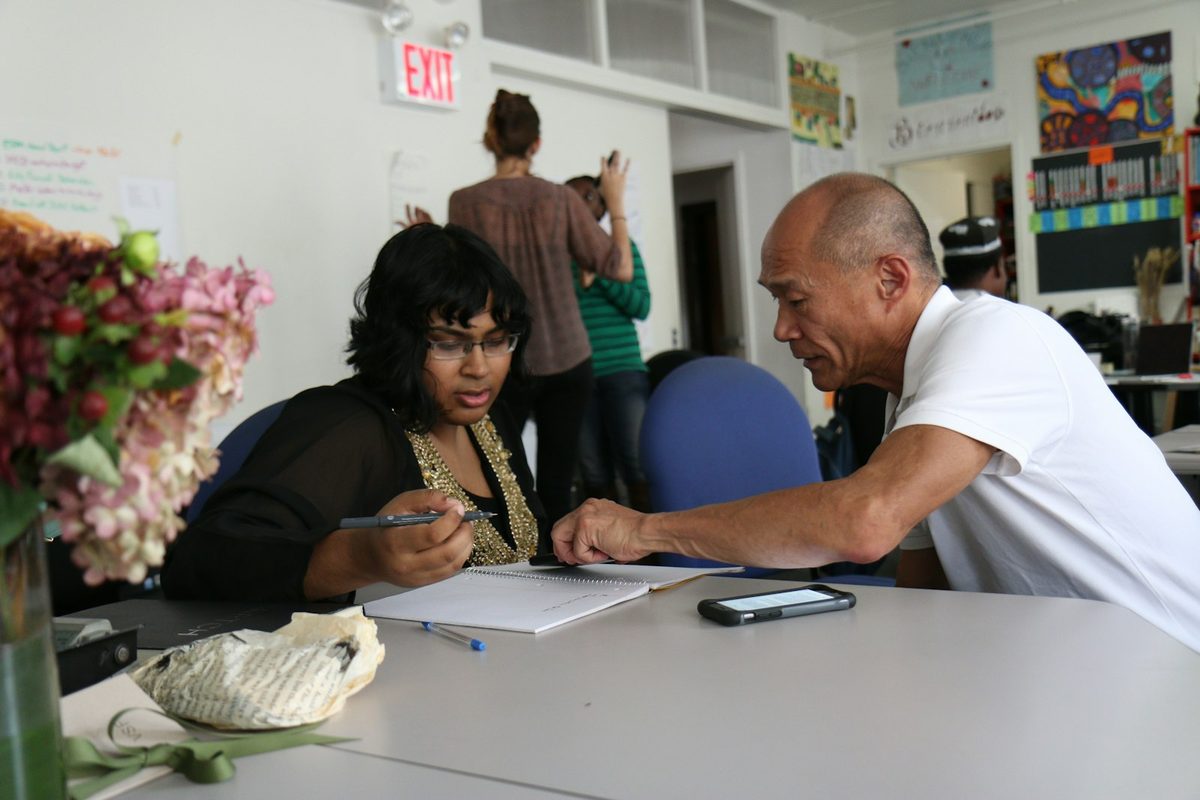
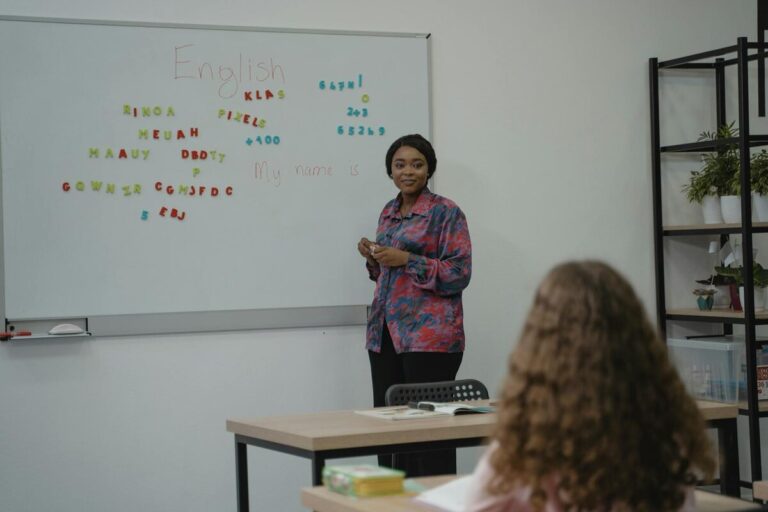
A word wall isn’t decoration. For ESL students — especially those whose first language uses a different script — having key vocabulary, grammar patterns, and classroom language visible in the room provides a reference they can glance at without stopping to ask.
What belongs on an ESL word wall:
- High-frequency academic vocabulary (from the Academic Word List)
- Topic-specific vocabulary for the current unit
- Functional classroom language: “Could you repeat that?”, “I’m not sure, but I think…”, “Can you give an example?”
- Grammar patterns the class is currently practising
One technique that pays off: let students contribute to the word wall. When a student encounters a word they find useful, they write it on a card and add it. Ownership increases use. Visual supports extend beyond the walls, too — timelines for past tense, sentence structure diagrams, picture dictionaries for beginners — all of these reduce cognitive load and free working memory for the production task itself.
6. Chunking Tasks
When a task feels overwhelming, students often give up before they start. Chunking means breaking the task into discrete, manageable steps and checking in after each one.
A 300-word opinion essay becomes:
- Choose a position (2 minutes, discuss in pairs)
- List three reasons (5 minutes, graphic organizer)
- Write your topic sentence (5 minutes, sentence frame available)
- Write body paragraph 1 using your first reason (10 minutes)
- Peer check: does the paragraph match the frame? (3 minutes)
The student who freezes at “write an essay” can almost always handle “write one sentence about your first reason.” Each chunk produces a small win, which generates momentum for the next step. Chunking also makes it easier to intervene — instead of watching a student stare at a blank page for fifteen minutes, you catch the sticking point at step 2 or 3 and address it immediately.
7. Strategic Grouping
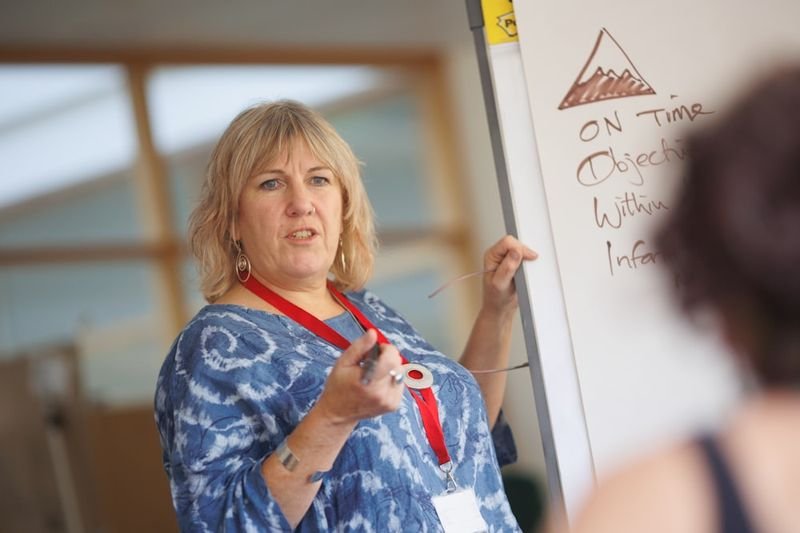
Who students work with is itself a scaffold. Heterogeneous pairing — matching a stronger student with a weaker one for specific tasks — creates natural peer support without singling anyone out. The stronger student consolidates their understanding by explaining; the weaker student gets a model at their level.
A few grouping principles:
- Fluency tasks (conversation, discussion) — pair similar levels. Mismatched levels in open conversation often result in one student dominating.
- Structured tasks (gap fills, sentence building, matching) — mixed levels work well. The task itself regulates the interaction.
- Reading tasks — form groups of three: one stronger reader, two at grade level. The stronger reader reads aloud while the others follow.
Strategic grouping only works if students rotate. If the same “weaker” students are always paired with “stronger” ones, it becomes a label rather than a scaffold. For more on managing different ability levels in one room, see Teaching Mixed-Ability ESL Classes.

8. The Gradual Release Model (I Do, We Do, You Do)
The gradual release of responsibility model ties everything else together. Developed by Pearson and Gallagher in 1983, it remains the clearest framework for moving students from dependence to independence — and it applies to every language skill.
The three stages:
I do — The teacher models the task completely, thinking aloud about the process. “I’m going to write a topic sentence. First, I think about my main idea… I want to say that sentence frames save revision time, so I’ll write: ‘Sentence frames reduce the gap between knowing an idea and being able to express it.'”
We do — Teacher and students complete the next example together. The teacher guides, students contribute, and errors get corrected in real time. This is where sentence frames and graphic organizers are most useful because they give structure to the shared effort.
You do (together) — Students work in pairs or small groups on a new example. The teacher circulates, observes, and provides targeted support without doing the task for anyone.
You do (alone) — Students complete the task independently. This is where you get an accurate read of what they’ve actually internalized versus what they borrowed from the scaffold.
The critical move is releasing at the right pace. Moving to “you do” too early wastes the scaffold. Staying in “we do” too long creates learned helplessness. Watch for the moment students start completing the “we do” step before you finish prompting — that’s the signal they’re ready to work independently.

When to Take the Scaffold Down
The purpose of scaffolding is its own removal. If you’re still giving the same sentence frames to the same students three months later with no plan for fading them, the scaffold has become a crutch.
Signs a student is ready to work without a particular support:
- They complete the task faster than expected and seem bored by the frame
- Their independent work matches the quality of their scaffolded work
- They start producing the structure spontaneously in speech or writing
The most effective fading technique is partial removal. Instead of pulling the frame entirely, give only the first word of each sentence, then nothing. Gradual withdrawal is more effective than sudden removal, which can produce a confidence crash in students who were relying on the support.
A Scaffolded Lesson in 45 Minutes
Here’s how a single lesson might sequence several of these techniques together:
- Pre-teach six vocabulary items from the reading — concept-check questions, not definitions (10 min)
- Read the model text together — students identify structure and highlight key phrases (5 min)
- Graphic organizer — students plan their own paragraph (5 min)
- I do — teacher writes a sample paragraph aloud (5 min)
- We do — class writes the opening sentence together (5 min)
- You do (pairs) — students write the body with sentence frames available (10 min)
- You do (solo) — students write the conclusion independently (5 min)
Students who arrived unable to produce a paragraph leave with a complete one. The scaffolding layers in and comes off within a single class period — which is exactly what it should do.
نیچے کی لکیر
Scaffolding isn’t about making things easier — it’s about making harder things possible. Start with one or two techniques that match your students’ specific sticking points: if the problem is vocabulary access, pre-teach and build a word wall. If it’s task initiation, add chunking and sentence frames. If students can do the task but lose confidence the moment the support is removed, you’re fading too fast.
For more on creating tasks that push students to produce language, see ESL Activities That Actually Work اور Building ESL Speaking Confidence — both apply scaffolding principles to specific skill areas. The goal in every case is the same: get students working just above their comfortable level, with just enough support that the attempt succeeds.
ذرائع
- ویگوٹسکی، ایل ایس (1978)۔ معاشرے میں ذہن: اعلیٰ نفسیاتی عمل کی ترقی. ہارورڈ یونیورسٹی پریس۔ — Source for the Zone of Proximal Development.
- Pearson, P. D., & Gallagher, M. C. (1983). The instruction of reading comprehension. Contemporary Educational Psychology, 8(3), 317–344. — Source for the gradual release of responsibility model.
- Stull, A. T., & Mayer, R. E. (2007). Learning by doing versus learning by viewing. Journal of Educational Psychology, 99(4), 808–820. — Research on student-generated graphic organizers.







 UR
UR  EN
EN  ZH
ZH  ZH_CN
ZH_CN  KO
KO  VI
VI  FR
FR  AR
AR  ES
ES  HI
HI  PT
PT  BN
BN  RU
RU  JA
JA  TR
TR  DE
DE  IT
IT  PL
PL  ID
ID  TH
TH  FA
FA  UK
UK  TL
TL  HE
HE  SW
SW  RO
RO  NL
NL  MS
MS  TA
TA  PS
PS  HU
HU  EL
EL  SV
SV  NB
NB  NN
NN  DA
DA  CS
CS  SR
SR  AM
AM