
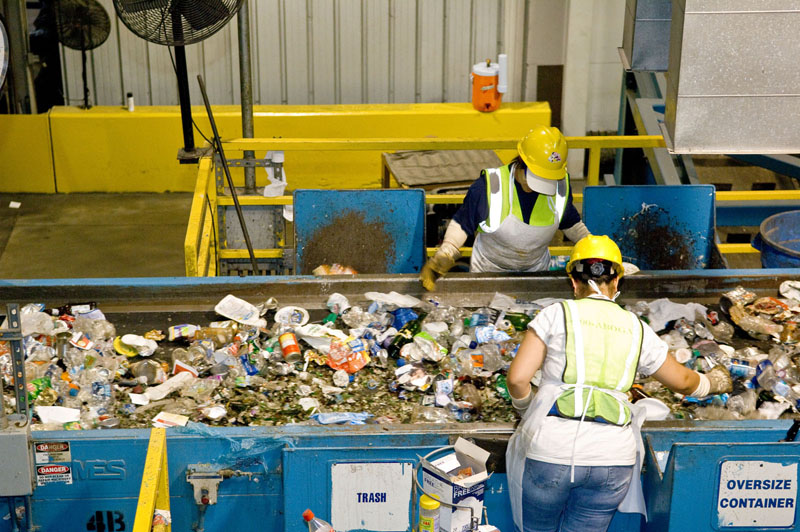
Enzymes vs. Plastic — A Cheaper Path to Recycling PET
Enzymes vs. Plastic: A Cheaper Path to Recycling PET
閱讀文章
Plastic pollution is one of the most persistent environmental challenges of the modern era. Unlike organic materials that decompose within weeks or years, most plastics remain intact in the environment for centuries. Recycling offers a partial solution, but conventional mechanical recycling of plastics — melting and reshaping them — degrades the material’s quality with each cycle and cannot handle all plastic types equally well. A breakthrough published in the journal Nature Chemical Engineering in 2025 may fundamentally change the economics of plastic recycling by making it cheaper to recycle than to manufacture plastic from scratch.
The focus of this research is polyethylene terephthalate, commonly known as PET. PET is one of the world’s most widely used polymers — large molecules composed of repeating structural units. It is found in beverage bottles, food packaging, and synthetic textile fibers such as polyester. Globally, hundreds of millions of tonnes of PET are produced each year, with only a small fraction meaningfully recycled. Most ends up in landfills, oceans, or incinerators.
The scientific approach that achieved this breakthrough is called enzymatic depolymerization — using biological catalysts called enzymes to break PET down into its chemical building blocks. Enzymes are proteins produced by living organisms that accelerate specific chemical reactions. In this case, a specially engineered enzyme called PET2-21M functions as a hydrolase — a class of enzyme that breaks chemical bonds by adding water molecules. PET2-21M was designed to attack the long polymer chains of PET and split them into their constituent monomers: terephthalic acid (TPA) and ethylene glycol (EG). These monomers can then be purified and reassembled into new, virgin-quality PET without any loss of material quality.
The key innovation in this study, conducted by researchers at the National Renewable Energy Laboratory (NREL) in the United States and the University of Portsmouth in the United Kingdom, involved solving a long-standing problem with the chemistry of enzymatic PET recycling. When PET is broken down by hydrolysis, the reaction produces acid byproducts that lower the pH of the reaction mixture, inhibiting the enzyme and requiring large quantities of strong base chemicals to neutralize. This neutralization step had previously been expensive and generated significant chemical waste.
The researchers found that ammonium hydroxide could serve as both a neutralizing base and a recyclable reactant. When ammonium hydroxide reacts with the acid byproducts of PET hydrolysis, it forms ammonium salts. These salts can subsequently be heated to regenerate ammonia gas, which can be converted back into ammonium hydroxide and reused in the process. This “closed-loop” approach virtually eliminates the need for large external base inputs and the waste they generate.
The quantitative results of this innovation are striking. Compared to previous enzymatic PET recycling methods, the new process achieved a 99% reduction in acid and base consumption, a 74% reduction in operating costs, and a 65% reduction in energy consumption. Greenhouse gas emissions from the process were reduced by nearly half compared to conventional recycling. Most significantly, the cost of producing recycled PET using this method was calculated at approximately $1.51 per kilogram — compared to approximately $1.87 per kilogram for virgin PET produced from petroleum feedstocks. For the first time, enzymatically recycled PET is cheaper than new PET.
The enzyme PET2-21M demonstrates another important capability: it can degrade not only clear bottle-grade PET, which is relatively easy to process, but also colored PET and textile blends — material types that are particularly difficult to recycle through conventional mechanical methods. This expands the range of materials that could enter the circular economy — a model of production and consumption in which materials are kept in use for as long as possible, waste is minimized, and end-of-life products are reintroduced as inputs to new production cycles.
Enzymatic plastic recycling draws on the natural world for its tools. The original discovery that microorganisms could degrade PET came in 2016 from Japanese scientists studying bacteria in a plastic-contaminated environment. The bacteria had evolved an enzyme — PETase — capable of attacking PET’s polymer structure. Subsequent years of research have involved engineering and optimizing variants of this enzyme for industrial scale and efficiency. PET2-21M represents the most economically competitive result of this ongoing effort.
The implications extend beyond PET. Researchers are actively developing enzymes capable of degrading nylon, polyurethane, and other common polymers. If the economic logic demonstrated for PET can be replicated across a broader range of plastics, enzymatic biodegradation could become a core technology of a genuinely sustainable materials economy.
詞彙
- Enzyme — a protein produced by living organisms that acts as a catalyst, accelerating a specific chemical reaction without being consumed in the process
- PET (polyethylene terephthalate) — a widely used synthetic polymer found in beverage bottles, food containers, and polyester textiles; the target material in this recycling study
- Hydrolase — a class of enzyme that breaks chemical bonds by adding water molecules; PET2-21M functions as a hydrolase to decompose PET polymer chains
- Depolymerization — the chemical process of breaking a polymer down into its constituent monomer building blocks; the reverse of the polymerization process used to manufacture plastic
- Circular economy — an economic model in which materials are continuously reused, recycled, or regenerated rather than discarded after a single use, minimizing waste and resource extraction
- Biodegradation — the breakdown of a substance by living organisms such as bacteria, fungi, or their enzymes into simpler compounds
- Catalyst — a substance that increases the rate of a chemical reaction without being permanently consumed or altered; enzymes are biological catalysts
- Polymer — a large molecule composed of many repeating structural units (monomers) bonded together; plastics are synthetic polymers
- Greenhouse gas emissions — gases such as carbon dioxide and methane released into the atmosphere by industrial processes, which trap heat and contribute to climate change
- Sustainability — the capacity to meet present needs without compromising the ability of future generations to meet their own needs; a key principle in environmental science and policy
理解題
1. What is PET, and why is it considered a major recycling challenge? (Short answer)
2. What does the enzyme PET2-21M do to PET plastic?
- A) It melts PET at high temperatures so it can be reshaped
- B) It breaks PET polymer chains into their constituent monomers using water
- C) It coats PET surfaces with a protective biodegradable layer
- D) It converts PET into carbon dioxide and water through combustion
3. What is enzymatic depolymerization? (Short answer)
4. Why had enzymatic PET recycling previously been expensive before this breakthrough?
- A) The enzymes required temperatures above 200°C to function
- B) PET polymers are too large for enzymes to attack without special equipment
- C) Large quantities of strong base chemicals were needed to neutralize acid byproducts
- D) The monomers produced by enzymatic breakdown were difficult to purify
5. What role does ammonium hydroxide play in the new recycling process?
- A) It dissolves the PET into liquid before the enzyme can act on it
- B) It serves as both a neutralizing base and a recyclable reactant that can be regenerated and reused
- C) It prevents greenhouse gas emissions by absorbing carbon dioxide
- D) It stabilizes the enzyme so it can function at higher temperatures
6. What does a “closed-loop” approach mean in the context of this research? (Short answer)
7. How does the cost of enzymatically recycled PET compare to virgin PET?
- A) Recycled PET costs $1.87/kg, virgin PET costs $1.51/kg — recycling is still more expensive
- B) Both methods cost approximately $1.70/kg — costs are roughly equal
- C) Recycled PET costs $1.51/kg, virgin PET costs $1.87/kg — recycling is now cheaper
- D) Recycled PET costs $0.80/kg due to government subsidies covering production costs
8. What makes PET2-21M particularly versatile compared to conventional mechanical recycling? (Short answer)
9. Where did the original scientific discovery that microorganisms could degrade PET come from?
- A) NASA laboratory experiments on long-term plastic storage in space
- B) Japanese scientists studying bacteria in a plastic-contaminated environment
- C) NREL researchers analyzing soil composition in landfill sites
- D) University of Portsmouth experiments on marine PET degradation
10. What is a circular economy, and how does enzymatic PET recycling support this model? (Short answer)
Critical Thinking
- The passage describes a 99% reduction in acid and base consumption through the use of ammonium hydroxide as a recyclable reagent. What does this specific number reveal about the importance of the chemical innovation, separate from the enzyme engineering itself? Could the enzyme alone have made this process economically viable?
- The fact that a bacterium in Japan had naturally evolved the ability to digest PET is remarkable. What does this tell us about biological adaptation and evolution? What conditions might have driven a bacterium to evolve this capability, and what does this suggest about the potential for other organisms to evolve novel chemical capabilities in a plastic-polluted world?
- The passage states that enzymatic recycling produces virgin-quality PET from recycled material, whereas mechanical recycling degrades quality over time. From a systems perspective, why does material quality matter for achieving a true circular economy? What happens to materials whose quality degrades with each recycling cycle?
- Even with this breakthrough, most PET worldwide ends up in landfills or oceans rather than recycling facilities. What barriers — economic, political, social, or infrastructural — prevent recycling technologies from being widely adopted even when they are technically available?
- The researchers suggest that enzymes for nylon, polyurethane, and other plastics may be developed using similar approaches. What are the potential environmental and economic consequences of a future in which most common plastics can be efficiently recycled by engineered enzymes? Are there any risks associated with widely deploying engineered enzymes in industrial settings?
Fill in the Blank
- The enzyme PET2-21M is classified as a ______, because it breaks the chemical bonds of PET polymer chains by adding water molecules.
- The new recycling process uses ammonium hydroxide as a recyclable base, creating a ______ approach that virtually eliminates the need for large external chemical inputs.
- A model of production and consumption in which materials are continuously reused and recycled rather than discarded is known as the ______.
Extended Response
Prompt 1: Explain how the combination of enzyme engineering and chemical process innovation — specifically the use of ammonium hydroxide as a recyclable reagent — made enzymatic PET recycling economically competitive for the first time. In your response, describe what the previous limitation was, how the researchers solved it, and what the quantitative results demonstrate. Conclude by explaining what this breakthrough means for the concept of a circular economy.
Prompt 2: The passage notes that a bacterium in Japan naturally evolved the ability to digest PET plastic — a material that has only existed since the 1940s. This observation inspired the development of engineered enzymes for industrial plastic recycling. Write a reflective essay on what this example reveals about the relationship between natural systems and human technology. How does biology serve as a source of technological innovation? What responsibilities come with engineering and deploying biological tools at industrial scale, and how should society balance innovation with caution?
Looking for free ESL worksheets? Browse our full collection — printable resources for every level and age group. Browse Free Worksheets →








 ZH
ZH  EN
EN  ZH_CN
ZH_CN  KO
KO  VI
VI  FR
FR  AR
AR  ES
ES  HI
HI  PT
PT  BN
BN  RU
RU  JA
JA  TR
TR  DE
DE  IT
IT  PL
PL  ID
ID  TH
TH  FA
FA  UK
UK  TL
TL  HE
HE  UR
UR  SW
SW  RO
RO  NL
NL  MS
MS  TA
TA  PS
PS  HU
HU  EL
EL  SV
SV  NB
NB  NN
NN  DA
DA  CS
CS  SR
SR  AM
AM