
English Idioms: Celebrations & Parties — 10 Expressions You Need to Know
Every culture celebrates, and English has built up a colorful vocabulary just for talking about it. When people paint the town red, get dressed to the nines, or watch someone roll out the red carpet for a guest of honor, they’re using idioms that have survived for centuries because they capture something literal clothing, dancing, bells, bonfires, toasts that everyone instantly recognizes. These expressions turn up constantly in weddings, holidays, award shows, and ordinary Friday nights, which makes them some of the most immediately useful idioms an ESL learner can add to their vocabulary.
In this week’s idioms guide we look at ten essential celebration expressions, grouped by what they describe — going out to have fun, giving an event everything you’ve got, dressing and welcoming people in style, honoring a moment with a toast, and — because not everyone is in a party mood — letting loose versus spoiling the fun. For each one you get a clear meaning, the real origin story behind it, and two natural example sentences you can use in class or at your own next celebration.

Why Teach Celebration Idioms?
Celebration idioms are some of the most culturally rich expressions in English because they’re tied to real customs — dances, toasts, bell-ringing, red carpets — that students can picture immediately, even if their own culture celebrates differently. Ask learners whether they’ve ever been told to let their hair down, or whether they know a party pooper, and you’ll usually get a laugh of recognition, because every culture has its own version of relaxing in public and its own version of the person who ruins it.
These expressions also appear constantly in news coverage of weddings, festivals, award ceremonies, and New Year’s Eve broadcasts, so recognizing them pays off well beyond the classroom. A learner who understands that a company pulled out all the stops for a product launch, or that a retiring employee’s office went out with a bang, will follow native-speaker small talk about celebrations far more naturally. Below are ten of the most useful celebration idioms, organized from going out to have fun all the way to the one person who refuses to join in.
Going Out to Celebrate

1. Paint the town red
意义: To go out and celebrate in a lively, enthusiastic way, often staying out late.
起源: The most widely repeated story traces the phrase to 1837, when the Marquis of Waterford and a group of friends went on a drunken rampage through the English town of Melton Mowbray, literally smearing red paint on tollgates, doors, and a statue after a night of fox hunting. Whether or not every detail of that story is accurate, “paint the town red” had become a fixture of English slang on both sides of the Atlantic by the end of the nineteenth century, and it has meant an exuberant night out ever since.
例如:
- After finishing exams, the whole class went out to paint the town red.
- They painted the town red to celebrate her promotion, staying out until two in the morning.
2. Have a ball
意义: To have a wonderful, enjoyable time.
起源: A “ball” has referred to a formal dance party since at least the seventeenth century, borrowed from the French bal, and for generations attending a ball was one of the most exciting social events available to ordinary people. By the early twentieth century, American English had stretched the word figuratively, so that having a wonderful time of any kind — not just dancing at a formal event — could be described as “having a ball.”
例如:
- The kids had a ball at the birthday party, especially during the water balloon fight.
- We had a ball at the reunion, even though half of us hadn’t seen each other in years.
Doing It Up Big

3. Pull out all the stops
意义: To do everything possible, using every available resource, to make something as impressive or successful as it can be.
起源: This idiom comes from the pipe organ, where “stops” are the knobs and levers that control which sets of pipes will sound. An organist who wants the loudest, fullest, most dramatic sound possible pulls out every stop at once, letting every pipe play together. English speakers were already using the phrase figuratively, for giving maximum effort on any task, by the middle of the nineteenth century.
例如:
- The hotel pulled out all the stops for the couple’s fortieth anniversary dinner.
- Her parents pulled out all the stops for her graduation party, renting a hall and hiring a live band.
4. Go out with a bang
意义: To end something in an exciting, memorable, or impressive way.
起源: “Bang” has long described a sudden, loud noise — fireworks, gunshots, slamming doors — so ending something “with a bang” naturally evokes a dramatic, attention-grabbing finish rather than a quiet one. The contrast became especially familiar after T. S. Eliot’s 1925 poem The Hollow Men ended with the line “not with a bang but a whimper,” which helped fix “bang” in the popular imagination as the sound of an impressive, memorable ending.
例如:
- The retiring teacher wanted her last class of the year to go out with a bang, so she planned a full day of games.
- The festival went out with a bang, closing with a thirty-minute fireworks show.
Dressed and Welcomed in Style

5. Dressed to the nines
意义: Dressed very elaborately, fashionably, or formally, usually for a special occasion.
起源: The exact source of “to the nines” is disputed. One theory points to eighteenth-century Scottish poetry, including a 1719 line from William Hamilton and later Robert Burns, where “to the nine” described reaching the highest possible degree of something. A popular but almost certainly false folk explanation claims a well-made suit required nine yards of fabric; linguists generally reject that story, but it hasn’t stopped the phrase from becoming the standard way to describe someone dressed to perfection.
例如:
- She showed up to the gala dressed to the nines in a floor-length gown.
- Everyone at the wedding was dressed to the nines, right down to matching shoes.
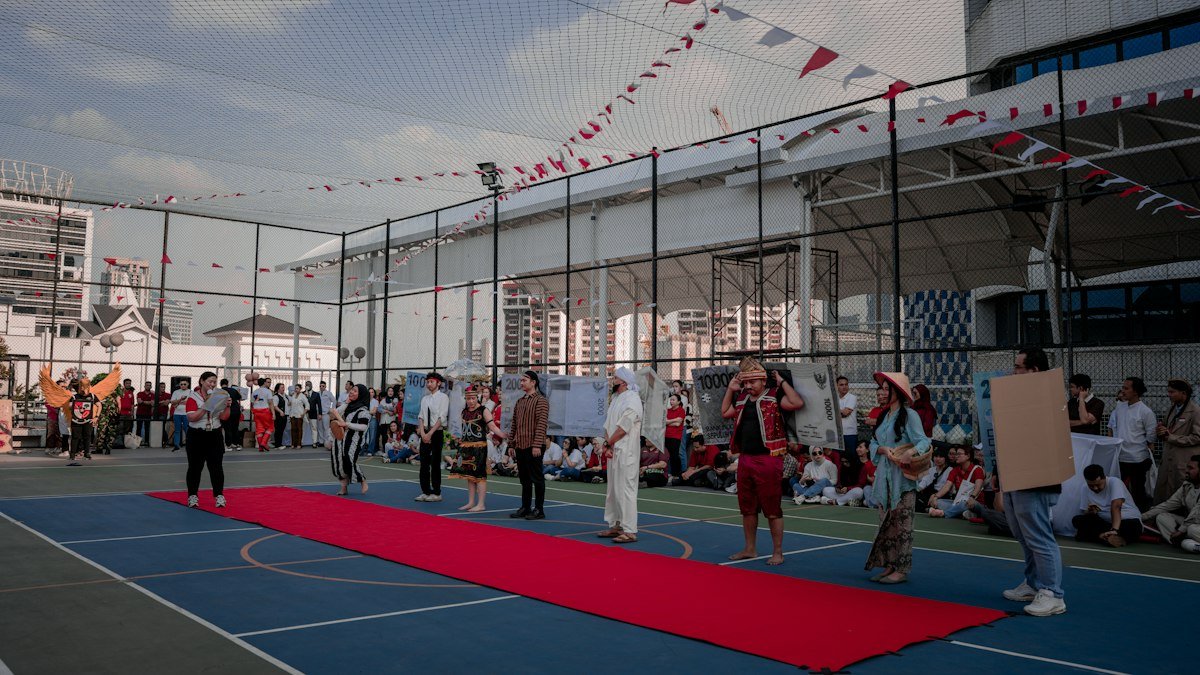
6. Roll out the red carpet
意义: To give someone a grand, special welcome, treating them like an honored guest.
起源: The image is ancient: in Aeschylus’s 458 BC play Agamemnon, a crimson path is laid out for a returning king, a welcome so lavish that other characters warn it tempts fate. The modern literal practice — a physical red carpet rolled out for arriving dignitaries — became common with early twentieth-century trains and ocean liners, and Hollywood premieres cemented the phrase in its current, figurative sense by the mid-1900s.
例如:
- The hotel rolled out the red carpet for the visiting diplomat, upgrading his room and arranging a private car.
- Our new client was impressed — the whole office rolled out the red carpet for her first visit.
Watch: Celebration Idioms in Action
Want to hear these expressions spoken by a native speaker? This video walks through everyday English idioms used to talk about parties and celebrations — a perfect listening follow-up to today’s lesson.
Honoring the Moment

7. Raise a toast
意义: To lift a drink and offer words of celebration, congratulation, or good wishes before drinking, usually in someone’s honor.
起源: The custom dates back to at least Shakespeare’s time, when English drinkers often placed a piece of spiced, toasted bread in a cup of wine to improve its flavor, especially for an honored guest. Over time, “toast” came to describe not just the bread but the entire ritual of raising a glass and speaking well of someone, and by the eighteenth century “to drink a toast” or “raise a toast” was standard English for the whole gesture.
例如:
- The best man raised a toast to the newlyweds before the first dance.
- We raised a toast to our grandmother on her ninetieth birthday.
8. Ring in the new year
意义: To celebrate the arrival of something new, especially the start of a new year.
起源: The phrase grows out of a genuinely old English custom of ringing church bells to mark the passing of the old year and the arrival of the new one, a tradition celebrated in Alfred Tennyson’s 1850 poem “Ring Out, Wild Bells.” “Ring in” later broadened from literal bell-ringing to any festive way of welcoming something’s beginning, though it is still most often paired with the new year.
例如:
- We rang in the new year with fireworks over the harbor.
- The city planned a huge concert to ring in the new year downtown.
Letting Loose (and Spoiling the Fun)

9. Let your hair down
意义: To relax and enjoy yourself freely, without worrying about being proper or formal.
起源: For centuries, women in many Western societies wore their hair pinned up in public as a mark of respectability, only taking it down in private or relaxed settings among family and close friends. By the early twentieth century, English speakers had generalized that literal gesture into a figurative one, so that anyone — regardless of hairstyle — could be told to “let their hair down” and stop being so formal.
例如:
- It’s a holiday party, so feel free to let your hair down a little.
- After months of overtime, the whole team finally let their hair down at the office party.
10. Party pooper
意义: Someone who spoils the fun or enthusiasm of a celebration, often by refusing to participate or by complaining.
起源: “Party pooper” is twentieth-century American slang, generally traced to the 1950s, built on the older verb “poop out,” meaning to become tired, give up, or fail to keep going, which was already common American English by the 1930s. A “pooper,” then, is someone whose lack of energy or enthusiasm visibly deflates everyone else’s good time.
例如:
- Don’t be a party pooper — come dance with us for one song.
- He was the only party pooper who wanted to leave before midnight.
How to Practice Celebration Idioms
The fastest way to make these idioms stick is to connect them to real events students already know. Ask learners to describe the last time they had a ball at a party, or to imagine planning a wedding where the hosts pull out all the stops 和 roll out the red carpet for every guest. Role-playing a New Year’s Eve countdown where everyone has to use at least one celebration idiom — ring in the new year, paint the town red, go out with a bang — turns passive vocabulary into language students will actually reach for outside class.
For homework, ask students to write a short paragraph about a celebration they attended, using as many of this week’s idioms as they can naturally fit, or to describe the most memorable party pooper they’ve ever met without naming names. Personalizing the language this way forces active recall instead of passive recognition. Master these ten expressions and you’ll be ready to talk about every celebration — from getting dressed to the nines 到 ringing in the new year — with real native-level color.









 ZH_CN
ZH_CN  EN
EN  ZH
ZH  KO
KO  VI
VI  FR
FR  AR
AR  ES
ES  HI
HI  PT
PT  BN
BN  RU
RU  JA
JA  TR
TR  DE
DE  IT
IT  PL
PL  ID
ID  TH
TH  FA
FA  UK
UK  TL
TL  HE
HE  UR
UR  SW
SW  RO
RO  NL
NL  MS
MS  TA
TA  PS
PS  HU
HU  EL
EL  SV
SV  NB
NB  NN
NN  DA
DA  CS
CS  SR
SR  AM
AM