
50 ESL Activities That Actually Work in the Classroom (Sorted by Lesson Stage)
Every ESL teacher hits the same wall eventually: the activities in the textbook fall flat, the warm-up runs out of steam in two minutes, and the last ten minutes of class turn into a slow-motion clock-watch. The fix is rarely a brand-new method — it is a deeper bench of activities you can drop into the right moment of the lesson. The 50 ESL activities below are sorted by lesson stage, so you can scan straight to the slot you need to fill.
Most of these activities need no prep beyond a whiteboard and some paper. A handful work better with flashcards, dice, or a printed handout, but none require a textbook publisher’s app or a paid subscription. They are organized as you would teach them: open the lesson, build language, practice it, recycle it, close the lesson.
Warm-Ups and Icebreakers (1–8)
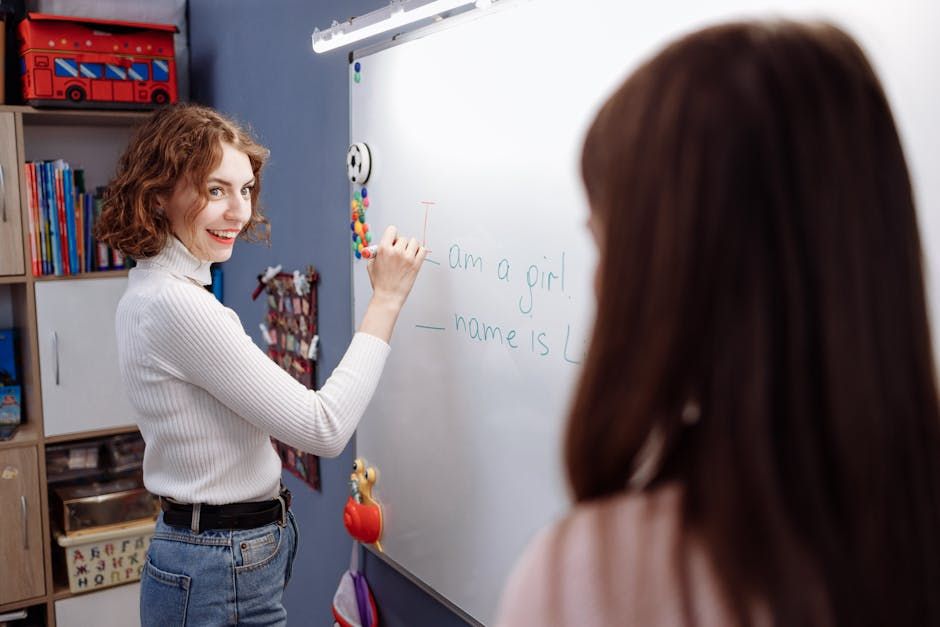
The first five minutes set the energy for the next fifty. These activities wake students up and move them from L1 brain into English brain without burning class time on a long set-up.
- Two Truths and a Lie — Each student writes three sentences about themselves; the class guesses the lie.
- Question Ball — Toss a ball with question prompts written on it; whoever catches answers the prompt under their thumb.
- Last Letter Vocabulary — Student A says a word, student B says a word starting with the last letter, and so on around the room.
- Word of the Day Defense — Put a word on the board; students take turns arguing why it is or is not useful.
- Three-Minute Mingle — Give one question; students stand up and ask three classmates before sitting down.
- Picture Reaction — Show one image; students write three sentences describing what is happening.
- Sentence Stretching — Start with “She runs.” Each student adds one word to make it longer and grammatical.
- Hot Seat — One student faces away from the board; the class describes a word for them to guess.
Vocabulary Activities (9–16)

Vocabulary sticks when learners encounter a word in multiple modes — reading, hearing, saying, drawing, sorting. Rotate these activities so students meet target words from at least three different angles.
- Vocabulary Quadrants — Students fold paper into four sections: definition, sentence, drawing, synonym.
- Word Stations — Set up four corners with target words; students rotate every two minutes doing a different task at each.
- Find Someone Who — Bingo-style sheet using target vocabulary in questions.
- Speed Definitions — Pairs face each other; one defines, the other guesses, then swap after sixty seconds.
- Concept Sort — Hand out word cards; teams group them by category and justify their groupings.
- Mystery Word Mind Map — Put a word in the center; students spend three minutes adding everything they associate with it.
- Vocabulary Pictionary — Standard Pictionary using only this week’s target words.
- Collocation Race — Write a verb on the board; teams race to list as many collocating nouns as possible in two minutes.
Grammar Practice (17–22)

Grammar drills do not have to be silent gap-fills. These activities make students notice form, produce it under light pressure, and self-correct without you turning into a red pen.
- Running Dictation — Post a paragraph on the wall; one student reads and runs back to dictate to a partner who writes.
- Sentence Auction — Give pairs a budget; they bid on sentences and only score points if the sentence is grammatical.
- Error Hunt — Hand out a paragraph with five hidden errors; pairs find and fix them.
- Grammar Battleship — Replace coordinates with subject + verb forms; students hit a square by producing the correct conjugation.
- Sentence Transformations — Active to passive, direct to reported, present to past — students rewrite ten short prompts.
- Conditional Chain — Student A says “If I had a million dollars, I would buy a boat.” Student B says “If I had a boat, I would…” and the chain continues.
Speaking and Fluency (23–30)

Fluency grows when students speak more, not when they speak perfectly. Time-pressured pair work and structured discussion give shy learners cover and stop the dominant student from monopolizing the floor.
- 4-3-2 Talk — Each student tells the same story to three different partners — first in four minutes, then three, then two.
- Discussion Wheel — Two concentric circles; outer circle rotates every ninety seconds with a new question.
- Roleplay Cards — Hand out scenario cards (returning a broken phone, ordering an unusual meal); pairs perform.
- Just a Minute — Speak about a topic for sixty seconds without hesitation, repetition, or going off-topic.
- Information Gap — Each partner has half the information; they must talk to complete the picture.
- Debate Lite — Give a low-stakes motion (“Cats are better than dogs”). Two minutes prep, three minutes debate.
- Storyboard Telling — Show a six-frame comic with no words; students narrate it.
- Opinion Lines — Mark a line on the floor from “Strongly Agree” to “Strongly Disagree.” Read a statement; students stand on the line and defend their position.
Listening Activities (31–35)
Listening is the most neglected skill in many ESL classrooms because it feels passive. The activities below force active processing — students must do something with what they hear.
- Dictogloss — Read a short text twice at natural speed; students take notes and reconstruct the text in pairs.
- Listen and Draw — Describe a picture; students draw what they hear, then compare with the original.
- Song Gap-Fill — Use a level-appropriate pop song with key words removed; students listen and fill in.
- True/False Prediction — Before listening, students predict; after listening, they confirm or correct.
- Identify the Speaker — Play short clips and ask students to guess age, mood, or relationship.
Reading Activities (36–40)
A reading text is a launching pad, not the activity itself. The five tasks below turn one short article into a thirty-minute lesson without losing student attention.
- Jigsaw Reading — Cut the text into four sections; each group reads one and teaches the others.
- Skim Race — Set five questions; students must find the answers in under three minutes.
- Headline Match — Give five short paragraphs and six possible headlines; students match and reject one.
- Reading Carousel — Post short texts on the walls; students rotate, read, and answer one comprehension question per text.
- Reverse Reading — Give students the comprehension questions first; they read with a clear purpose.
Writing Activities (41–45)
Writing in class is hard because it is silent and slow. These activities keep the energy up by adding a partner, a constraint, or a deadline.
- Six-Word Stories — Students write a complete story in exactly six words, then share.
- Pass-the-Paper — Each student writes one sentence of a story, folds, and passes. Read the result aloud.
- Constrained Writing — Write a paragraph without using the letter E, or with every sentence under five words.
- Postcard Pairs — Each student writes a postcard from an imaginary trip; partners reply.
- Newspaper Headline Expansion — Give a real headline; students write the first paragraph of the article.
Review Games (46–48)
Review days die when they feel like review days. Disguise the recycling as competition and students will run drills they would refuse if you called them drills.
- Quiz Bowl — Two teams, buzz-in style. Mix vocabulary, grammar, and content questions from the unit.
- Board Race — Two columns on the board. Read a clue; one runner from each team races to write the answer.
- Trashketball — Answer a question correctly to earn a shot at the trash can with a paper ball. Distance equals points.
Cool-Downs and Exit Tickets (49–50)
The last two minutes are formative-assessment gold. A quick exit ticket tells you what to reteach tomorrow without grading sixty papers tonight.
- 3-2-1 Exit — Students write three things they learned, two questions they still have, and one thing they enjoyed.
- One-Sentence Summary — Students summarize today’s lesson in a single grammatical sentence on a sticky note.

How to Choose the Right Activity
A great activity in the wrong slot becomes a flop. Before you pick one from the list, ask three questions: What is the lesson goal? How much energy is in the room? How much time is left? A loud team game on a Monday morning at 8 a.m. dies; the same game after lunch on a Friday saves the lesson. Match activity to context, not to your favorite from teacher training.
Make It a System, Not a Scramble
Print this list, tape it inside your lesson-plan notebook, and highlight the ten activities you have used in the last month. Pick three you have never tried and slot them into next week. Within a term you will have a personal repertoire of twenty go-to activities you can deploy without reading the instructions, which is the real definition of a teacher who has the room.

Final Thoughts
The activities that actually work are not the most clever ones — they are the ones you have rehearsed enough that you can run them while paying attention to your students instead of your notes. Start with five from this list, master them this month, and add five more next month. By the end of the school year you will have run all fifty, and your students will notice the difference long before you do.
מקורות
- British Council — TeachingEnglish
- American English — U.S. Department of State
- Cambridge English Language Teaching Blog
- Oxford University Press ELT






 HE
HE  EN
EN  ZH
ZH  ZH_CN
ZH_CN  KO
KO  VI
VI  FR
FR  AR
AR  ES
ES  HI
HI  PT
PT  BN
BN  RU
RU  JA
JA  TR
TR  DE
DE  IT
IT  PL
PL  ID
ID  TH
TH  FA
FA  UK
UK  TL
TL  UR
UR  SW
SW  RO
RO  NL
NL  MS
MS  TA
TA  PS
PS  HU
HU  EL
EL  SV
SV  NB
NB  NN
NN  DA
DA  CS
CS  SR
SR  AM
AM