
10 ESL Pronunciation Activities That Build Real Fluency
ESL pronunciation activities are the gap between students who can read English well and students who can actually speak it. You can drill vocabulary for weeks, correct grammar in every essay, and still have students who freeze the moment they open their mouths in a real conversation. The problem is almost never knowledge — it’s the physical skill of producing sounds they’ve never trained. That’s where targeted pronunciation work comes in. These 10 activities give your students the repetition they need to build muscle memory, the feedback to self-correct, and enough variety to stay engaged lesson after lesson.
Why ESL Pronunciation Deserves Its Own Dedicated Time
Most ESL curricula treat pronunciation as an add-on — something you mention when a student mispronounces a word, then move on. Research from Studies in Second Language Acquisition tells a different story: pronunciation instruction that is explicit, systematic, and task-based produces measurable improvements in intelligibility, while incidental correction alone has little lasting effect.[1]
For your adult and young adult learners, intelligibility is the goal — not accent elimination. Students don’t need to sound like BBC presenters; they need to be understood by a range of listeners. That shift in framing removes a lot of classroom anxiety and helps students engage more willingly with pronunciation work.
Another reason to carve out time: pronunciation errors that fossilize early are extraordinarily hard to correct later. A student who has been saying “sheet” instead of “seat” for three years will resist changing that pattern even when they understand the difference. Intervene early, give it focused attention, and you save both yourself and your student significant frustration down the road.
ESL Pronunciation Activities That Actually Build Skills
1. Minimal Pairs Drills — The Foundation
Minimal pairs are two words that differ by exactly one sound: ship/sheep, bit/beat, pat/bat. They’re the bread and butter of pronunciation teaching because they train students to hear and produce distinctions that don’t exist in their first language.
The standard drill goes like this: say one word from the pair, students hold up a card (or point to a column on their paper) to indicate which one they heard. Then flip it — students say the word while you identify which one. What makes this activity stick is the immediate feedback loop. Students can self-monitor whether their mouth shape and tongue position are producing the right perception in the listener.
To keep it communicative rather than mechanical, build minimal pairs into a quick listening game. Say a sentence that only makes sense with one word from the pair: “The ship was sailing through the harbor.” Students identify the word, then explain why the other word would change the meaning. This adds semantic processing on top of phonetic discrimination — two birds, one drill.
Best pairs for common learner groups:
- Spanish speakers: b/v, s/z, d/ð
- Chinese speakers: r/l, sh/s, final consonants
- Japanese speakers: r/l, v/b, si/shi
- Korean speakers: p/f, b/v, l/r
2. Tongue Twisters — Not Just for Kids
Tongue twisters have a reputation as classroom novelties, but they’re genuinely effective for drilling specific phonemes at speed. The goal isn’t to say them perfectly — it’s to isolate a sound and repeat it rapidly enough that students can feel whether they’re producing it correctly.
Try teaching tongue twisters in three stages. First, say the twister at half-speed together, exaggerating the target sound. Second, have students whisper it — whispering forces more precise mouth positioning. Third, say it at full speed, accepting errors with good humor. The laughter that comes when everyone stumbles on “She sells seashells by the seashore” is a genuine stress-reducer that makes students more willing to attempt sounds they’re unsure of.
Write your own short twisters targeting your class’s specific problem sounds. For a class struggling with /θ/ (the “th” sound): “Three thin thieves thought a thousand thoughts.” Ten seconds, high repetition, immediate feedback on whether the tongue is making contact with the teeth.
3. Record and Compare — Self-Monitoring That Sticks
Students are often shocked the first time they hear their own voice. That shock is useful. Recording activities build the metacognitive habit of comparing one’s output to a target model — which is exactly what autonomous language learners do outside the classroom.
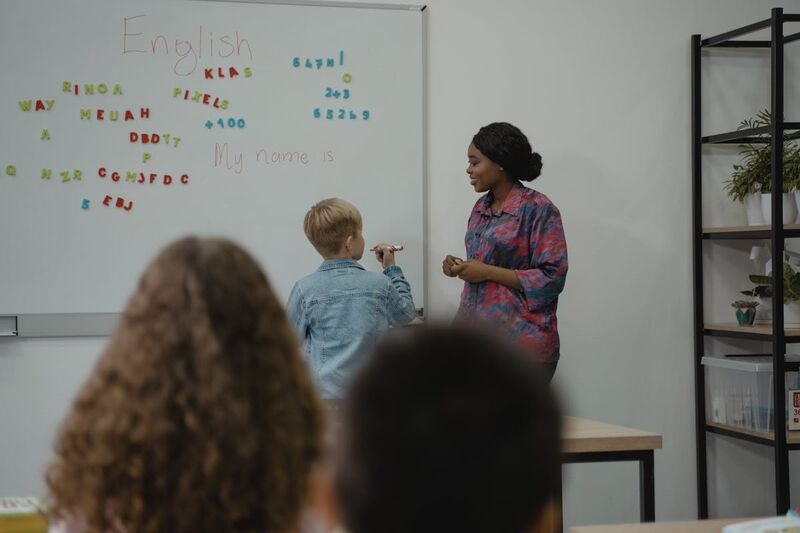
The setup is simple. Give students a short paragraph — 3-4 sentences, built around your target sounds. Play a model recording (your voice, a clip from a podcast, or a text-to-speech tool like ElevenLabs). Students record themselves reading the same passage using their phones. Then they listen back and compare. Ask them to identify one specific moment where their pronunciation diverged from the model.
The magic isn’t in the recording itself — it’s in the listening back. Students who’ve been saying a sound wrong for years often can’t hear the error in real time. The recording creates enough cognitive distance that they can suddenly notice what everyone else was noticing all along. Keep the atmosphere low-pressure: everyone shares what they discovered, including the teacher.
4. Sentence Stress Clapping
English is a stress-timed language, which means syllables don’t come at regular intervals — stressed syllables do. This rhythm is one of the most disorienting aspects of English for speakers of syllable-timed languages like French, Spanish, Japanese, or Mandarin. If students don’t hear and produce the stress pattern, they sound unnatural even when every individual word is pronounced correctly.
Clapping activities make the invisible visible. Write a sentence on the board. Mark the stressed syllables. Say it together while students clap on every stressed beat. Then say it again without clapping, trying to maintain the same rhythm. This works because it gives students a physical anchor for something they can’t see.
Take it further with contrastive stress. “She ate the apple” (not stole it) vs. “She ate the apple” (not the orange) vs. “She ate the apple” (not her brother). Students have to decide which word carries the emphasis based on a context you give them. This turns phonetics into pragmatics — suddenly pronunciation is about communication, not just sound production.
5. Shadow Reading — Synchronize With a Native Speaker
Shadowing is the technique of speaking simultaneously with an audio recording, mimicking the rhythm, intonation, and stress of the speaker in real time. It’s used by professional interpreters and by many of the world’s most successful language learners precisely because it forces multi-channel attention: you’re monitoring meaning, sound, and your own output at the same time.
In a classroom context, use a short clip — 30-60 seconds from a podcast, news broadcast, or YouTube video. Play it once for comprehension. Play it again and have students shadow aloud. Then play it a third time while students shadow but look away from any transcript. The version without the transcript is where real transfer happens.
The key instruction: don’t worry about understanding every word while shadowing. The goal is to ride the wave of the sound. Students who stop to process meaning fall behind the recording and lose the phonetic benefit. Brief them on this before you start — it reduces the cognitive anxiety of not understanding 100%.
6. Intonation Graphs — Visual Pronunciation
Most students think intonation is abstract — something you either have or you don’t. Drawing it makes it concrete. Write a sentence on the board and literally draw a line above the words that goes up and down with your voice as you say it. Students copy your diagram, then try to reproduce the intonation pattern using the graph as a guide.

This is particularly useful for yes/no questions (rising intonation in many English varieties), list intonation (rise-rise-rise-fall), and the “I’m not finished speaking” pattern that keeps the floor in a conversation. These aren’t just pronunciation features — they’re conversational tools. A student who says “Would you like coffee, tea, or juice?” with flat intonation sounds rude or confused. The same words with the right melody sound warm and competent.
For ESL konuşma etkinlikleri that incorporate intonation work, try having students record two versions of the same line — one with flat intonation, one with the intended pattern — and let the class vote on which sounds more natural. The contrast makes the point far better than any explanation.
7. Minimal Pair Bingo
Take the pedagogical value of minimal pairs and wrap it in a format students already love. Create bingo cards where each square contains one word from various minimal pairs. As caller, you say sentences in which one of the pair appears. Students have to listen carefully to mark the right square — because “ship” and “sheep” are both on the card, and you just said one of them.
The beauty of this game is the competitive attention it creates. Students who would zone out during a standard drill lean forward during bingo because they’re worried about missing their square. Keep the calling sentences slightly ambiguous — “I saw it in the water” could cue “ship” or “sheep” until you add more context. That ambiguity is exactly the linguistic processing you want.
8. Pronunciation Speed Dating
Set up pairs of chairs facing each other. Each student gets a card with a target word or short phrase containing difficult sounds. They have 90 seconds to pronounce it to their partner, get feedback, and try to improve — then one row rotates and they repeat with a new partner.

Speed dating formats create low-stakes repetition. Students say the same word to 6-8 different people, each time refining slightly based on feedback. By the end of the rotation, most students have made measurable improvement on their target sound — and they’ve had 6-8 brief social interactions in English, which is the whole point of English conversation practice.
9. Segmental Phoneme Cards
For lower-level classes or learners who haven’t been exposed to the phonemic alphabet, a card system works well. Create a set of illustrated cards, each showing a single phoneme — the mouth position, a key word, and the IPA symbol. Don’t try to teach the whole IPA at once. Focus on the 6-10 sounds that cause the most intelligibility problems for your specific class.
Use the cards as a quick warm-up drill: flash a card, students produce the sound; say a sound, students find the card. Then integrate them into word-level and sentence-level work. Students who’ve been taught to associate the phoneme symbol with a mouth position have a self-correction tool they can use independently — which is exactly what you want them developing.
Linking phoneme cards to ESL vocabulary games multiplies the value: when students encounter a new word, they can decompose it into phonemes they’ve already practiced and build a mental pronunciation map before they ever say it aloud.
10. The Weekly Pronunciation Focus
Rather than treating pronunciation as an isolated activity, try designating one sound per week as the class’s phonetic focus. Post it on the board. Every time a student uses a word containing that sound, the class marks it. Students can earn points for correctly pronouncing it in spontaneous speech — not during a drill, but in actual classroom conversation.
This builds noticing habits. When students know that this week’s focus is the /v/ sound, they start scanning the language around them for it. They notice it in the textbook reading, in the teacher’s speech, in songs on their phone. That ambient attention accelerates acquisition in a way that even the best 10-minute drill cannot.
Fitting Pronunciation Into Your Existing Lessons
You don’t need to redesign your curriculum to make space for pronunciation work. Three to five minutes at the start of class — a tongue twister, a minimal pair drill, or a quick shadow of a 30-second clip — is enough to create consistency. Consistency is what builds the habit of phonetic self-monitoring.
The activities above scale from beginner to advanced. Minimal pairs and sentence stress work at every level; intonation graphs and record-and-compare are especially powerful with intermediate to advanced learners who already have enough language to process feedback. Speed dating and bingo work across all ages and proficiency levels because the format carries the engagement while the phonetics do the teaching.
A word on error correction during pronunciation work: use it judiciously. Stopping a student mid-sentence to correct a sound interrupts the fluency they’re building. Better to note the error, address it as a class pattern at the end of the activity, and then build a drill around that specific sound in a future lesson. Pronunciation is a physical skill — it improves through targeted repetition and low-anxiety practice, not through constant interruption.
Watch: ESL Pronunciation Games in Action
For a practical classroom demonstration of how these activities look in real time, this video breaks down the top pronunciation games used by experienced ESL teachers:
Building a Pronunciation-Positive Classroom
The biggest barrier to pronunciation improvement isn’t phonetic difficulty — it’s fear. Adult learners in particular carry significant anxiety about speaking differently from people around them, being laughed at, or signaling their immigrant or foreign status through their accent.
You build a pronunciation-positive classroom through the norms you set in the first week. Laugh with students, not at them. Model imperfect pronunciation yourself — try a few sounds from your students’ first languages and let them correct you. Share recordings of respected public figures who speak English with strong accents. The goal is intelligibility and growth, not conformity to an idealized native-speaker standard that most students will never need and wouldn’t find useful anyway.
When students see pronunciation as a skill to develop rather than a flaw to hide, they practice voluntarily, seek feedback willingly, and make progress that compounds over time. That’s the whole point of every activity on this list — not just to drill sounds, but to build the habit of caring about how one sounds and having the tools to improve.
Kaynaklar
- Studies in Second Language Acquisition (Cambridge University Press) — Peer-reviewed research on pronunciation instruction and intelligibility in ESL contexts.
- TESOL Üç Aylık Dergisi — Professional journal covering classroom-based pronunciation research and pedagogical applications.
- Cambridge ELT Blog: Teaching Pronunciation — 5 Tips — Practical guidance from Cambridge English on integrating pronunciation into ESL lessons.





 TR
TR  EN
EN  ZH
ZH  ZH_CN
ZH_CN  KO
KO  VI
VI  FR
FR  AR
AR  ES
ES  HI
HI  PT
PT  BN
BN  RU
RU  JA
JA  DE
DE  IT
IT  PL
PL  ID
ID  TH
TH  FA
FA  UK
UK  TL
TL  HE
HE  UR
UR  SW
SW  RO
RO  NL
NL  MS
MS  TA
TA  PS
PS  HU
HU  EL
EL  SV
SV  NB
NB  NN
NN  DA
DA  CS
CS  SR
SR  AM
AM