
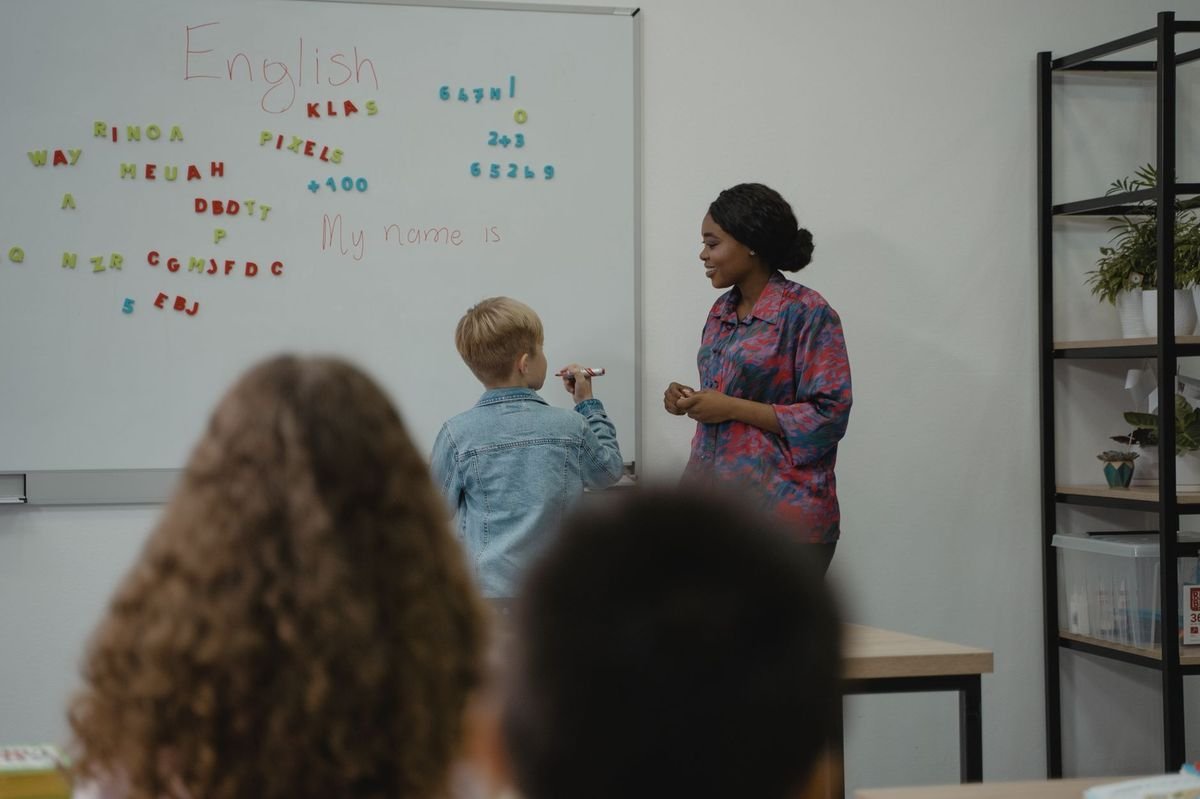
Scaffolding Techniques ESL: 7 Best Methods
Most classroom failures aren’t motivation problems — they’re task-calibration problems. The lesson is too hard, there’s nothing bridging the gap, and students shut down. A 2016 study in the journal System found that when language learners were given tasks calibrated to their Zone of Proximal Development with appropriate scaffolds, willingness to produce language increased by 38% compared to tasks at the independent level. Seven techniques account for most of that difference in practice.
What Scaffolding Actually Means in an ESL Classroom
Lev Vygotsky introduced the Zone of Proximal Development — the gap between what a learner can do independently and what they can do with guidance. Scaffolding is the set of supports that lives inside that gap. The construction metaphor is exact: a temporary structure that holds the building in place while it’s going up, then comes down once the building can stand on its own.
Three categories cover most scaffolding techniques: linguistic (sentence frames, word banks, starter phrases), visual (graphic organizers, diagrams, realia), and interactional (modeling, think-alouds, peer work). A well-planned lesson draws from at least two columns. Worth noting: scaffolding is not simplifying the task. If you reduce the reading level so far that it no longer challenges students, you’ve eliminated the productive stretch — and Vygotsky’s zone collapses to nothing.

Scaffolding Technique 1: Modeling — I Do, We Do, You Do
The most reliable scaffolding sequence in language teaching has three stages. In the first (“I do”), the teacher performs the target task while narrating their process. In the second (“We do”), teacher and students attempt a second example together — the teacher shares control but steers the direction. In the third (“You do”), students work independently with no teacher support. This gradual release of responsibility model was formalised by Pearson and Gallagher in 1983 and remains the backbone of explicit instruction in both L1 and L2 contexts.
The mistake most teachers make is cutting straight from “I do” to “You do” in a single step. Students watch a model, then try to replicate it alone. Adding even five minutes of joint practice — working through a second example together on a different topic — significantly improves first-attempt accuracy and lowers the number of students who ask “I don’t understand” during independent work. The “We do” phase is not optional; it is where the scaffolding actually happens.
Scaffolding Technique 2: Think-Alouds

Language learners see the output of fluent speakers but not the process behind it. A think-aloud bridges that gap. You work through a reading or writing task in real time and narrate your internal decisions: “I’m not sure what this word means, so I’ll look at the surrounding context first…” or “I want to disagree here, so I’ll open with ‘While it’s true that…'” The cognitive process becomes visible rather than assumed.
Think-alouds are strongest for reading comprehension and the writing process. A 2020 meta-analysis in Reading Research Quarterly covering 32 studies found that think-aloud instruction improved comprehension scores among second-language readers by a mean effect size of 0.67 — a strong result for a technique that costs nothing beyond planning time. In large classes, a three-minute screencast of a narrated worked example serves the same purpose and can be replayed.
Scaffolding Technique 3: Graphic Organizers

ESL students often fail at writing tasks not because of language but because they lack a structure for organising their thinking. Graphic organizers give that structure a visible form before any writing begins. The type of organizer has to match the task: a Venn diagram helps with comparison writing but adds nothing to a narrative; a plot arc frame scaffolds storytelling but confuses students writing a persuasive paragraph. When the organizer fights the task, students spend cognitive energy on the format rather than the language.
A practical refinement: give students a partially completed organizer, not a blank one. Seeing two of the four sections already filled in shows beginners what the completed version looks like and gives them a concrete entry point. This preserves the stretch — students still need to contribute original thinking — while removing the blank-page paralysis that stops many low-intermediate learners before they start.
Scaffolding Technique 4: Sentence Frames and Starters

A sentence frame is a partial sentence with a slot for students to complete: “The author’s main argument is ___” or “One key difference between X and Y is ___.” Frames scaffold academic language — the register students need for written tasks and formal discussions — which research by Cummins (1979) shows typically lags conversational English by three to five years for school-age learners. A student can discuss last weekend in natural English long before they can write an analytical paragraph without structural help.
The research backing for frames is strong: Nattinger and DeCarrico’s 1992 work on lexical phrases found that pre-packaged chunks are how fluent speakers actually store and retrieve language — not as individually assembled grammar rules. Teaching frames isn’t a shortcut; it mirrors the acquisition process. The removal schedule matters: keep frames visible for the first two uses of a task type, give a partial version on the third, and remove them entirely by the fifth. If students still reach for the frame on task five, that’s diagnostic — you need another acquisition cycle, not another dose of the same support. A systematic formative assessment check at each stage tells you exactly where students are.
Scaffolding Technique 5: Chunking Complex Tasks

A common failure mode: students receive a multi-step task, spend ten minutes staring at it, and produce nothing. The problem is total cognitive load — too many new elements active at once. Chunking solves this by breaking the task into sequential pieces, each with a specific achievable output before moving forward.
A writing lesson, for example, might chunk into: (1) brainstorm with a word web, (2) arrange ideas in a graphic organizer, (3) write only the topic sentence, (4) add supporting details one at a time. Students never face the full complexity of “write a paragraph” in one moment. Chunking also makes grading diagnostic. When students succeed at step one (ideas) but fail at step two (organisation), you know exactly what to address next — and that feeds directly into a tighter ESL課程計劃 for the following session.
Scaffolding Technique 6: Peer Scaffolding

Vygotsky’s ZPD concept was never limited to teacher-to-student support. A more capable peer — one working just above a student’s current level — scaffolds just as effectively as a teacher, and often more naturally. The register between peers is closer to conversational English, which lowers the affective filter and increases willingness to attempt. Students say things to classmates they would never risk saying to a teacher.
Effective peer scaffolding requires deliberate pair design. Placing a beginner with an advanced student and calling it “pair work” doesn’t scaffold anyone — the stronger student does the task, the weaker one watches. The productive pairing is adjacent: an A2 learner with a B1, not an A2 with a C1. Give the stronger partner explicit instructions: “Ask your partner to tell you their idea first, then help them find the right word if they get stuck — but don’t give the word immediately. Ask ‘what are you trying to say?’ first.” This approach connects directly to 差異化教學, because it only works when you know your students’ actual proficiency levels precisely enough to build meaningful pairs.
Scaffolding Technique 7: Visual Aids and Realia

A physical object or a concrete image activates more neural pathways than a definition or translation. Realia — real objects brought into class (a food label, a map, a transit timetable) — give beginners a direct sensory anchor for new vocabulary. Visuals do the same for abstract concepts. The theoretical backing is Allan Paivio’s dual coding theory (1971): when information is encoded both verbally and visually, retrieval is significantly stronger than verbal encoding alone. For students working in a second language, adding a visual channel reduces the cognitive cost of processing new words.
One practical note: visuals need to be precise, not decorative. A generic photo of “people talking” does nothing to scaffold the language point “expressing disagreement politely.” A diagram showing a short exchange with labelled speech bubbles — one making a claim, one pushing back with a specific frame — does exactly that. The image’s job is to carry meaning. If it could be cut without affecting comprehension, it’s decoration, not scaffolding.
Knowing When to Pull the Scaffold
Every scaffold needs an exit condition. Without one, what began as support calcifies into dependency — and students stop acquiring the target language because they never have to produce it independently. The clearest signal that a scaffold has run its course: students complete the task accurately, without consulting it, on a first attempt, in a novel context. Not “they did it last week on that specific topic” — acquisition has to transfer.
A practical release schedule: introduce the scaffold in lesson one, offer a reduced version in lesson two, remove it entirely in lesson three, and assess independent performance in lesson four on a different topic. If students cannot perform in lesson four, the language isn’t stable yet. Bring the scaffold back for one more cycle — not indefinitely. Treating every struggling student as needing permanent support misses the point: scaffolding is temporary by design. The goal is the moment you can take it away and nothing falls.
來源
- Vygotsky, L.S. (1978). Mind in Society哈佛大學出版社。 — Original Zone of Proximal Development theory.
- Pearson, P.D., & Gallagher, M.C. (1983). The instruction of reading comprehension. Contemporary Educational Psychology. — Gradual release of responsibility model.
- System journal (2016). ZPD calibration and language output study. — 38% willingness-to-produce increase with ZPD-calibrated tasks.
- Reading Research Quarterly (2020). Meta-analysis of think-aloud instruction. — d=0.67 comprehension gains for L2 readers.
- Cummins, J. (1979). Linguistic interdependence and the educational development of bilingual children. ELT Journal. — BICS/CALP framework and academic language lag.
- TESOL國際協會。 — Peer-reviewed research on classroom scaffolding practices.








 ZH
ZH  EN
EN  ZH_CN
ZH_CN  KO
KO  VI
VI  FR
FR  AR
AR  ES
ES  HI
HI  PT
PT  BN
BN  RU
RU  JA
JA  TR
TR  DE
DE  IT
IT  PL
PL  ID
ID  TH
TH  FA
FA  UK
UK  TL
TL  HE
HE  UR
UR  SW
SW  RO
RO  NL
NL  MS
MS  TA
TA  PS
PS  HU
HU  EL
EL  SV
SV  NB
NB  NN
NN  DA
DA  CS
CS  SR
SR  AM
AM